Woods’ Rose – A Long-Time Companion
By Felicia King
Broadcast 5.27 & 5.30.2026
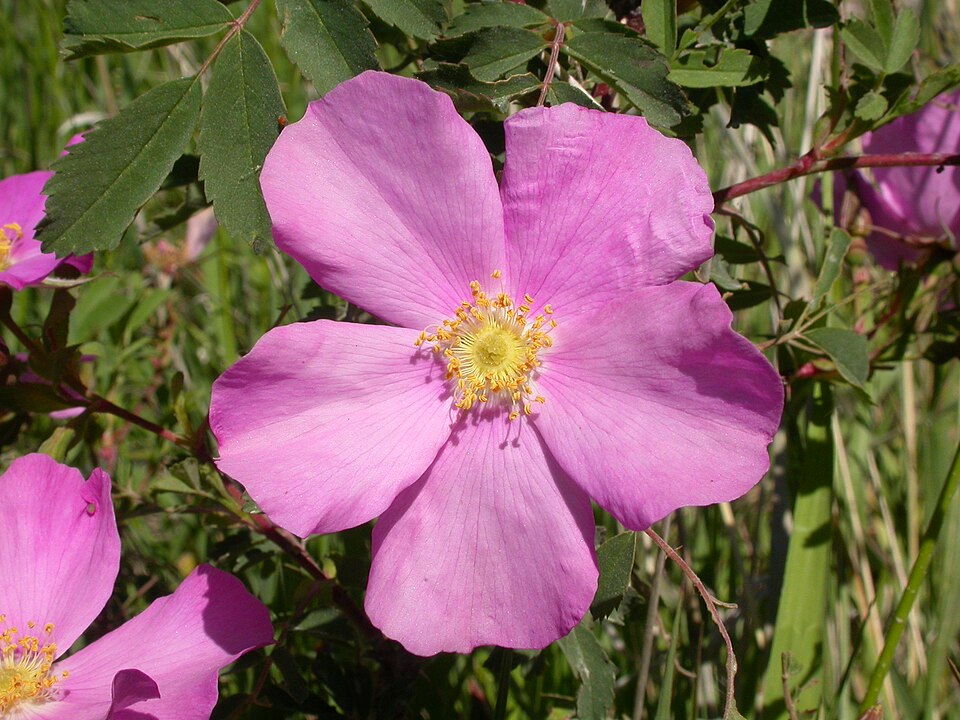
Woods’ rose in bloom. Photo by Matt Lavin, Bozeman, MT. CC by-SA 2.0.
Listen:
It is well into spring, which comes with the temptations of longer days—the pull to romp through a meadow or wander down a skinny game trail along a creek just to see where it will take you.
During these aimless adventures (and most of the time, really), I seek out novelty and switch up where I go. Yet, regardless of where I choose, I keep running into an old friend that’s one step ahead of me: Woods’ rose. Also known as prairie rose, wild rose, and mountain rose, it was one of the first native plants I learned to identify after moving to Montana almost a decade ago, and it holds a special place in my heart.
I run into them just about everywhere because they are so adaptable. They’re often dominant in riparian and wetland areas, but they also do well in meadows, dry forest clearings, and even on grassy slopes. They readily colonize disturbed sites like roadsides and cutbanks, and many gardeners plant them to attract bumblebees, birds, and other pollinators. Though familiar here in Montana, their range spans most of North America west of the Mississippi River—from Alaska south into northern Mexico. Part of this success comes from their many strategies for spreading: root crown sprouts, rhizomes, and seeds dispersed far and wide by animals that eat their small fruits.
Across this range, Woods’ rose provides a valuable source of energy and protein for wildlife. In Montana, big game, porcupines, and beavers browse its leaves, while many mammals and birds rely on its dried fruits through the winter, when snow covers the ground and food is scarce. Other diners include squirrels, coyotes, bears—and people.
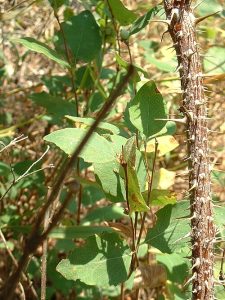
The thorny stem of a Woods’ rose. Photo courtesy of USDA Natural Resources Conservation Service, Montana. Public domain.
Traditionally, Native Americans used the roots, stems, leaves, flowers, and fruits of Woods’ rose for both food and medicine. The Shoshone tribe, who inhabited a large swath of the Western U.S. extending from the Rockies, see the rose as a symbol of their people. From June to August, the petals can be harvested to make a subtle tea that was traditionally consumed to treat diarrhea or used as a wash for sore, red eyes. The fruits, known as rosehips, are orange-red and pea-sized; they ripen from August into fall and are rich in vitamin C and bioflavonoids, if you don’t mind their chapstick-like texture. These rosehips can be harvested after early freezes and dried to make a tea for sore throats and general good health. The Crow also mixed rosehips into their pemmican (think meat-based bar that was staple to their diet). Interestingly, a Woods’ rose typically begins flowering at 2–5 years of age and produces a good crop of fruit only every other year.
This early in the season, I recognize the plant by its deep red stems, covered (and I mean covered!) with small thorns. Sometimes those thorns find me before I find them—tugging at my socks and clothes or catching my hand when I grab a hold of something to steady myself along a riverbank. I’m used to stopping mid-jaunt to clumsily remove one—or many—of these small, persistent spines from my hands.
But hey…all worthwhile relationships are complicated at times. I’ll forgive my frenemy and forget the thorns, and my heart will soar come summer when those sweet five-petal flowers appear in shades of pink with bright yellow centers. And you bet I’ll stop and smell those roses. ’Cause they smell really good.
Every week since 1991, Field Notes has inquired about Montana’s natural history. Field Notes are written by naturalists, students, and listeners about the puzzle-tree bark, eagle talons, woolly aphids, and giant puffballs of Western, Central and Southwestern Montana and aired weekly on Montana Public Radio.
Click here to read and listen to more Field Notes. Field Notes is available as a podcast! Subscribe on Apple Podcasts or wherever you listen to podcasts.
Interested in writing a Field Note? Contact Allison De Jong, Field Notes editor, at adejong [at] montananaturalist [dot] org or 406.327.0405.
Want to learn more about our programs as well as fun natural history facts and seasonal phenology? Sign up for our e-newsletter! You can also become a member and get discounts on our programs as well as free reciprocal admission to 300+ science centers in North America!