Sky Full of Swallows
By Cedar Lloyd
Broadcast 7.1 & 7.4.2026
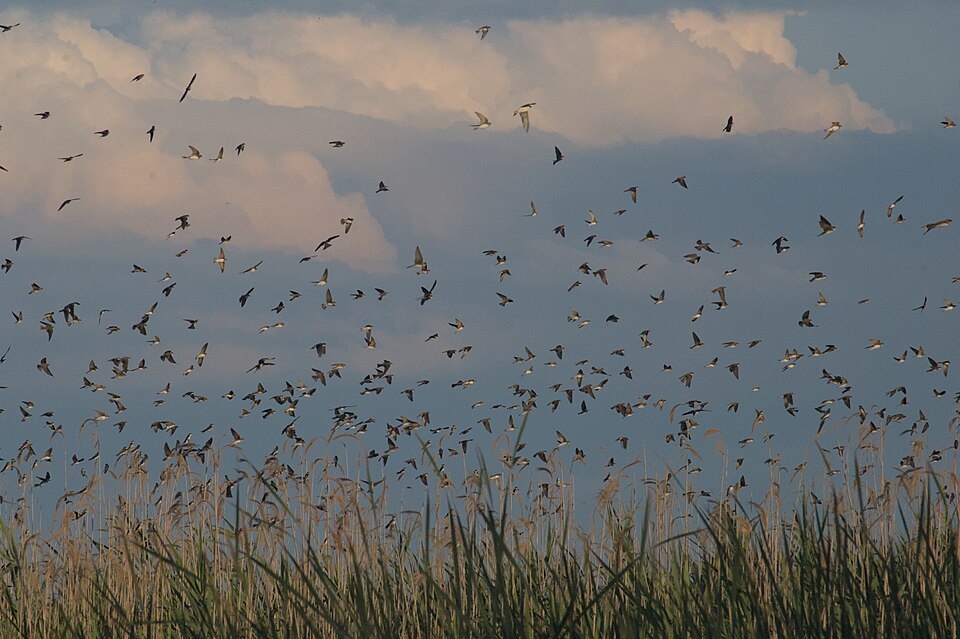
Swallows in flight against a stormy sky. Photo by Lgbt7274, CC BY-SA 4.0.
Listen:
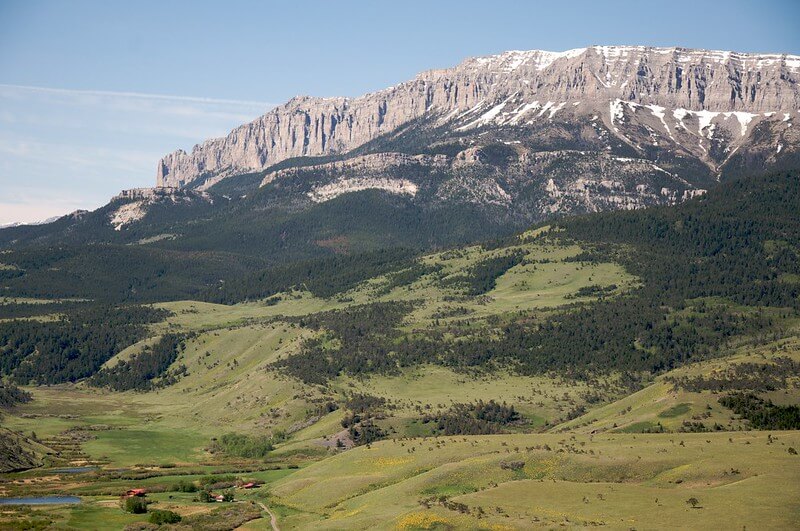
The sweet smell before a storm. Sky full of swallows. A cacophony of chirps. Rocky Mountains bruised purple. Dark clouds resting just above them, waiting to break. Each plume of grass undulating in the rising wind. The silent charge in the air fills every piece of my being.
I’m sitting on the picnic table outside my house. It’s summer. Violet-green swallows are dancing above me. Hovering weightlessly before plummeting toward the green earth and catching themselves at the last moment on invisible currents of air. Their metallic green and royal purple feathers shimmer in the evening light. With their white chests, they look as if they’re wearing tiny tuxedos. They’ve migrated north for breeding season and scientists think their iridescent feathers attract mates. The swallows are my neighbors this summer, living in a birdhouse outside my bedroom window. I’ll move north when the season ends, and they’ll migrate south to live in giant cacti in the desert. I wish I was going with them instead.
Their midair acrobatics are unbelievable, a skill they’ve perfected to hunt for delicacies like flies, moths, wasps, bees, beetles, and winged ants. These twenty-gram birds can turn so quickly thanks to their streamlined bodies, forked tail, and long pointed wings. They often hunt for thirteen hours at a time with few breaks, cruising at speeds of around twenty-eight miles per hour.
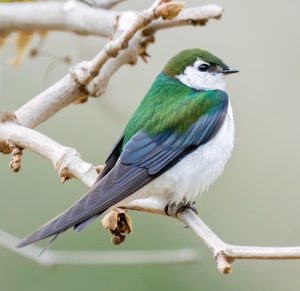
Violet-green swallow, with its iridescent feathers, sits on a branch. Photo by Steve Colwell, CC BY-2.0.
The frenzied swallows chirp to one another frantically. What are they talking about? Are they flirting? Chatting about the weather? Bird calls serve many purposes, including courtship, claiming territory, signaling alarm, or communicating location change. When they chirp constantly as they fly, maybe they’re just saying: “I’m here!” “Now I’m here” “I moved, now I’m actually here!”
The stormy sky is now painted in shades of grey. Each time I blink the clouds tear apart and curl into new shapes. The grandeur of the heavens dwarfs the mountains. Palaces of mist, dissolving as fast as they form. I hope in another life I have wings.
The swallows go quiet. Birds can sense changes to barometric pressure and may alter their behavior in response. Swallows have sensitive ears, which allow them to notice barometric drops. When they sense a storm coming, they fly close to the ground where the air is most dense. They may also seek shelter and quiet down in preparation for the storm.
I close my eyes for a while and when I open them again blue dusk has settled over the world. The mountains are watery in the distance, blanketed in a thick mist. I hear a few raindrops falling around me, then more, until cold orbs begin to strike my face. Through the trees, the moon has risen. Nearly full, it floats in the wet blue sky. Its craters and ridges are painted in pale yellow and its hazy edges radiate against the fading sky. The swallows have returned to their nests and I go inside, too.
Every week since 1991, Field Notes has inquired about Montana’s natural history. Field Notes are written by naturalists, students, and listeners about the puzzle-tree bark, eagle talons, woolly aphids, and giant puffballs of Western, Central and Southwestern Montana and aired weekly on Montana Public Radio.
Click here to read and listen to more Field Notes. Field Notes is available as a podcast! Subscribe on Apple Podcasts or wherever you listen to podcasts.
Interested in writing a Field Note? Contact Allison De Jong, Field Notes editor, at adejong [at] montananaturalist [dot] org or 406.327.0405.
Want to learn more about our programs as well as fun natural history facts and seasonal phenology? Sign up for our e-newsletter! You can also become a member and get discounts on our programs as well as free reciprocal admission to 300+ science centers in North America!