 Book Review:
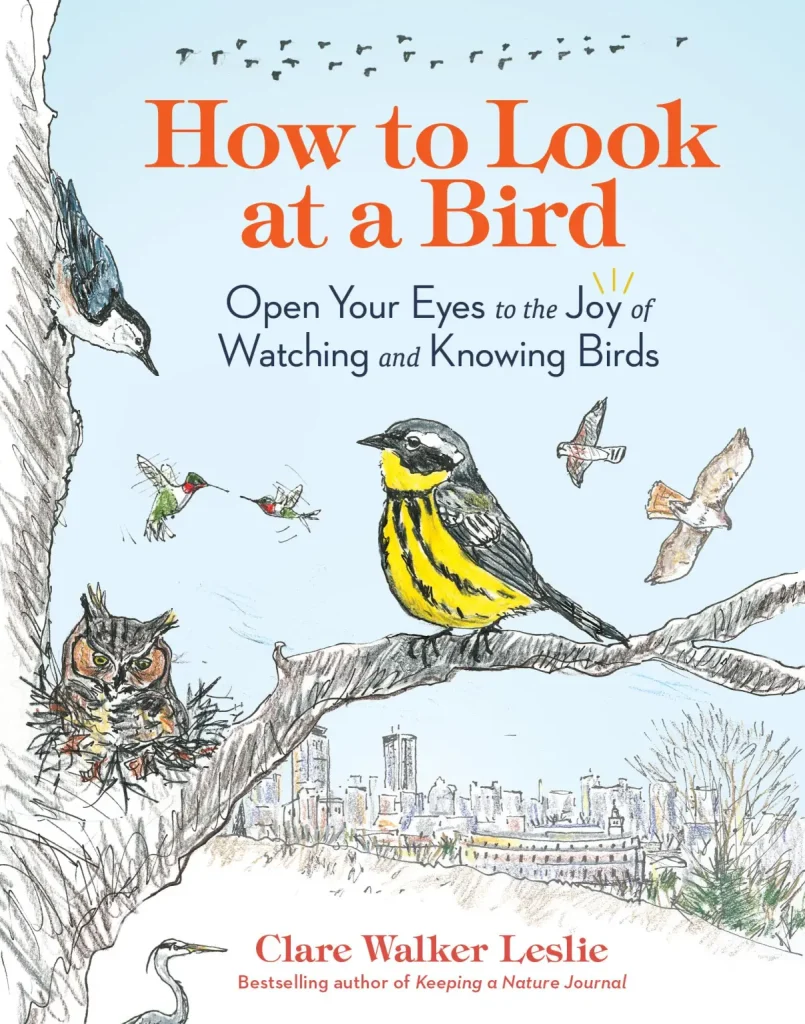
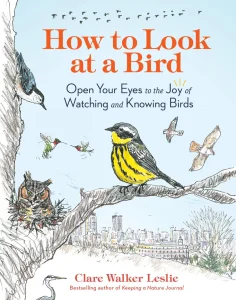
How to Look at a Bird: Open Your Eyes to the Joy of Watching and Knowing Birds by Clare Walker Leslie
Reviewed by Mary Ann Reuter
Curiosity and a sense of wonder are all you need to discover the simple pleasures of observing and knowing birds.
I’m a bird nerd, so naturally I want to introduce novice bird observers to the joy of birding. Still, I know the hobby can be intimidating at first. As a long-time fan of Clare Walker Leslie, one of the modern pioneers of nature journaling (along with John Muir Laws, another of my favorite authors on the subject), I was thrilled to discover her most recent book, How to Look at a Bird: Open Your Eyes to the Joy of Watching and Knowing Birds (Storey Publishing, 2024).
This delightful little book is brilliant in its simplicity. The text and illustrations combine to cover the basics for beginning birders of all ages – all in a compact, succinct 143 pages. Walker Leslie covers seeing birds, listening to birds, and understanding bird behavior before diving into a basic lesson on how to draw them. (For a more in-depth tutorial, refer to The Laws Guide to Drawing Birds by John Muir Laws, published by Heyday Books, 2012.)
I especially loved the slow birding “city bird/country bird” tips on observing birds at feeders and the call-out of “what bird is that?” for Northern Cardinals, nuthatches, and hummingbirds. In fact, different spotlight birds are included in each chapter, where the novice can learn about commonly observed birds like Red-tailed Hawks, chickadees, woodpeckers, starlings, Great Blue Herons, and Western Jays.
The author gives bird identification tips familiar to experienced birders – start with size, look at shapes, observe flight patterns, look at feather colors and patterns, notice beaks and feet – but injected with her characteristic mindfulness. And because some birds are easier to identify by sound than by sight, she includes a description of their calls vs. songs.
Of the chapters on understanding bird activity, I found the chapter on “Nesting Habits” the most interesting. In just a few pages, she captures the many ways that birds find mates, make nests, and raise babies – including the specialized nesting sites of birds that migrate north to the tundra. My curiosity piqued, I rushed to enroll in the newest Cornell Lab Bird Academy course called The Hidden World of Nests and Eggs with Robyn Bailey.
As with all her books, Walker Leslie’s simple illustrations reinforce the essence of the text perfectly. Drawn to Nature (2005), The Nature Connection (2010), The Curious Nature Guide (2015), and Keeping a Nature Journal (2021, 2003, 2000) all celebrate the seasons as this talented wildlife artist, naturalist, author, and educator invites us to slow down, be mindful, and delight in the wonders of the natural world through nature journaling.
In How to Look at a Bird, the author reveals she had long wanted to write a book just about birds. “Why? Because everywhere I look, I see birds. Their free and independent ways never fail to cheer me,” she says. She dedicates the book to “all the birds who continually fill our hearts with joy, curiosity, comfort, and inspiration.” If it were up to me, however, I would also dedicate this delightful book to (current and future) bird nerds, everywhere.
Note: You can watch a recorded conversation between Clare Walker Leslie and John Muir Laws about Returning to the Solace of Nature. In it, the authors discuss the healing power of nature and how nature journaling can be a powerful form of self-care.
Mary Ann Reuter is a retired marketing professional who loves reading nature books and writing articles about the natural world. She is a graduate of the Montana Master Naturalist program and also the Wild wonder Foundation nature journaling educator program.