A Crescendo in Spring: Discovering the Elegant Mariposa
By Dawn Gelderloos
Broadcast 7.15 & 7.18.2026
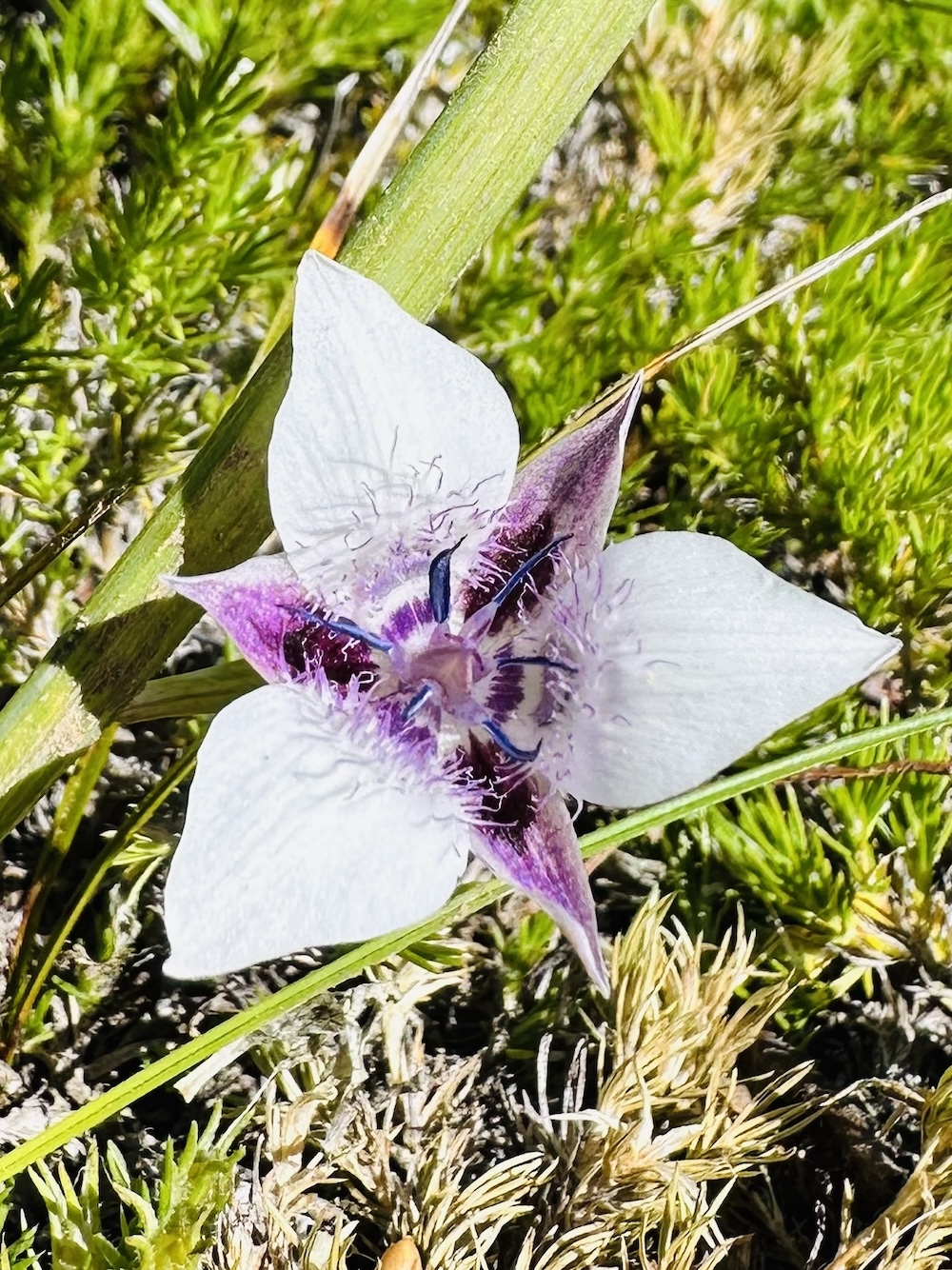
Elegant mariposa lily, Calochortus elegans, along the Stateline Trail above Heart Lake in the Great Burn Recommended Wilderness. Photo by Allison De Jong.
Listen:
Spring came gradually, and all at once, in the Ninemile area, west of Missoula. Early on, when the grasses were still brown, the first sign of color caught my eye. The sagebrush buttercup, a splash of yellow atop a sleeping hillside. Each day a few more emerged, a sign that spring was arriving and I just had to watch. Next, white spring beauties and yellow glacier lilies. Great white trillium appeared in shaded grasses. Soon, meadows were blanketed in green and dark-throated shooting stars brought their magenta glory. Creeping mahonia, also known as Oregon grape, began to bud yellow flowers. The large-flowered triteleia and small camas sprinkled in a purple hue. And then, like an orchestra building to a crescendo, lupine and arrowleaf balsamroot filled the hillsides nearby with brilliant yellow and purple flowers side by side. It feels like moments ago.
And while all of this was happening above, a kaleidoscope of color suddenly all around, I spotted a small white flower tucked in the grass next to me and I couldn’t look away. For a moment, everything seemed quiet. The sight of this small plant with its slender, bent stem and delicate white flower brought on a feeling that’s still hard to describe. The hush of surprise.
First one and then several more, the elegant mariposa lily, also called cat’s ear and star tulip, tucked in among delicate grasses. I discovered that this particular variety, the selwayensis, is only found in eastern portions of north-central Idaho, near the Selway River, and adjacent in northwest Montana.
This delicate lily has three-pointed white petals and, depending on the variety, a hairy inner surface. The inside is a purple hue, and then at the base, an even darker purple crescent-shaped gland. Hybrids of the elegant mariposa are known in Montana and can have varying characteristics.
The name “star tulip” often refers to the flower’s shape, while “cat’s ear” refers to the petals, which do indeed resemble a kitten’s ear. This perennial herb produces a large slender unbranched stem up to 6 inches long and often bears more than one flower per stem. The fruit, a winged capsule, is less than an inch long. By late summer the capsule dries and opens to release its seeds.
Flowering in May and June, these elegant beauties can be found on grassy hillsides, in open coniferous forests, and even at middle to higher elevations in the mountains. They have a deep-seated bulb, which historically provided an important food source for Native Americans.
Native to fire-prone ecosystems, like our valleys and grasslands and forest openings here in Montana, this plant is also fire resistant. The underground bulb is often protected from the intense heat of wildfires and re-emerges the season following a wildfire and often blooms more profusely.
It’s not surprising to find that the mariposa lily symbolizes delicate strength, beauty, and resilience. From the Greek calochortus meaning “beautiful grass,” with its intricate petal markings, and “mariposa” from the Spanish word for butterfly, depicting its delicate and graceful petals. This fragile-looking flower thrives in harsh environments like dry grasslands and even alpine rock fields, serving as a reminder of endurance and resilience.
Now as I walk through grassy meadows and along trails and roadsides, I want to remember to look down, too. Hidden in the lush grasses of spring, the quiet and elegant mariposa, a surprise to be seen. I am enchanted.
Every week since 1991, Field Notes has inquired about Montana’s natural history. Field Notes are written by naturalists, students, and listeners about the puzzle-tree bark, eagle talons, woolly aphids, and giant puffballs of Western, Central and Southwestern Montana and aired weekly on Montana Public Radio.
Click here to read and listen to more Field Notes. Field Notes is available as a podcast! Subscribe on Apple Podcasts or wherever you listen to podcasts.
Interested in writing a Field Note? Contact Allison De Jong, Field Notes editor, at adejong [at] montananaturalist [dot] org or 406.327.0405.
Want to learn more about our programs as well as fun natural history facts and seasonal phenology? Sign up for our e-newsletter! You can also become a member and get discounts on our programs as well as free reciprocal admission to 300+ science centers in North America!