A Heritage of Huckleberries
By Hilary Oliver
Broadcast 7.8 & 7.11.2026
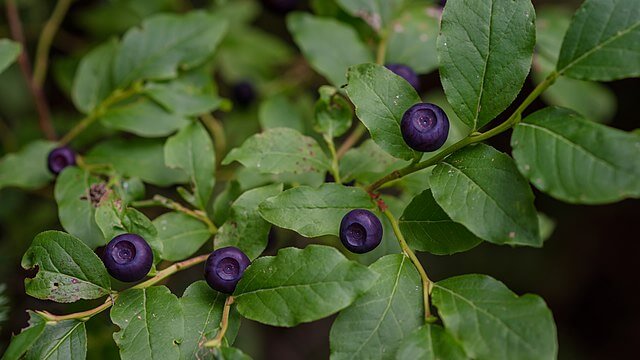
Perfectly ripe huckleberries, food for bears, birds…and humans, too. Photo by Bruno Karklis, CC BY-SA 3.0.
Listen:
My son was two years old the first time I heard him say “mmmmm” when he tried a new food. He was riding in the backpack baby carrier. Sun was spilling through the forest canopy onto the underbrush around us. I reached my hand back to him and felt him lean forward to take the berry from my fingers. I couldn’t see his face. But I heard the distinct “mmmmm” as he swallowed his first huckleberry.
I didn’t grow up in huckleberry country, and when I first moved to Montana I quickly learned not to take it personally when a friend mentioned going picking but didn’t invite me to join. I just felt thankful when they shared their spoils with me at pancake brunches or in gifted jars of preserves. And I quickly learned to identify huckleberry plants myself by gestalt.
Like recognizing the familiar silhouette of a family member from across the room, identifying plants by gestalt is less about rattling off details like leaf pattern, fruit shape, and petal colors and more about overall, big-picture impressions and feelings.
For example, you could know that huckleberry plants are deciduous shrubs, part of the heath family. They have thin leaves with finely toothed margins and small, urn-shaped flowers. They grow one to four feet tall and turn bright red to purple in the fall. But the best berry pickers can spy a berry patch when it’s still much too far away to tell that its leaves have finely toothed margins. Or that they’re pointed at the tip. They just know the plant’s general shape and placement—its vibe, if you will.
Sweet, juicy berries are a great motivation to learn to identify a plant. So I’m sure it won’t be long before my son also recognizes huckleberry bushes. I want to teach him about the plants, and how to forage respectfully.
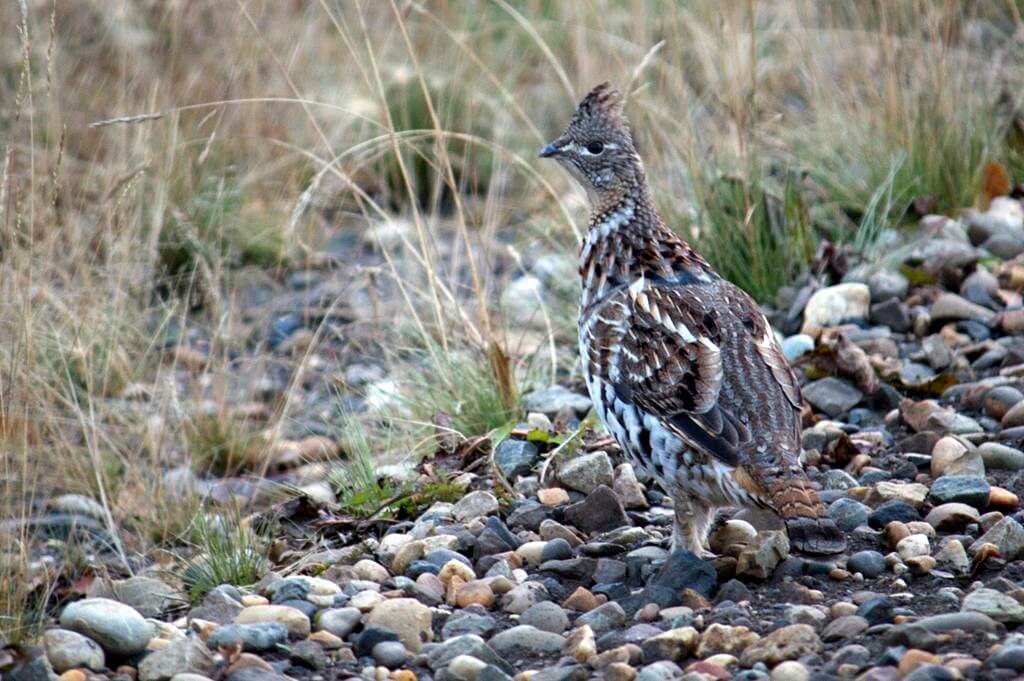
In the Northern Rockies where other nutrient-dense food like salmon aren’t available, huckleberries are a crucial food source for grizzlies. Black bears, elk, moose, and deer also rely on the plants. Small mammals, grouse, and other birds also eat the berries and use the shrub for cover. And the history of humans and huckleberries goes way back.
Indigenous Americans didn’t just eat them. The berries played significant roles in their culture, sociology, economics, and spirituality. Harvest was a time for gathering with friends and relatives, to work during the day and enjoy celebration, oral histories, and legends in the evenings.
The earliest record of the commercial sale of huckleberries in Montana was in 1926 by the Kalispell Mercantile Company. Today Montana wild huckleberry products produce over $1 million in sales revenue each year. But in some places, habitat for huckleberries is shrinking.
The national policy of fire suppression has allowed tree canopies to thicken where previously burns would have occasionally cleared meadows. And over time, development, grazing, and commercialization of huckleberry products has taken its toll.
So where does that leave us, as we pass the berry picking tradition on to our children? I’ll paraphrase Potawatomi botanist and author Robin Wall Kimmerer:
Never take the first, never take the last. Take only what you need.
Never take more than half, and leave some for others. Always minimize harm.
Never waste what you’ve taken. And share.
Give thanks for what you’ve been given, and give a gift in reciprocity.
Every week since 1991, Field Notes has inquired about Montana’s natural history. Field Notes are written by naturalists, students, and listeners about the puzzle-tree bark, eagle talons, woolly aphids, and giant puffballs of Western, Central and Southwestern Montana and aired weekly on Montana Public Radio.
Click here to read and listen to more Field Notes. Field Notes is available as a podcast! Subscribe on Apple Podcasts or wherever you listen to podcasts.
Interested in writing a Field Note? Contact Allison De Jong, Field Notes editor, at adejong [at] montananaturalist [dot] org or 406.327.0405.
Want to learn more about our programs as well as fun natural history facts and seasonal phenology? Sign up for our e-newsletter! You can also become a member and get discounts on our programs as well as free reciprocal admission to 300+ science centers in North America!