Where Do Forest Seedlings Come From?
By Kathy Eyster
Broadcast 7.24 & 7.27.2024
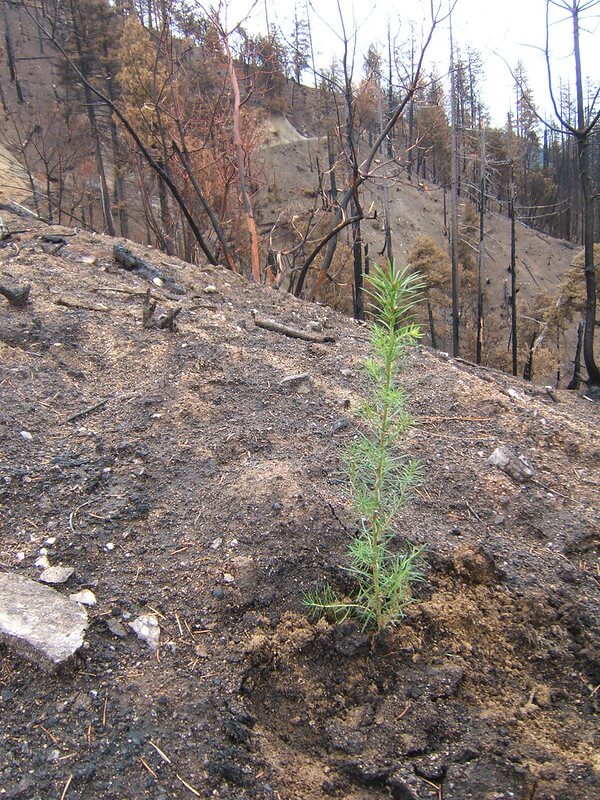
Newly planted Douglas-fir seedling. Photo by USFS Pacific SW Region, CC BY-2.0.
Listen:
As I drove home from Missoula, I was alarmed to see wildfire smoke across the freeway from my house in Frenchtown. Even more concerning was the convoy of pickups pulling stock trailers. The area up Mill Creek Road was being evacuated and the fire was visible from my yard. The 2007 fire on Forest Service land was initially reported to cover 850 acres, but by the time it was contained, it had burned 11,754 acres.
The fire burned through a section of forest in which I frequently hiked and knew very well. I did not return to the devastated area for a couple years. When I did, I found grasses had grown back and many seedlings, wrapped in protective netting, had been planted throughout the burned hills. How did the foresters decide what species to plant? Where did all those thousands of seedlings come from?
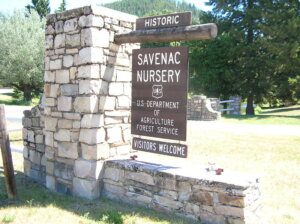
Photo by USFS Northern Region, CC BY-2.0.
Even more years later, driving back to Montana from Seattle, I noticed a sign along Interstate 90 for the Savenac Historic Tree Nursery. Curious, I decided to return later for a visit.
I learned that the nursery was established by forester Elers Koch in 1907, just two years after the U.S. Forest Service was founded. Unfortunately, the fledgling tree nursery was mostly destroyed in the 1910 fire that burned three million acres in northern Idaho and western Montana. What survived at Savenac were the irrigated seedlings planted in 1908.
These tiny trees were the foundation of a Forest Service program to provide seedlings for reforestation in the areas of the 1910 fire. There was a nationwide need for new trees to help forests regenerate after severe wildfires, erosion due to logging, or loss of trees due to disease. By 1916 three million seedlings annually came from Savenac Nursery and were distributed through Montana, Idaho, and Wyoming. Today the Forest Service’s nursery operates out of Coeur d’Alene, Idaho.
So how do the foresters decide what species to plant in the burned area? Why do they intercede to plant new trees instead of letting the forest recover on its own?
In areas where fires burn with unusual intensity, even fire-adapted species, such as western larch and ponderosa pine, can struggle to regenerate on their own. When the fire burns extremely hot, the dirt becomes sterile, lacking the nutrients and microorganisms necessary to support seed germination. So even if there are seeds available in the ground, they can’t grow on their own.
Enter the Forest Service and other organizations to give the forest a hand. After determining what native tree species were in the affected forest, nurseries grow baby trees from seeds previously gathered in the same area and elevation. In the Mill Creek fire, forests were predominantly ponderosa pine with a few Douglas-firs. So these species were planted to jump-start the regeneration process.
In 2019 in the aftermath of the 2017 Rice Ridge Fire near Seeley Lake, the National Forest Foundation partnered with the Lolo National Forest to plant over 200,000 seedlings in the affected areas. Here a different mix of trees was used. Along with ponderosa pine, western larch and whitebark pine seedlings were chosen because all three types are adapted to fire and are not susceptible to Douglas-fir beetle, which attacks Douglas-fir trees.
So the next time you are walking through an area recovering from wildfire and see little yellow “baskets” surrounding tiny new trees, recognize that those trees were specifically chosen for that forest to replace the ones that had burned. Hundreds of hands planted thousands of trees grown in Coeur d’Alene to help the forests recover.
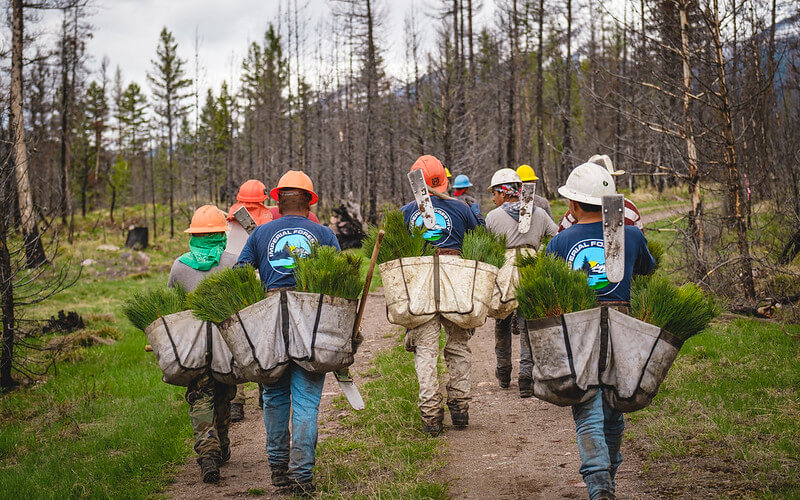
The Lolo National Forest planted 530,500 seedlings across 2,536 acres in 2020. Photo courtesy of National Forest Foundation by Dave Gardner Creative, CC BY-2.0.
Every week since 1991, Field Notes has inquired about Montana’s natural history. Field Notes are written by naturalists, students, and listeners about the puzzle-tree bark, eagle talons, woolly aphids, and giant puffballs of Western, Central and Southwestern Montana and aired weekly on Montana Public Radio.
Click here to read and listen to more Field Notes. Field Notes is available as a podcast! Subscribe on iTunes or wherever you listen to podcasts.
Interested in writing a Field Note? Contact Allison De Jong, Field Notes editor, at adejong [at] montananaturalist [dot] org or 406.327.0405.
Want to learn more about our programs as well as fun natural history facts and seasonal phenology? Sign up for our e-newsletter! You can also become a member and get discounts on our programs as well as free reciprocal admission to 300+ science centers in North America!