Let Lichen Be A Guide
By Priya Subberwal
Broadcast 5.20 & 5.23.2026
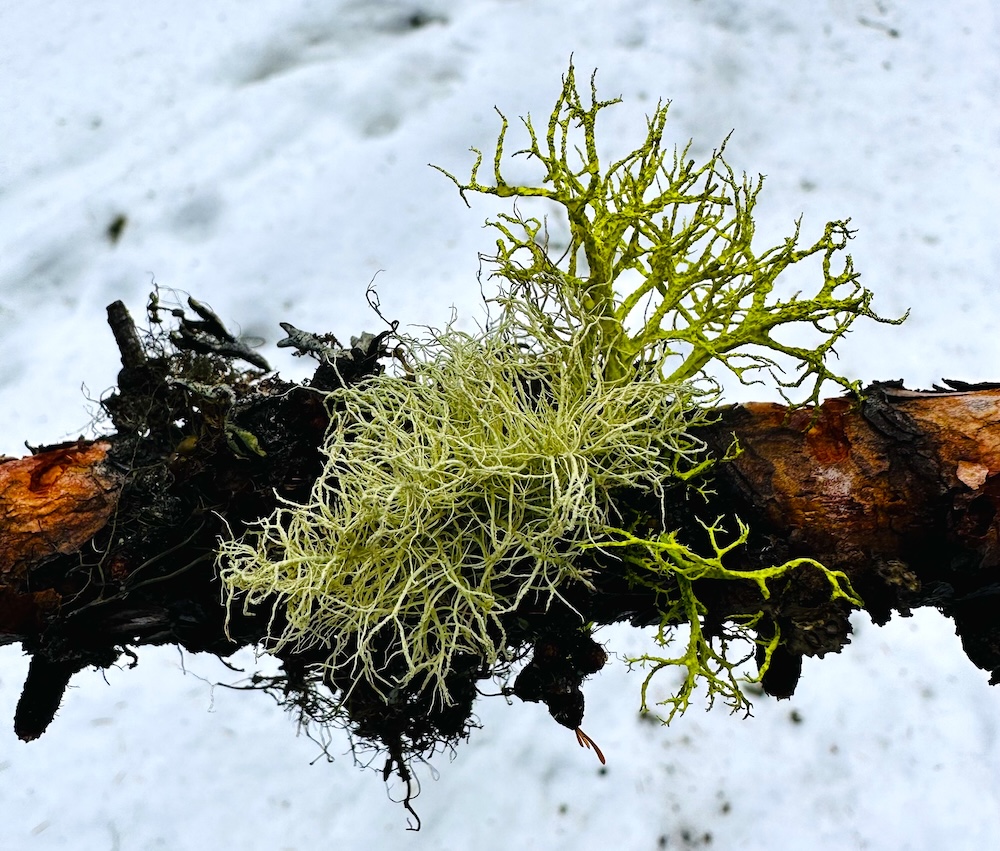
Several genera of lichen (wolf lichen in back on right). Photo by Allison De Jong.
Listen:
I can’t stop staring at them. Their beauty seems otherworldly; they’re radiantly fluorescent against the snow. It’s almost scandalous, that neon green, that buzzing orange. It’s like the Rattlesnake Wilderness is practically glowing, humming with colors too bright for this grey winter. The trees are jewelled in swaths of glistening lichens—thin, silver-green strands of angel hair, the curling red lips of pixie cups, or, my favorite, the beaming, radioactive chartreuse of wolf lichen.
With over 17,000 (known) species on Earth and as one of the least-studied groups, lichen defy our attempts to define and categorize them. It’s been known that lichen are not an individual organism, but rather a symbiosis between algae and fungi (I was taught that Alex Algae and Francine Fungi took a lichen to one another, but now their relationship is on the rocks). Recently, however, scientists have learned that lichen’s symbiosis is actually much more complicated, and involves the meeting of many different partners, including bacteria and protozoa. Each variety is a unique collaboration, and plurality is at the root of both their essence and their endurance.
I think that, beyond their defiance of category and resistance to any human attempt to fully understand them, it’s their predilection towards survival against unthinkable odds that compels me to lichen. They are resistant to sub-freezing temperatures and can survive without oxygen for extended periods of time, and there’s even a theory they came from space—because of their strange capacity for survival, some scientists wonder if they were perhaps seeded on earth millions of years ago by an asteroid. Some might call them aliens, or settlers. But in the time since those travellers from elsewhere first landed here, or since those first fungi and algae reached for each other, they’ve taken (metaphorical) root and thrived in extraordinarily hostile conditions. It now feels impossible to imagine an earth without these collaborative creatures—habitat as they are for countless other species, and food for even more. They’re essential participants in the ecosystem.
Lichen are steeped in paradox. While they’re incredibly resilient, they’re also profoundly vulnerable; because they do not have roots, they receive water and nutrients directly from the surrounding air, and are heavily impacted by sudden changes in their environment. As climate change intensifies, lichen’s resilience lies in their ability to adapt. Sensitive to sudden changes, they will intentionally dry up and freeze their metabolic processes, staying alive in limbo for years until the conditions are right for growth again. They know what good growing feels like, and how to hold out until then.
What is there to learn from lichen? Lessons in community, surely. That the only way we can survive the unsurvivable is with each other, that collaboration is at the heart of life. The inevitable interdependence of all things. Maybe also, that home is a thing that is made, and is built entirely of our relationships. While I am still on my way to learning these things, let lichen be a guide. Lawrence Millman wrote, “May the gods of the tundra grant me lichen until I become lichen myself.” Collaboration and creation lies waiting at the edge of all things, whether we are prepared to understand them or not. Until then, let’s look a little closer. See what is growing there, in the cracks, in the spaces in between.
Every week since 1991, Field Notes has inquired about Montana’s natural history. Field Notes are written by naturalists, students, and listeners about the puzzle-tree bark, eagle talons, woolly aphids, and giant puffballs of Western, Central and Southwestern Montana and aired weekly on Montana Public Radio.
Click here to read and listen to more Field Notes. Field Notes is available as a podcast! Subscribe on Apple Podcasts or wherever you listen to podcasts.
Interested in writing a Field Note? Contact Allison De Jong, Field Notes editor, at adejong [at] montananaturalist [dot] org or 406.327.0405.
Want to learn more about our programs as well as fun natural history facts and seasonal phenology? Sign up for our e-newsletter! You can also become a member and get discounts on our programs as well as free reciprocal admission to 300+ science centers in North America!