Rarities Hiding in Our Remaining River Corridors
By Lily Haines
Broadcast 5.13 & 5.16.2026
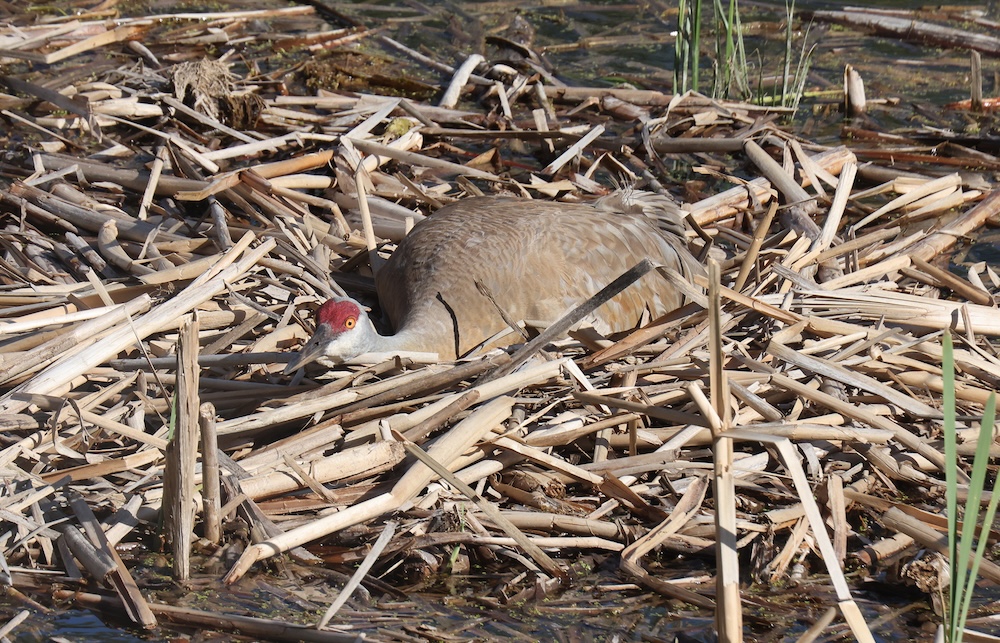
Sandhill Crane, camouflaged on her nest. Photo © RT Cox.
Listen:
We begin slowly, perched on an old road cut up the McCauley Butte, know as Smlk̓͏ʷsšná to the Bitterroot Salish, on the southern edge of Missoula. Through spotting scopes we watch American Wigeon and Common Goldeneyes on the large open-water ponds, formerly gravel quarries, below us. The Bitterroot River glides by just beyond, juxtaposed to the man-made still water. Inquisitive chatter fills the air. “How long has this been here?” “Will it be open to the public?” “People walk their dogs here ALL the time.”
Fifteen of us have gathered for an annual Spring Migration Watch, and every bird we’ll see today is tied to the unique conservation value of this four-mile corridor of grassland and pine forest, cottonwoods, wetlands, and riparian habitats. This is a special area. Uniquely undisturbed by parks, trails, and other human developments. It holds the most species-rich site for birds in Missoula County, by far.
As interest wanes on the butte, we head downhill and onto the river flats. Soon, we’re entering the cottonwood forests that flank the river. Stands of deciduous trees interrupted by the swales and sloughs of past river meanders. Here we must be quiet. Up on the butte, our lively chatter was no cause for alarm to wildlife residents. Down here, a different strategy is needed.
Hush. In these guarded habitats, quiet creatures are comfortably acting out their seasonal lives. Secretive Wood Ducks might be right around the corner. Look carefully. Before the cottonwoods unfurl their leaves, we can see the Red-tailed Hawk hatchlings, barely downy, draped across the edge of their sky nursery, and warming in the spring sunshine.
From my left, a whisper. “There’s a Sandhill Crane down there, on a nest.” Disbelieving, I glance over my shoulder and confirm the thrill of a truly special discovery shining on my fellow birder’s eye.
With its full body flattened across its nest, stretched out long and low, this crane is so camouflaged, so still, it takes a full minute to spot her. My jaw drops. She is also so close. Quickly and quietly, we move well away, reconvening in wonder at a more respectful distance.
A relatively small number of the Sandhills we see in Montana stay here to breed. They’ll nest in quiet wetlands with shallow water and dense vegetation, hiding their nests in secluded spots, even atop small self-made islands. Isolation offers protection. The young cranes, called colts, will walk and swim within hours of hatching, but will need several months to become strong flyers, able to avoid the perils of ground-bound life. For now, this uninterrupted mosaic of habitats along the river provides the resources to ensure their success.
Conservation-minded landowners and easements, active floodplains, and public closures currently protect the wildlife here. But there is no guarantee for this crane family.
Soon, the City of Missoula will begin to chart the future management of 84 acres of this corridor, just next door to the crane family’s private island. Ambitious development plans capitalizing on the prime riverfront location pop up every few years. The number of people recreating here increases each spring. Back on the bluff, I watch an enthusiastic pup run from its owner through the spotting scopes. Will it stray and discover a flightless colt?
I think about the crane family often, almost desperately. Will this rare and secretive crane nest disappear from our valley as people simply become too close for comfort? What would it take for a growing mountain town, full of fly fishers and Labradors, to value this stretch of river as a vital natural artery, as well as a community amenity, and to place emphasis on the former?
Management for wildlife habitat and recreation can be a tricky balance.
Maybe the story of a crew of curious birders, ages six to sixty, and the shared amazement of their completely uncommon discovery, can help us all gravitate towards protecting the remaining best habitats our valley has.
Every week since 1991, Field Notes has inquired about Montana’s natural history. Field Notes are written by naturalists, students, and listeners about the puzzle-tree bark, eagle talons, woolly aphids, and giant puffballs of Western, Central and Southwestern Montana and aired weekly on Montana Public Radio.
Click here to read and listen to more Field Notes. Field Notes is available as a podcast! Subscribe on Apple Podcasts or wherever you listen to podcasts.
Interested in writing a Field Note? Contact Allison De Jong, Field Notes editor, at adejong [at] montananaturalist [dot] org or 406.327.0405.
Want to learn more about our programs as well as fun natural history facts and seasonal phenology? Sign up for our e-newsletter! You can also become a member and get discounts on our programs as well as free reciprocal admission to 300+ science centers in North America!