The Scent of Home
By Victoria Yee
Broadcast 4.9 & 4.12.2025
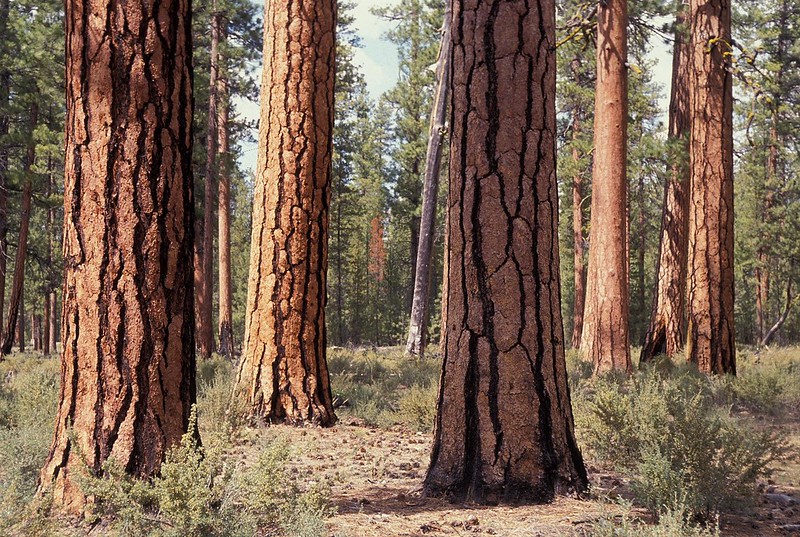
Ponderosa pine forest on a sunny day. Photo by Matthew Reilly, CC BY-SA 2.0.
Listen:
In my first job out west, I worked and lived in the wilderness of Utah as a youth field guide. To escape the scorching desert in the summertime we relocated to the Uinta Mountains, a place filled with fluttering aspens and pines. The moment we arrived my co-guide walked up to a huge pine tree, pressed her nose to its bark, and took a deep breath. A grin spread across her face as she announced, “My favorite smell!” I was intrigued. I pressed my nose up against the bark and took a deep whiff. Butterscotch? And maybe vanilla! I had never smelled such a scent on a tree before and it was enchanting. This was my first encounter with ponderosa pine.
On my first trip to Missoula, I drove straight to Rattlesnake Creek. When visiting new places it is never the city that makes me feel at home but the nature that shapes it. Ten minutes from the highway I was surrounded by a forest of ponderosa pines. My nose was struck with the sweet, familiar ponderosa scent. Here I was, nine hours north from the place I lived, and yet it smelled like the forests back home. Walking along I wondered, why do ponderosa pines have such a wonderful scent? Surely, the reason couldn’t simply be to convince me to move to Missoula. (Though in that regard it was successful.)
The answer to my wonder is a substance called resin. All trees in the Pinaceae family, including Pinus ponderosa, produce resins. Resins are glue-like substances created in the inner and outer bark that act like the tree’s immune system. When the tree is damaged, resins flow in to seal the wound. Resins also have antimicrobial properties to prevent further attack or damage. Chemically, resins contain a high concentration of terpenes, compounds consisting of carbon and hydrogen. When the unique combination of ponderosa pine terpenes are exposed to the air, they volatilize and release the sweet smell of butterscotch vanilla!
Now, as a resident of Missoula, my visits to the Rattlesnake are frequent. Today I stroll along the creek in the wintertime. I stop by a ponderosa to say hello and take a whiff but I can’t smell anything. Hm. I walk along to the next ponderosa, repeating the process, but this time only catch a faint scent. Why is it that one ponderosa has a strong aroma and another does not? Beyond the presence of resin there must be a variety of factors that influence the action of terpenes.
Today is a cold, 40-degree, overcast day, and research indicates that warmer days and direct sunlight can make terpenes more volatile or aromatic. Another factor is tree age. Ponderosa bark varies in color and depth with age. A young ponderosa has brown-black bark with shallow furrows. As the tree matures, the bark becomes segmented into large puzzle-piece plates that are deeply furrowed, with shades of yellow, brown, and cinnamon. I’ve been more successful in smelling vanilla on older, deeply furrowed trees as opposed to younger trees. Could this be due to more bark surface area and therefore resins as the tree has grown? Could deeper furrows be exposing more resin to the air? I’m not sure.
I keep walking and smelling, and more questions arise. I will most likely never be a research scientist and I may never know the answers to these questions. That’s ok. The simple act of asking questions has made me more curious and engaged with these living giants that make up my home. Today, I have experienced the joy of the poet Rilke’s words. He says, “Be patient towards all that is unsolved in your heart and try to love the questions themselves. Live the questions now.”
Every week since 1991, Field Notes has inquired about Montana’s natural history. Field Notes are written by naturalists, students, and listeners about the puzzle-tree bark, eagle talons, woolly aphids, and giant puffballs of Western, Central and Southwestern Montana and aired weekly on Montana Public Radio.
Click here to read and listen to more Field Notes. Field Notes is available as a podcast! Subscribe on Apple Podcasts or wherever you listen to podcasts.
Interested in writing a Field Note? Contact Allison De Jong, Field Notes editor, at adejong [at] montananaturalist [dot] org or 406.327.0405.
Want to learn more about our programs as well as fun natural history facts and seasonal phenology? Sign up for our e-newsletter! You can also become a member and get discounts on our programs as well as free reciprocal admission to 300+ science centers in North America!