The Ephemeral, Enchanting Glacier Lily
By Melissa Matthewson
Broadcast 6.2004, 7.2016, 5.2019, and 4.29 & 5.2.2026
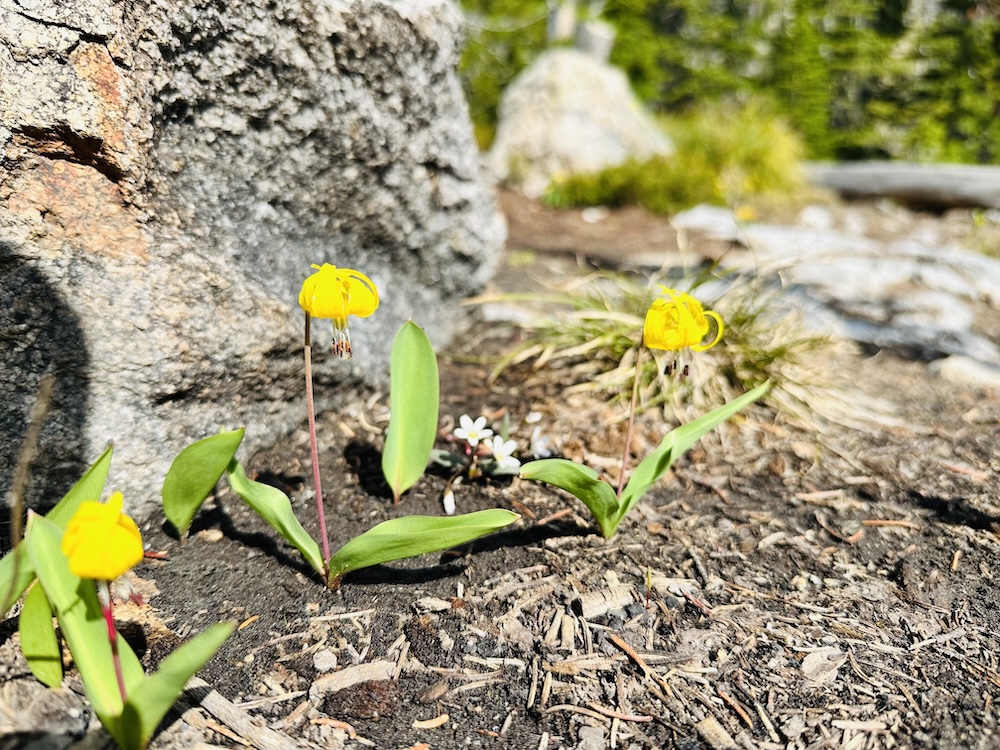
Glacier lilies in early spring. Photo by Allison De Jong.
Listen:
I was enchanted with the yellow glacier lily the first time I saw it – a flash of bright yellow among the brown and gray mix of meadow grasses and shrubs just starting to bud. The flower, nodding its head to the ground, six petals upturned towards the sky, was graceful and lovely. It was early April and I was following a trail along a high ridge in the Rattlesnake Wilderness when it captured my attention. I stepped off the trail and bent low to examine the solitary flower. The lily was delicate and slight, like bending arches, a contrast to the tall pines and dry grass that grew nearby. Its stamens pointed towards the ground and the bright green leaves formed spears jetting out from its base. I wondered about the lily – wondered about its uses and purpose on this high spot in the Montana mountains.
What I later found is that glacier lilies are ephemeral, living only ten weeks between first emergence and leaf fall. A perennial herb, the flower is also known as the dogtooth violet, fawn lily, or avalanche lily and is native to western North America from southern British Columbia to northern California, and east to Alberta, Colorado, and Wyoming. It overwinters as a corm, lying dormant under the frozen ground, and emerges soon after the snow melts on sagebrush slopes. In Montana, glacier lilies also regenerate by dropping their seeds gradually and slowly as the wind or animals disturb the flowers. In turn, the seeds require one hundred days of cold before they can germinate. Some individuals of the flower take eight years to reach full reproductive maturity.
Animals use the corms and seeds as a vital food source, as do human populations who have historically depended on the lily for both food and medicine. Native Canadians cherished the bulbs as a key component of their diet. The Blackfoot ate the corms fresh or with soup, and the dried bulbs of the glacier lily were a popular trade item between tribes. They can be eaten raw, like onions, but become sweeter and more pleasing to the tongue when roasted, boiled, or glazed. The leaves are edible as well and the green seedpods taste like green beans when cooked.
Before going out to find the lily, the eager forager should know that yellow glacier lilies are very sensitive to disturbance and harvesting the corm will effectively kill the plant. Though native tribes practiced active management of the plant, the flower populations have been greatly reduced in areas and it is better to leave collection to animals of the forest than to gather them for novel use in soups or barbecues. In fact, the bulb of the glacier lily is essential to the grizzly bear’s diet in the spring. The bears will dig them up when other food is scarce and the nutritional content of the bulb is at its highest.
I think that overall, to me, glacier lilies set standards in beauty and cultural importance. Indeed, this charming flower is multifarious — they are the lights of spring, indicators of winter’s end, symbols of nutrition, yellow images of patience and longevity, and, for me, a new and solid representation of pure human enchantment.
Every week since 1991, Field Notes has inquired about Montana’s natural history. Field Notes are written by naturalists, students, and listeners about the puzzle-tree bark, eagle talons, woolly aphids, and giant puffballs of Western, Central and Southwestern Montana and aired weekly on Montana Public Radio.
Click here to read and listen to more Field Notes. Field Notes is available as a podcast! Subscribe on Apple Podcasts or wherever you listen to podcasts.
Interested in writing a Field Note? Contact Allison De Jong, Field Notes editor, at adejong [at] montananaturalist [dot] org or 406.327.0405.
Want to learn more about our programs as well as fun natural history facts and seasonal phenology? Sign up for our e-newsletter! You can also become a member and get discounts on our programs as well as free reciprocal admission to 300+ science centers in North America!