Foraging Creeping Thistle
By Emily Qiu
Broadcast 4.15 & 4.18.2026
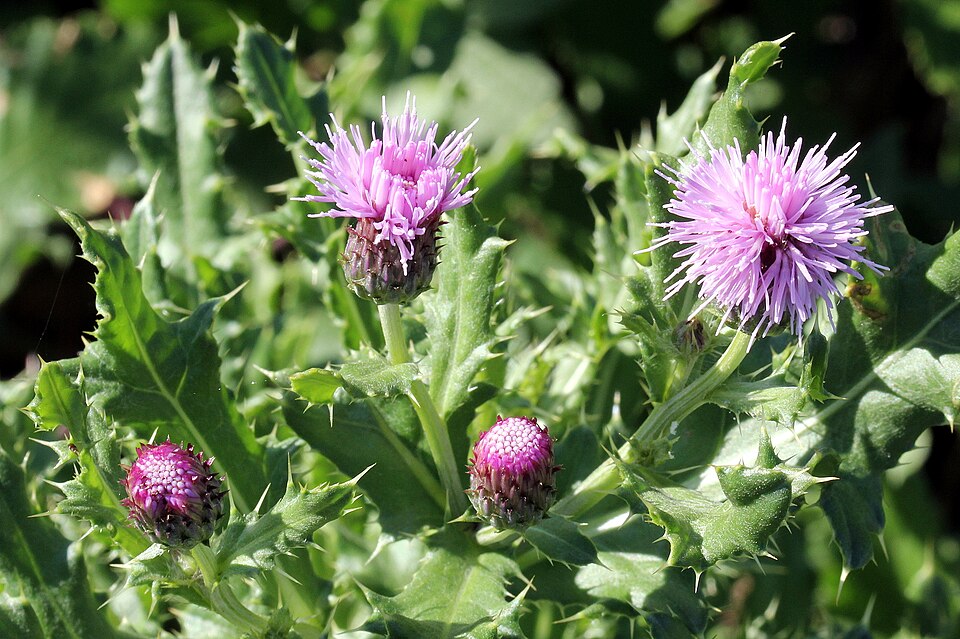
Creeping thistle: pretty purple flowers, noxious weed, or a tasty snack? Photo by Joan Simon, CC BY-SA 2.0.
Listen:
It’s spring: my favorite season. The days stretch longer, the streams swell, wildflowers pop into bloom…and my perennial adversary makes its reappearance.
I first learned about Canada thistle through a somewhat passive aggressive email sent by our HOA. The prior owners had a history of neglect when it came to fighting these invasive and prolific invaders. Our neighbors must have realized that upon moving in, our plan was to wave the white flag, more out of an ignorance that we were sharing our yard with these persistent underground creepers. So the email included a “friendly” reminder that under Montana law, we were required to ensure that these invasive and “noxious” plants were “dealt with.”
With a googled image of “Canada thistle” open on my phone in one hand, I started walking around our front yard, and quickly realized that the pretty purple “wildflowers” I had commented on when we moved in were in fact these perennial weeds.
I began searching the internet for how to get rid of the extensive network of former-pretty-wildflowers-now-noxious weeds in my two-acre yard. Turns out Canada thistle (Cirsium arvense), also known as creeping thistle, is a spreading perennial weed that appears across much of the northern United States. In our case, it sprawled across much of the front lawn, marching towards our front door. I was ready to do battle. I reached down towards the first large thistle I saw and wrapped my fingers around the stem. Recoiling, I realized that this thistle had armored itself with serrated leaves with spiny edges.
Growing their way through the Americas, creeping thistle is a part of the aster family, and its blooms are composed of composite flowers. Native to Eurasia, the plant is known in some places as cursed thistle, an apt name—my yard was cursed by a botanical hydra. The plant is widespread in various habitats like pastures, fields, woodlands, riparian areas, and of course my yard, former farmland. Creeping thistle notably appears where humans appear.
I soon learned that, like many invasive weeds, removing creeping thistle is not a one-time event but rather a sisyphean process. Weeks hunched over in the sun pulling spiky thistle from the ground must have reoriented my moral compass because I found myself longing for a truckload of chemicals to spray across my yard. Canada thistle’s ability to spread through both seeds and budding from underground roots—which can reach more than fifteen feet out and six feet down—meant that we were at a stalemate. If I took one day off, I would return to more thistle than before.
After each weed-pulling session, I felt like one battle had been won, but in a few days, the enemy was back at the gates. What ultimately brought a temporary pause to this stalemate was the first snow, when the thistle goes dormant for the winter. And with the arrival of spring, it begins again.
This spring, however, I learned a new, game-changing fact about my adversary in a foraging class: it’s edible. The idea that I could eat my enemy created some comedic fortitude as I prepared for my first weeding session of the season.
Thistle stalks are crispier and juicier in spring, sometimes curved and tangled like they’re still figuring out how to reach for the sky after months underground. I pulled up the inaugural thistle, brushed off the dirt, and took a tentative bite of the spikeless lower stem. The taste reminded me of crisp lettuce. I continued weeding and occasionally snacked on some more thistle.
Each bite of thistle dulled the sharp edge of my dislike for the plant. And I’ve since learned to appreciate it more: young thistle leaves can be rolled up to neutralize the spines and eaten whole. Thistle tops can serve as a potherb, and young stalks can be peeled and eaten raw. My relationship with thistle has changed. And even though I do not plan to let the thistle take over my yard, I see its value.
This morning, with the grass still wet with dew, I walk barefoot into the yard. I reach down towards the young thistle growing out of the grass. As my fingers find the stem, I’m no longer pulling weeds, but gathering for my table.
Foraged Thistle Salad Recipe
Ingredients:
- 2 handfuls of foraged young thistle leaves (washed and dried) and stems (peeled if preferred)
- A few dandelion leaves (also from the yard, washed and dried)
- 2 to 3 tablespoons of vinegar or lemon juice
- 1 tablespoon of jam (I like the Roots Kitchen and Cannery Blackberry and Earl Grey jam)
- 3 to 4 tablespoons of olive oil
- 2 tablespoons of toasted pepitas
- 1 tablespoon of hemp seeds
- 1 ripe tomato, diced
- Half cucumber, diced
- Half avocado, diced
Directions:
- Add dandelion leaves and thistle to salad bowl
- Add tomato, cucumber, and avocado
- Mix in pepitas and hemp seeds
- Mix vinegar/lemon juice, oil, and jam
- Pour dressing mixture over salad
- Serve with warm sourdough toast
Every week since 1991, Field Notes has inquired about Montana’s natural history. Field Notes are written by naturalists, students, and listeners about the puzzle-tree bark, eagle talons, woolly aphids, and giant puffballs of Western, Central and Southwestern Montana and aired weekly on Montana Public Radio.
Click here to read and listen to more Field Notes. Field Notes is available as a podcast! Subscribe on Apple Podcasts or wherever you listen to podcasts.
Interested in writing a Field Note? Contact Allison De Jong, Field Notes editor, at adejong [at] montananaturalist [dot] org or 406.327.0405.
Want to learn more about our programs as well as fun natural history facts and seasonal phenology? Sign up for our e-newsletter! You can also become a member and get discounts on our programs as well as free reciprocal admission to 300+ science centers in North America!