The Gift of Silence
By Francine Miller
Broadcast 6.25 & 6.28.2025
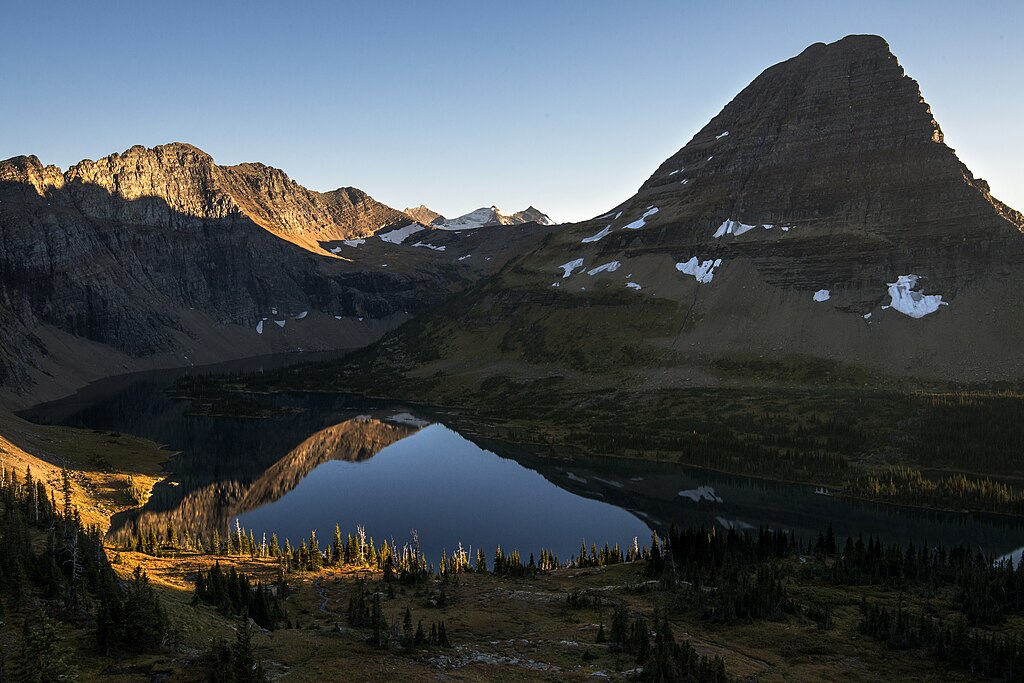
Sunset on Hidden Lake Trail in Glacier National Park. Photo by NPS / Tim Rains, public domain.
Listen:
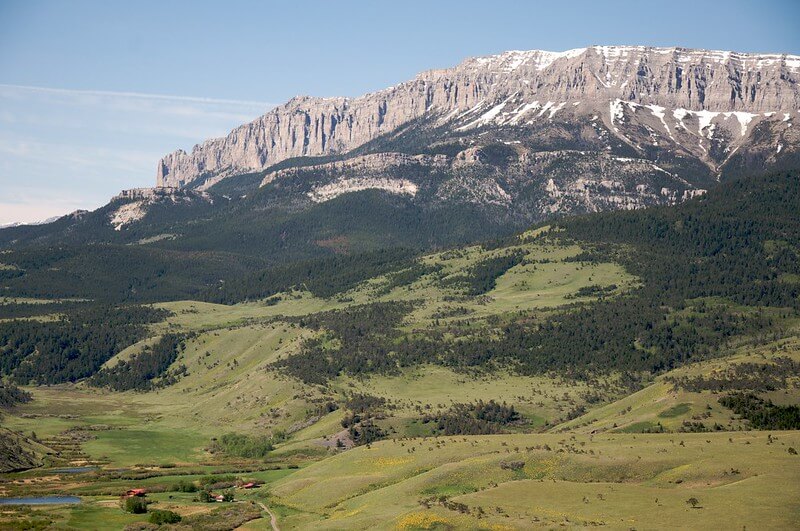
Last week when all was quiet and sunrise was coloring the sky, I thought how lucky I am to know silence. I was thrilled to watch the sky turn pink, fade to dark purple and then bright blue. I had left home an hour before sunrise to photograph elk, owls, or bighorn sheep. Hearing birds singing, I kept wishing for another Great Horned or Short-eared Owl. I call mornings with elk, owls, and bighorns the trifecta.
As I drove along through the quiet morning, I thought about all the people who have never heard silence. I began to muse about everyone perceiving silence differently. Can we experience silence by ignoring the buzz of air conditioners, refrigerators, fluorescent lights, or the annoyance from cell phones? Can we find silence alone at home with no distractions?
That morning, alone in my car, I turned off the engine near a running creek. There was no sound but that of water running over rock. Is that considered silence?
My first experience of true silence was forty years ago while hiking through the Arizona desert. I grew up in Phoenix when it was a small desert town, and walked the quiet nearby sands many times. Hiking towards a favorite place, a young man from Manhattan and I were enjoying the smell of cactus in bloom. We paused to watch a coyote and he said, “Listen.” We stopped. We heard no wind, no birds, no traffic. He gave me my first gift of silence.
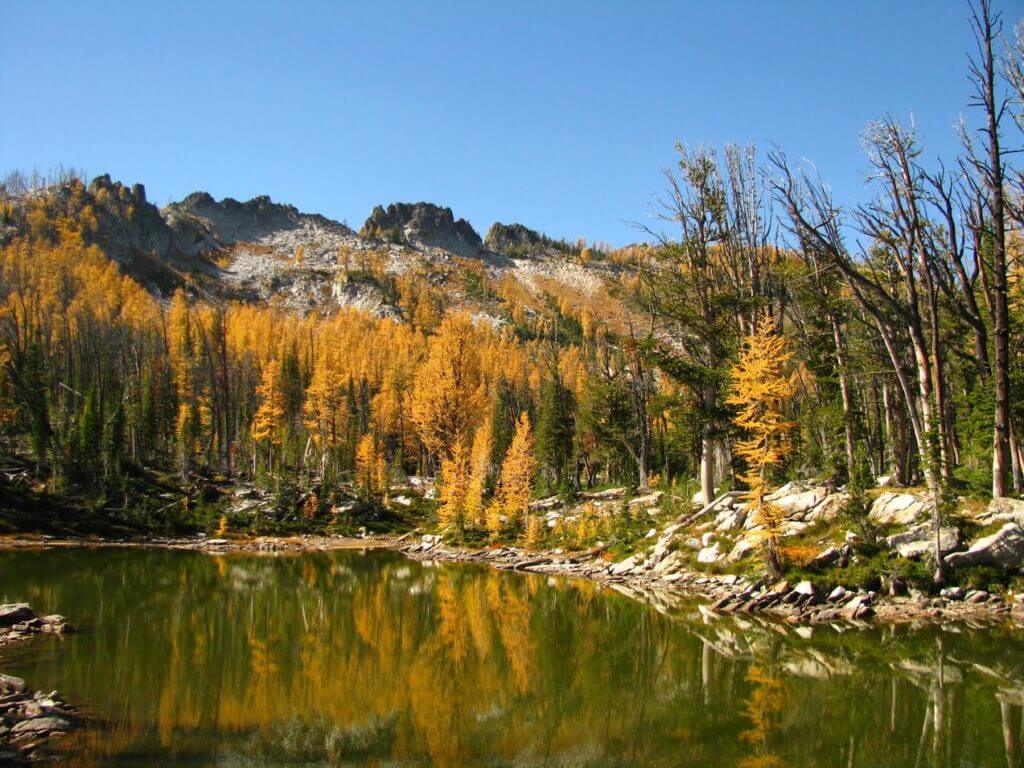
From that day on I have never taken the peace of silence for granted, and have sought it out in many places. Twenty years ago, at sunset, I was watching mountain goats off the Hidden Lake Trail in Glacier National Park. I became aware of a huge dark shadow. All alone, feet frozen, I stared at this giant. I knew in my heart that it had to be a grizzly. My heart pounding in my ears, with only a touch of light left in the sky, I sighed: not a bear but a boulder. Was that silence?
We all perceive silence differently. “Silence, whatever it is, is not a sound,” writes Chaz Firestone, co-author of the 2023 paper The Perception of Silence. “It’s the absence of sound. And yet it often feels like we can hear it. If silence isn’t really a sound, and yet it turns out that we can hear it, then hearing is more than just sound.”
Last winter I heard true silence again. While watching giant snowflakes fall, I stepped outside onto our back porch to check on baby Oliver, rescued from the Missoula Humane Society. I stood in silence watching Oliver run around the backyard catching snowflakes on his pink tongue. All sound was muffled by the snow, including his running feet. I could smell the whiteness of the snow. That night is one I will never forget because I heard pure silence. It lasted only a moment. Oliver saw me and bounced up the steps. I sent him back into the snow, but the moment was broken.
We are truly blessed who know the outdoors. If we listen we can learn that nature has the ability to give us a true gift: that of silence. Silence, once learned, is more than just the absence of sound. It teaches us that being in the outside world can free us from the daily stresses, distractions, and buzz of everyday life. What would humankind be like if each of us took the time to know true silence?
Life becomes quite simple and uncomplicated when walking outside and asking nothing from nature. Silence can give us peace.
Every week since 1991, Field Notes has inquired about Montana’s natural history. Field Notes are written by naturalists, students, and listeners about the puzzle-tree bark, eagle talons, woolly aphids, and giant puffballs of Western, Central and Southwestern Montana and aired weekly on Montana Public Radio.
Click here to read and listen to more Field Notes. Field Notes is available as a podcast! Subscribe on Apple Podcasts or wherever you listen to podcasts.
Interested in writing a Field Note? Contact Allison De Jong, Field Notes editor, at adejong [at] montananaturalist [dot] org or 406.327.0405.
Want to learn more about our programs as well as fun natural history facts and seasonal phenology? Sign up for our e-newsletter! You can also become a member and get discounts on our programs as well as free reciprocal admission to 300+ science centers in North America!