Squirrels vs Magpies
By Lexi Turpack
Broadcast 5.28 & 5.31.2025
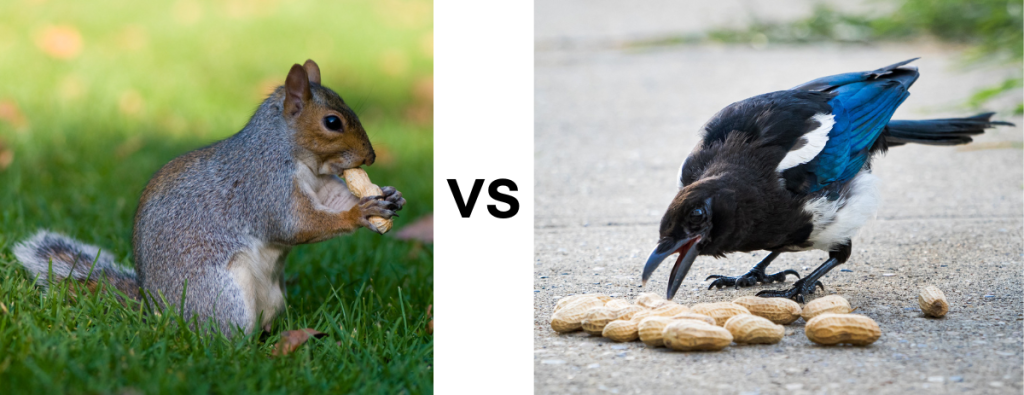
Squirrels and magpies both like peanuts…and will compete for them! Squirrel photo by Steve Harris, CC BY-NC 2.0. Magpie photo by Dave Sutherland, CC BY-NC-SA 2.0.
Listen:
It seems like almost every day I witness a fierce battle in my backyard: the Squirrels vs the Magpies. Two worthy competitors go head to head in competition for the golden prize—a crunchy, delicious delicacy: the glorious peanut.
The games begin with the squirrel, our first competitor to enter the scene. It comes bounding into the yard, the coveted peanut in its mouth. It seems to be looking for something, hopping this way and that, sniffing the ground. Ah! Finally it comes upon the perfect spot, worthy of the precious nut.
It digs a hole with its masterful front paws. They look like little hands, or tiny garden trowels, with primitive thumbs and strong claws, perfectly designed for digging peanut holes. Their back paws, on the other hand, help them grip while climbing. Did you know that squirrels can rotate their back paws 180 degrees, so they can go head first down trees?
Happy with its digging job, our crafty squirrel inserts its peanut into the hole, and covers it meticulously with leaves and soil, patting it repetitively like an expert baker folding dough. Squirrels bury their nuts in the fall to create a hidden pantry for when winter blows in, so they have a source of food during the cold months. They can retrieve up to 95 percent of their buried treats using their keen sense of smell and memory. With the nut safely in its hiding place, content with its work, our squirrel hops away.
Mere moments later, our opponent swoops in: a black-and-white beauty, with an iridescent sheen to its feathers like a fancy tuxedo, dressed ready for a gala.
A magpie.
It looks confident as it toddles around, in search of the scrumptious nut, peeking here and there, prodding with its powerful, pointy beak—an excellent shape for drilling out buried objects, like peanuts. Commonly thought of as a bit of a menace, magpies are actually intelligent, social creatures. They can recognize themselves in mirrors, grieve, and work together in teams to solve problems. They also have a keen ability to track down missing objects, making the magpie a tough competitor in this battle for the peanut.
And ah! Just there! After hunting about for a few minutes, the magpie finds the prized nut. It digs it up with its proud, sharp beak, and like a criminal eager to escape the scene, our magpie quickly flies off to snack in peace. It seems the magpie won this battle—but not to worry, this is just the first round!
The magpie may appear the dominant player in our game, but as it turns out, squirrels have developed a crafty strategy to outsmart sneaky nut thieves like magpies. Sometimes called “deceptive caching,” squirrels will actually pretend to bury a nut! They’ll go through the motions of digging a hole, pretending to insert their tasty treat, and covering it up with dirt…but no nut is inside! The squirrel will then dart away in a different direction, likely quietly celebrating its wily trick.
So while the magpie won the nut this time, at the end of the day, it’s hard to say if one competitor comes out on top. But from what I’ve observed, seeing both creatures enjoy many a peanut in my yard (and, yes, littering it with peanut shells that I pretend don’t drive ME nuts), I’d say both squirrels and magpies are winners at this nutty game.
Every week since 1991, Field Notes has inquired about Montana’s natural history. Field Notes are written by naturalists, students, and listeners about the puzzle-tree bark, eagle talons, woolly aphids, and giant puffballs of Western, Central and Southwestern Montana and aired weekly on Montana Public Radio.
Click here to read and listen to more Field Notes. Field Notes is available as a podcast! Subscribe on Apple Podcasts or wherever you listen to podcasts.
Interested in writing a Field Note? Contact Allison De Jong, Field Notes editor, at adejong [at] montananaturalist [dot] org or 406.327.0405.
Want to learn more about our programs as well as fun natural history facts and seasonal phenology? Sign up for our e-newsletter! You can also become a member and get discounts on our programs as well as free reciprocal admission to 300+ science centers in North America!