Sounds of a Summer Evening at Lee Metcalf Wildlife Refuge
By Pam Murphy
Broadcast 6.11 & 6.18.2025
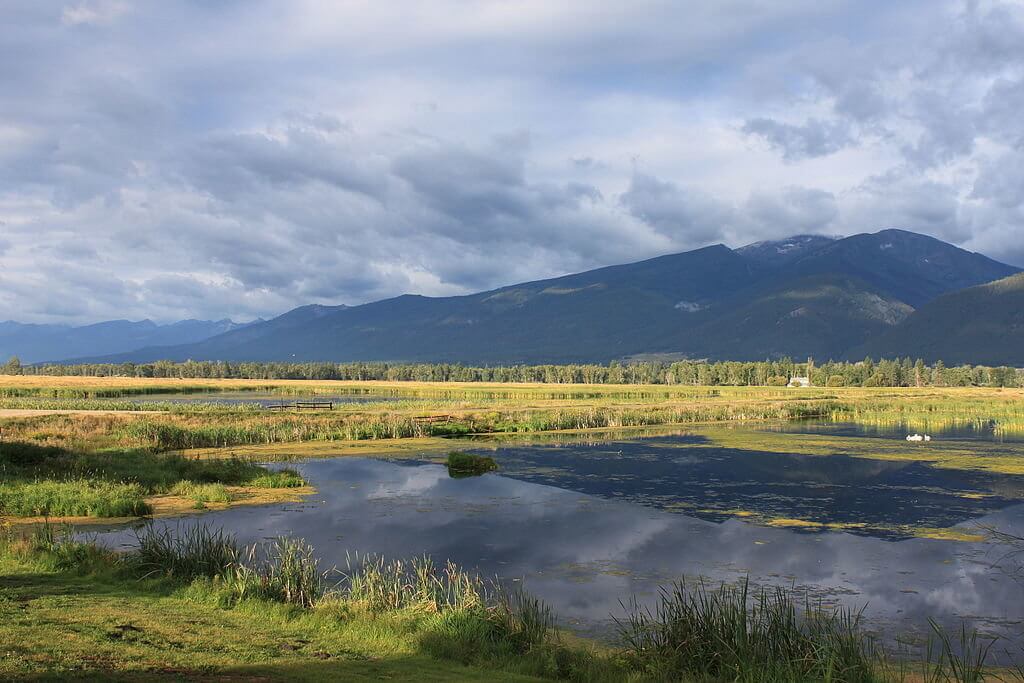
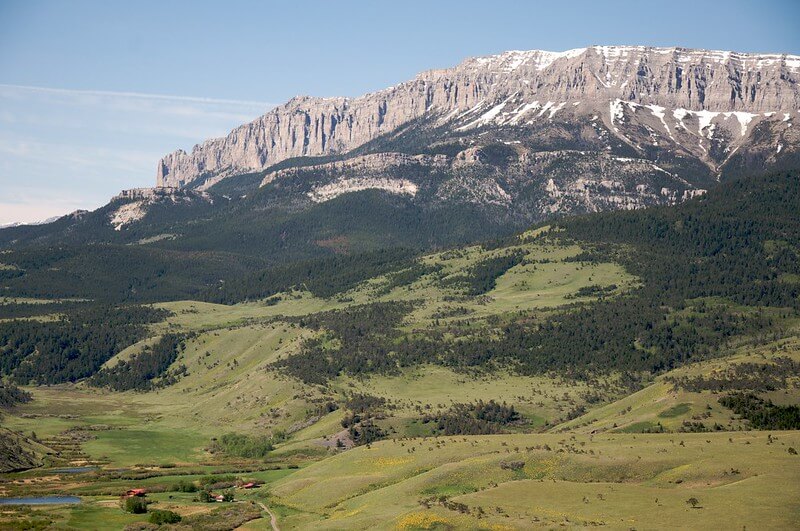
Summer sunlight at Lee Metcalf National Wildlife Refuge. Photo by Bob Danley/USFWS, CC BY 2.0.
Listen:
The road dissecting Lee Metcalf National Wildlife Refuge meanders from agricultural to wetland to forest habitats. Bird sightings abound, and a cacophony of bird songs and calls provides a soundtrack for walking, from the “quack-quack-quack” of Mallards to the “kok-kok” of the Ring-necked Pheasant to the “hoot-a-hoot-hoo-hoo” of the Great-horned Owl.
“Garoo-a-a-a,” the stuttering, rattling call of Sandhill Cranes, greeted me when arriving. It’s a loud call that sounds like gargling while playing a trumpet and is caused by the crane’s two feet of trachea coiled into an “S” shape as it descends into the chest, resulting in a rich, low-pitched call.
I scan the field with binoculars, hoping for assistance from Kali, my border collie, a breed infamous for moving wayward sheep back to the flock with their “border collie eye.” Kali’s “stop-and-stare” is unparalleled for indicating nearby pheasant, crane, or heron; and once, a beaver. Even though cranes range from 2.5 feet to 4.5 feet tall, they can be very difficult to see as they walk in the tall reeds and cattails. These birds are gray, but in the spring they cover their feathers with oxidized mud, resulting in the reddish-brown color that allows them to hide in plain sight. This evening, they eluded binoculars and a dog with exceptional focus and perseverance.
Continuing our walk, we approached a cottonwood and the tree was singing! A chorus of “peent” and “beer” rang through the stillness of the late summer evening, as dozens of European Starlings, invisible behind the canopy of leaves, sang with joy.
European Starlings were introduced into the U.S. in 1890 when one hundred birds were released into Central Park by Shakespeare enthusiasts who wanted America to have all the birds mentioned by the playwright. These birds, often considered invasive pests, are known for their imitations of the Red-tailed Hawk, Western Meadowlark, American Robin, and Northern Flicker. Upon hearing the scream of a red-tail, a birder must often confirm whether the bird calling is actually a hawk or a mimicking starling.
We walked across the levee between ponds while strolling west, noticing two Trumpeter Swans swimming languidly. Passing the swans and listening intently for other bird calls, “WHUMP-WHUMP-oh-OH” broke the quiet of the evening as the swans beat the air with their wings.
Trumpeter Swans are the largest waterfowl in the U.S., up to six feet tall with a wingspan of eight feet and weighing over 20 pounds.They need at least a 100-yard-long “runway” of open water (football field minus the end zones) to gain enough speed to take off, and almost sound like galloping horses (“whump-whump”) as they run hard across the water to generate speed. Their call did not sound like a bird at all; it sounded like a trumpet (“koh-oh”) breaking the quiet of the late summer evening
As we continued walking, Kali and I scanned the cattails and marsh grasses, looking for the familiar red and yellow wing patches, colorful epaulets of the Red-winged Blackbird. None were visible but “conk-la-reeees” reverberated, creating an aural path; the birds were out of sight but impossible to ignore. My binoculars, and Kali’s expert eyes, were scanning unsuccessfully for a Red-winged Blackbird perched on top of or among the cattails. Red-winged Blackbirds are harbingers of spring in Montana, among the early arrivals to the state, beginning to arrive in February as they instinctively know when to return to breeding grounds for mating and nesting; also seeming to know instinctively when birders long for snow to melt and winter to fade.
It was almost dark as we finished our walk. The total birds seen this evening were two—thank you, Trumpeter Swans—but the orchestra of cranes, starlings, and blackbirds brought the species total much higher, filling the evening air with the music and the magic found at Lee Metcalf Wildlife Refuge.
“Garoo-a-a.” “Oh-OH.” “Peent.” “Beer.” “Conk-la-reeee.”
Daily walk. Birds sang. Departed and relaxed.
Every week since 1991, Field Notes has inquired about Montana’s natural history. Field Notes are written by naturalists, students, and listeners about the puzzle-tree bark, eagle talons, woolly aphids, and giant puffballs of Western, Central and Southwestern Montana and aired weekly on Montana Public Radio.
Click here to read and listen to more Field Notes. Field Notes is available as a podcast! Subscribe on Apple Podcasts or wherever you listen to podcasts.
Interested in writing a Field Note? Contact Allison De Jong, Field Notes editor, at adejong [at] montananaturalist [dot] org or 406.327.0405.
Want to learn more about our programs as well as fun natural history facts and seasonal phenology? Sign up for our e-newsletter! You can also become a member and get discounts on our programs as well as free reciprocal admission to 300+ science centers in North America!