Wildflower Regeneration After the Rice Ridge Fire
By Jean Pocha
Broadcast 6.18 & 6.21.2025
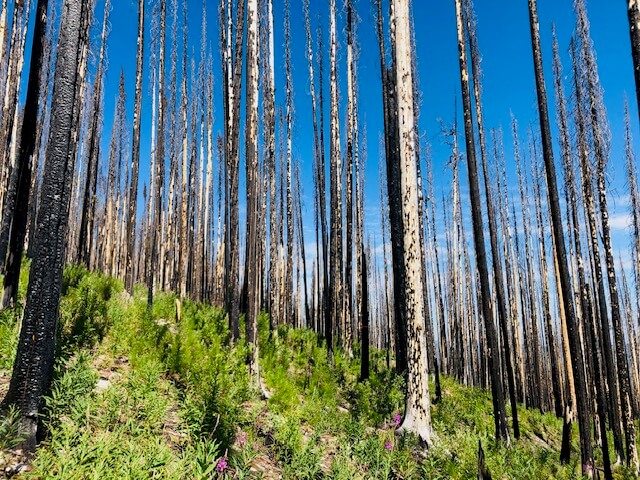
Fireweed blooming, post-fire. Photo by Allison De Jong.
Listen:
The mountain range north of my home in the Blackfoot Valley was smoke-covered for 56 days during the Rice Ridge fire in 2017. The continual smoke, friends’ evacuations, fire traffic, and terrible air quality made me feel like I was living at ground zero.
A mid-September snowfall quenched the fire and cleared the skies. What joy to see the mountains again! My only thought was to walk on the land that had been burned. With our two dogs, I ventured to the North Fork Trailhead along the Blackfoot River.
Although the trailhead appeared pristine, the scene soon changed as we walked along. At a junction, the trail surface changed from dust to ash. The dogs’ paws kicked up puffs of ash as they trotted along. Bits of charred bark and blackened trees were scattered like pick-up sticks across the landscape. Huge chasms where trees had burned into the roots were sprinkled through the remains of the forest. I was both stunned and curious.
Soon I heard the sound of splashing. The dogs had come to a small creek, bubbling along through the desolation, bits of charred bark and branches floating on the surface. Balanced on two rocks lay a piece of blackened bark with a knothole burned out in the shape of a heart. The sight oddly filled me with hope.
I knew that the processes that would bring regeneration were tucked away in the land, waiting to kick into gear. The only direction the land could go would be towards growth. And I wanted to watch it grow.
The skipping and winding behavior of fire allows a mix of burned and unburned spaces to exist in close proximity. Areas that burned at lower intensity recover more quickly, sending roots and seeds into severely burned parts of the forest to help the land regenerate.
Through yearly ventures into the area since the fire I have learned and observed plants’ varied strategies to regenerate and repopulate the forest. These include rhizomatous roots that can travel 20 feet underground, hard-coated seeds that require fire to crack the seed coat, and wind-borne seeds, which can travel for many miles.
The following year, in 2018, I saw the first lodgepole pine sprouts and stalks of fireweed. An emblem of Montana wildflowers, fireweed seed pods pop open and release plumed seed into the air. Seeds have been documented traveling up to 120 miles. In addition, fireweed has rhizomatous roots, allowing it to quickly spread, stabilizing soil and reducing erosion as it does so.
In 2020 ceanothus, aka buckbrush, began sprouting. Ceanothus seeds have a very hard seed coat, requiring a hot fire to crack them open—and also protecting the seed for as long as decades in the absence of high-intensity fire. In parts of Canada, ceanothus had largely disappeared due to a century of fire-restrictive policies. After allowing high-intensity fires to burn again, ceanothus returned, showing how long the seed can lie dormant in the soil.
By 2021 spiraea and Oregon grape—also rhizomatous plants—began to grow.
In 2022 I noticed yarrow sprouting up, another rhizomatous plant. That year prairie smoke and sugar bowl also showed up, both of which have wind-borne seeds.
The trail was clogged with ceanothus bushes up to my waist in 2023. The meadow bloomed with many varieties of wildflowers and shrubs. Up on the bench, arrowleaf balsamroot scattered a few golden blooms, likely seeded by birds.
Watching the successful unfolding of the plants’ regeneration story has been a blessing. It has been an honor watching this landscape come back to life. I am inspired by these lessons of resilience: having deep roots, receiving help from near and far, and being ready to grow.
Every week since 1991, Field Notes has inquired about Montana’s natural history. Field Notes are written by naturalists, students, and listeners about the puzzle-tree bark, eagle talons, woolly aphids, and giant puffballs of Western, Central and Southwestern Montana and aired weekly on Montana Public Radio.
Click here to read and listen to more Field Notes. Field Notes is available as a podcast! Subscribe on Apple Podcasts or wherever you listen to podcasts.
Interested in writing a Field Note? Contact Allison De Jong, Field Notes editor, at adejong [at] montananaturalist [dot] org or 406.327.0405.
Want to learn more about our programs as well as fun natural history facts and seasonal phenology? Sign up for our e-newsletter! You can also become a member and get discounts on our programs as well as free reciprocal admission to 300+ science centers in North America!