The Role of Oak Galls in Shakespeare’s Plays
By Lavonne Rus-Ogilvie
Broadcast 7.30 & 8.2.2025
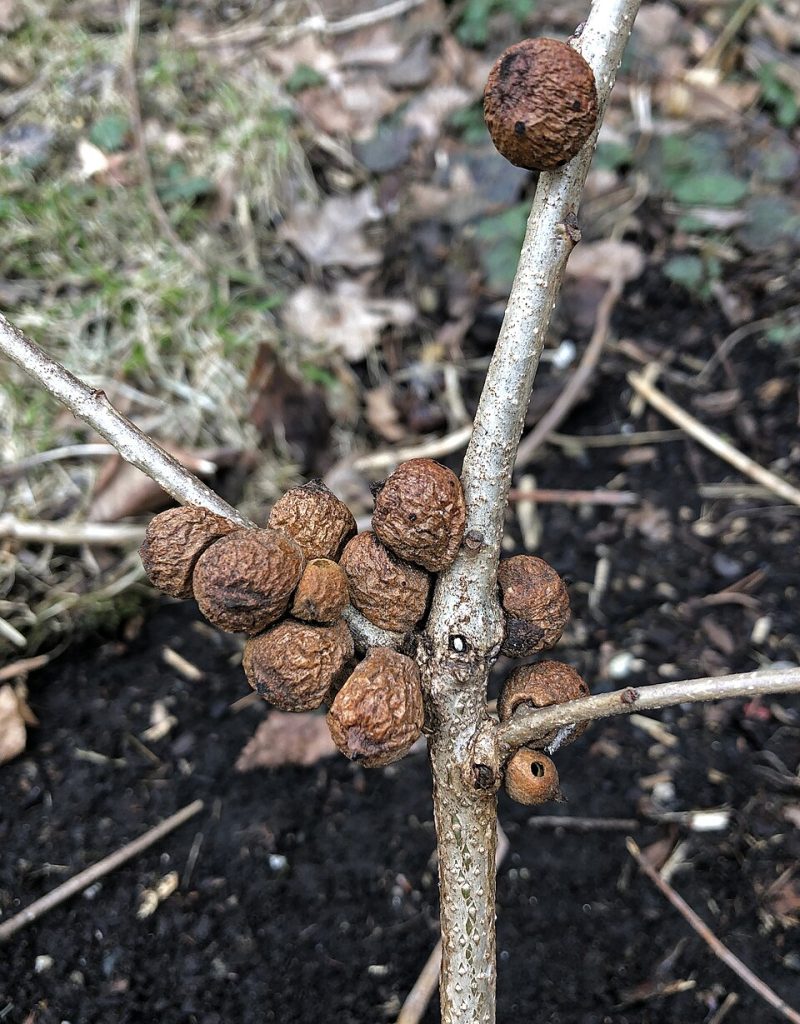
Oak galls from an oak rough bulletgall wasp. Photo by threelark on iNaturalist, CC BY 4.0.
Listen:
In April, the boulevard bur oaks are hard to love. Hard, gnarly clusters cover their dark empty branches. If I pay any attention at all to these scary silhouettes, it’s with a wish that they would leaf out: one, to improve their appearance, and two, to convince me they are still alive. But mostly I pass them by.
Today, I pause. I move in and circle around for a closer look. I gently bend a branch to inspect those knobby clusters. Amazing! There must be hundreds on this one tree alone: small wooden balls with a pin-hole dot. Some are old, dark, and dry, and others a smooth, chestnut brown. Grown from the woody branches, they range in size between a malted-milk ball and a large grape. They crowd together and overlap in intricate bundles.
What drove me to have a closer look at these strange formations? It was a line in a book. By Any Other Name, a novel by Jodi Picoult, explores the possibility that a woman may have secretly written some of Shakespeare’s plays. In the book, the character dips her feather quill into oak gall ink. “What?” I wondered. I needed to know more.
Turns out, galls (or gall nuts) are common on bur oak, Montana’s only native oak tree. These are slow-growing trees and can live up to 200-300 years.
Galls are weird growths that trees produce when something bugs them. In this case, it’s an actual bug–the oak rough bulletgall wasp. When it lays its egg under the tree bark, a process is set off and the tree begins to grow woody tissue, fully surrounding the gallmaker.
We start to see oak galls mid summer, and each one houses only a single wasp larva. In the fall, after metamorphosis, a self-fertile adult female burrows her way out and lays eggs on future oak leaf buds. When spring arrives, both female and male wasps emerge. They mate, and the females lay their eggs in the fresh branches. And the cycle begins all over again with the tiny larva developing inside the gall until its fall debut.
Bullet galls can remain on a host tree for as many as five years after the gall-maker has left. While they can reduce the growth rate of a host tree, current thinking is galls do not kill the branches. These galls also secrete a sticky honeydew substance that attracts wasps, bees, and ants. These insects feed on the sticky sweetness and protect the gallmaker from its natural enemy–parasitic wasps. These honeydew-covered condos are also rich in tannic acid—and this brings us back to oak gall ink. Tannic acid provides a source of color, turning black when mixed with iron sulfate, and many types of oak galls can be used to make ink.
Oak gall ink was the most popular ink in Europe from the Middle Ages to the 19th century. The Book of Kells from A.D. 800, the Magna Carta, and the Declaration of Independence were all written in gall ink. And while we’re not sure if a woman did write some of Shakespeare’s plays, they were written in that special combination of iron sulfate, water, gum Arabic, and gall nuts.
It took a line in a book to draw me to these oak trees—and they are easier to love now that I know their historical role in putting ink on the page.
Every week since 1991, Field Notes has inquired about Montana’s natural history. Field Notes are written by naturalists, students, and listeners about the puzzle-tree bark, eagle talons, woolly aphids, and giant puffballs of Western, Central and Southwestern Montana and aired weekly on Montana Public Radio.
Click here to read and listen to more Field Notes. Field Notes is available as a podcast! Subscribe on Apple Podcasts or wherever you listen to podcasts.
Interested in writing a Field Note? Contact Allison De Jong, Field Notes editor, at adejong [at] montananaturalist [dot] org or 406.327.0405.
Want to learn more about our programs as well as fun natural history facts and seasonal phenology? Sign up for our e-newsletter! You can also become a member and get discounts on our programs as well as free reciprocal admission to 300+ science centers in North America!