Kickstart My Heart
By Janet Sweeney
Broadcast 3.11 & 3.14.2026
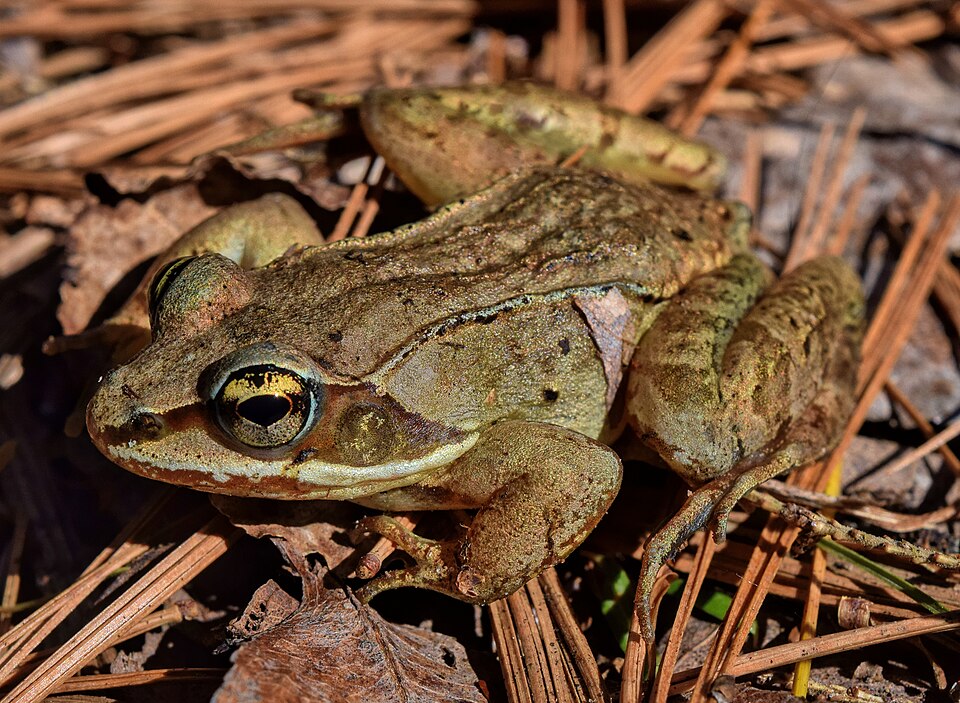
Wood frogs’ small size and camouflaged coloring can make them hard to see against the leaf litter. Photo by The Cosmonaut, CC by-SA 2.5 SA.
Listen:
In spring frozen wood frogs start thawing from the inside out. To survive winter, these tiny frogs have adapted to freeze nearly solid. At this time, the freezing part of the wood frog’s life cycle is generally well understood but not so much about what triggers the tiny frog’s heart to start back up again, initiating the thawing process. Puzzled (and perhaps slightly envious), I assume the frog doesn’t ponder whether or not to “re-start” its heart; it happens or it does not. The National Park Service designated the wood frog a “biological miracle” for this adaptation, stating, “First the heart starts beating. Then the brain activates. Finally, the legs move. Nobody yet understands what starts the wood frog’s heart after being frozen and inert for the entire northern winter.”
Two seemingly contradictory but paired adaptations appear to be simultaneously preparing the wood frog to withstand overwintering nestled away out of sight within frozen layers of mud, duff, and snow. One enables internal body cavities, including those in and around organs and blood vessels, to freeze solid without noticeable damage after thawing. This is possibly due to the formation of “flat” ice crystals instead of “spiky” ones in these areas. The other adaptation sends a signal to the liver to start making massive amounts of glucose, which acts as a cryoprotectant, keeping cells from freezing or being destroyed by sharp ice crystals and dehydration. One study found that the frog’s relative glucose level increases as high as 450 times that of a human’s. Eventually, most of the water is transported out of the frog’s cells as they are pumped full of the sugary substance. These winterization processes are likely initiated when specialized skin cells sense the onset of freezing temperatures, and may be complete in just a few hours.
The more difficult-to-see “reversal” adaptations to start thawing and reanimate—including what seems to be a self-resuscitation of sorts—are less understood but equally critical. Without these unseen reversal adaptations, the life-preserving freezing adaptations would be irrelevant. Even without being able to “see” these adaptations happening, spotting the first wood frog each spring year over year still evokes a childlike awe. I briefly pause to marvel at how profoundly well adapted they are to this particular place and time near my home in south-central Alaska.
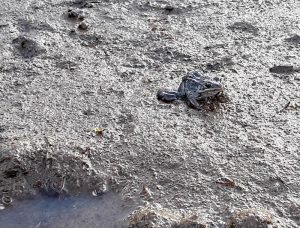
A wood frog well camouflaged against the mud. Photo by Janet Sweeney.
Well camouflaged and relatively small, wood frogs can be easily overlooked after emerging from their winter nests despite being the most widespread and abundant amphibian in Alaska. Nose to tail, adults typically range in length from 1.5 to 3.25 inches. Sitting motionless surrounded by freeze-dried duff, the wood frog’s coloration and texture allow it to blend in with various shades of tan, brown, and black. Distinct dark facial markings, a solid cream underbelly, and its ability to overwinter on land distinguish the wood frog from Alaska’s other frog, the Columbia spotted frog, which is currently found only in the southeast portion of the state. Curiously and conversely, the Columbia spotted frog is Montana’s most abundant frog species, yet is only found in Western Montana.
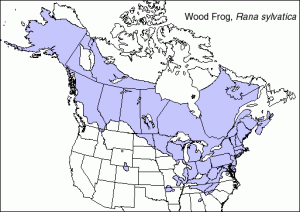
Wood frogs have a vast range, but are found in just two small, separate places in the western U.S. USGS image, public domain.
The vast contiguous range of the wood frog spans from Alaska and Canada through the mid- and eastern United States, and as far south as Georgia. Hopping completely over Montana and down to the neighboring states of Wyoming and Colorado, two relict populations of wood frogs exist in geographic isolation, two small spots on the map completely separated from the rest. Is it possible these two relict populations are clues? Did wood frogs once inhabit an even broader or southern range that possibly included parts of Montana?
Next spring when I spot the first wood frog of the season and pause, I will also welcome the possibility that there was once a last wood frog of southern Montana. What other clues, seen or unseen, might connect these awe-inspiring yet tiny amphibians to places and times both near and far?
Every week since 1991, Field Notes has inquired about Montana’s natural history. Field Notes are written by naturalists, students, and listeners about the puzzle-tree bark, eagle talons, woolly aphids, and giant puffballs of Western, Central and Southwestern Montana and aired weekly on Montana Public Radio.
Click here to read and listen to more Field Notes. Field Notes is available as a podcast! Subscribe on Apple Podcasts or wherever you listen to podcasts.
Interested in writing a Field Note? Contact Allison De Jong, Field Notes editor, at adejong [at] montananaturalist [dot] org or 406.327.0405.
Want to learn more about our programs as well as fun natural history facts and seasonal phenology? Sign up for our e-newsletter! You can also become a member and get discounts on our programs as well as free reciprocal admission to 300+ science centers in North America!