by Allison De Jong
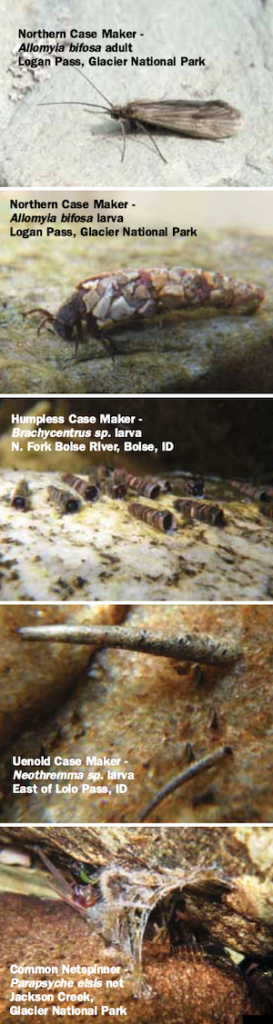
Photos © Jim Giersch.
Imagine you’re hiking along a trail in your favorite Montana mountains. It’s spring—there’s still snow beneath the Douglas-firs and the larches have not yet leafed out. You come to a rushing stream, but instead of immediately crossing the bridge to the other side, you walk down to the edge and touch your fingers to the icy cold water. If you reached in a little further, perhaps turned over a rock or two, you might just spot that amazing little aquatic insect, the caddisfly.
Caddisflies are insects of the order Trichoptera, which means “hairy wings,” so named for the minute hairs that cover the wings of the adult insects. Trichoptera encompasses 21 families and more than 1,400 species in North America, and is the largest insect order that is entirely aquatic—aquatic, that is, at the larval and pupal states (which together last anywhere from four months to two years), but terrestrial for their 30 or so days as adults. And, unlike any other aquatic insects, caddisfly larvae produce silk.
Like butterflies and moths, to which they are closely related, caddisfly larvae have silk glands in their lower lip, and it is their ability to produce a sticky silk that enables them to build for themselves the inch-long, tube-shaped shelters that have caused fly fishers to dub them “rock rollers.” Some of those shelters are portable cases, usually tapered tubes made of intricately-arranged grains of sand, small rocks, pieces of bark, or other plant material. Others are attached retreats, secured to underwater rocks or logs and made entirely of silk or of bits of rock, plant material, and other detritus held together with silk.
Their ability to build these portable or attached homes enables caddisflies to survive in a variety of aquatic environments. The largest number of caddisflies live in relatively small, cool streams, but they can also be found in larger, warmer rivers or even standing water. Those that live in swift-moving water use their cases as ballast; the weight of the case keeps them from being borne away by the current, yet is light enough to keep them buoyant. Those that build attached retreats find quieter eddies or sheltered areas in the stream where their fragile homes won’t be easily torn away. And whether they live in homes of sand or bark or silk, the larvae are constantly exposed to a regular flow of fresh, oxygenated water. Even in slow-moving or still water, the larvae can wiggle inside their cases, creating their own tiny currents—and a fresh supply of oxygen.
Despite their protective cases, however, caddisflies do get eaten, and are, indeed, an important food source for trout, other fish, and various birds. Some species break down plant material into smaller pieces that can be eaten by even tinier creatures, while other species catch minute pieces of organic material in silk nets, eat them, and, in digesting them, produce larger pieces of organic material that can be eaten by other organisms. Whether the eater or the eaten, caddisflies have an important role to play in freshwater ecosystems.
So if you do happen to glimpse a crawling tube of pebbles or a tangled silky net of leaf bits clinging to a rock in a mountain stream, take a closer look and see if you can find the little larva inside…and don’t forget to return the rocks gently to the way you found them.
Caddisfly Silk Biomimicry
Unlike spiders and butterflies and silk worms, caddisflies spin their silk underwater, where it is not only sticky but is able to stick to a surprising number of objects, from rocks to leaves to bark. Some caddisflies have even used glass beads and flakes of gold as case-building materials. This quality is quite remarkable when you consider the difficulty of, say, getting a band-aid to adhere to wet skin. Researchers at the University of Utah have identified the chemical and structural makeup of the Trichoptera silk, with hopes to replicate it and create adhesive tape that could be used during surgical procedures. To read more, go to archive.unews.utah.edu/news_releases/glue-fly-glue/.
This article was originally published in the Spring/Summer 2012 issue of Montana Naturalist magazine, and may not be reproduced in part or in whole without the written consent of the Montana Natural History Center. ©2012 The Montana Natural History Center.
Click here to read more articles from Montana Naturalist magazine.
Want to learn more about our programs? Sign up for our e-newsletter! You can also become a member and get discounts on our programs as well as free reciprocal admission to 300+ science centers in North America!