I Saw the Earth Breathe
by Marian McKenna
Broadcast 4.1 & 4.4.2026
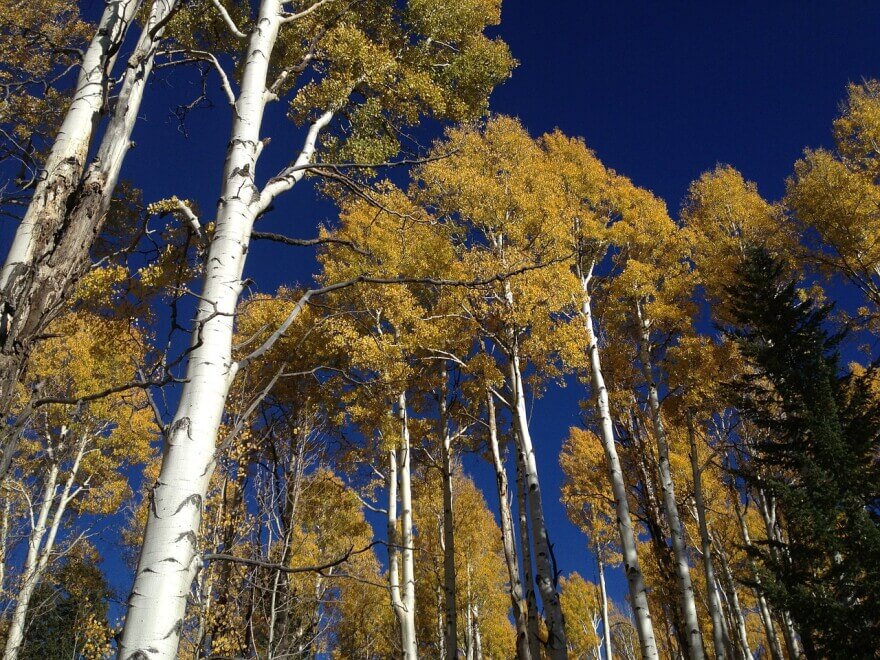
Aspen grove. Public domain image.
Listen:
It was a soft autumn day. The breeze was soft and fragrant, the ground was soft with golden fallen leaves, the sun was soft on my skin. Ralph, my husband, and I were at our ranch near Ovando, Montana, in the Blackfoot Valley. Since it was such a clear, cloudless day, we decided to go up to check the culvert filtering the spring from which our drinking water comes. It was a good hike across the front pasture, through the aspen grove where the horses would go to find shade, and over the hill to the back pasture.
I decided that I wanted to slow down and take in the day, so I did not go up to the culvert with Ralph. Instead, I sat down under the aspen trees, enjoying their fragrance and wealth of leaves all around me. I leaned back against a tree, slouched down into a comfortable, cushioned position. I entered a meditative state, soothed by the gentle day and comfortable lounge chair I had discovered in the leaves. I lay there for quite a while with a quiet mind.
As I was about to stand up, I saw or felt a slow movement on the surface of the earth. This movement, a very gentle lifting, carried all the way to the horizon. I stayed rock still. Was I feeling or seeing this phenomenon? Nothing on the surface of the earth moved. It was a very infinitesimal lifting as if the earth was expanding with breath, contracting in a sigh. In that moment, I had no understanding of what I was seeing and feeling. Was it even real?
Telling a colleague about this experience, she shared with me that the scientific community discovered what they are calling a “26-second pulse” in the early 1960’s. I was thrilled and determined to learn more about this phenomenon. In 1960, geologist Dr. Jack Oliver first noted the pulse, a slight but regular tremor of the earth’s crust that seemed to be originating near the equator, specifically the Gulf of Guinea. It wasn’t until 2005, when scientists had sophisticated seismometers that they located what they believe to be the origin of the mysterious pulse. They determined it was in the equatorial Atlantic Ocean, near the Bight of Bonny off the west-central African coast where Africa’s coastline shifts from north-south to east-west. So, they had a point of origin, but still no explanation of what caused it. There is still no concrete explanation for the cause of this pulse, which happens at regular, 26-second intervals.
Scientists do have preliminary theories. One explanation holds that the pulse is generated by the strength of deep, powerful ocean waves crashing into the African tectonic plate just beneath the Bight of Bonny. In this plate, there is a 1000-mile-long rift known as the Cameroon line. There is a chain of volcanoes along this rift, known as hot spots, that cause structural weakness in the plate which allows magma to rise to the surface. Another explanation is that the pulse is created by actual volcanic activity, rather than deep waves.
But neither theory can explain its regularity. Scientists and funding agencies have just not felt enough urgency to undertake further investigations of these 26-second pulses. Funding is very scarce for science that does not investigate phenomena that directly affect climate or human populations. Therefore, though we know it exists, and that it comes from equatorial Africa, the cause of this phenomenon remains unknown.
I think I like the idea that we don’t exactly know what is causing this pulse that can be located and recorded. I don’t even know if this mysterious pulse is what I experienced. For me, the earth was breathing that day as I lay in the aspen grove. It’s enough. I shared a moment with the living, breathing earth.
Every week since 1991, Field Notes has inquired about Montana’s natural history. Field Notes are written by naturalists, students, and listeners about the puzzle-tree bark, eagle talons, woolly aphids, and giant puffballs of Western, Central and Southwestern Montana and aired weekly on Montana Public Radio.
Click here to read and listen to more Field Notes. Field Notes is available as a podcast! Subscribe on Apple Podcasts or wherever you listen to podcasts.
Interested in writing a Field Note? Contact Allison De Jong, Field Notes editor, at adejong [at] montananaturalist [dot] org or 406.327.0405.
Want to learn more about our programs as well as fun natural history facts and seasonal phenology? Sign up for our e-newsletter! You can also become a member and get discounts on our programs as well as free reciprocal admission to 300+ science centers in North America!