Shimmers of Courage and Grace: Black-Chinned Hummingbirds
By Dawn Gelderloos
Broadcast 6.4 & 6.7.2025
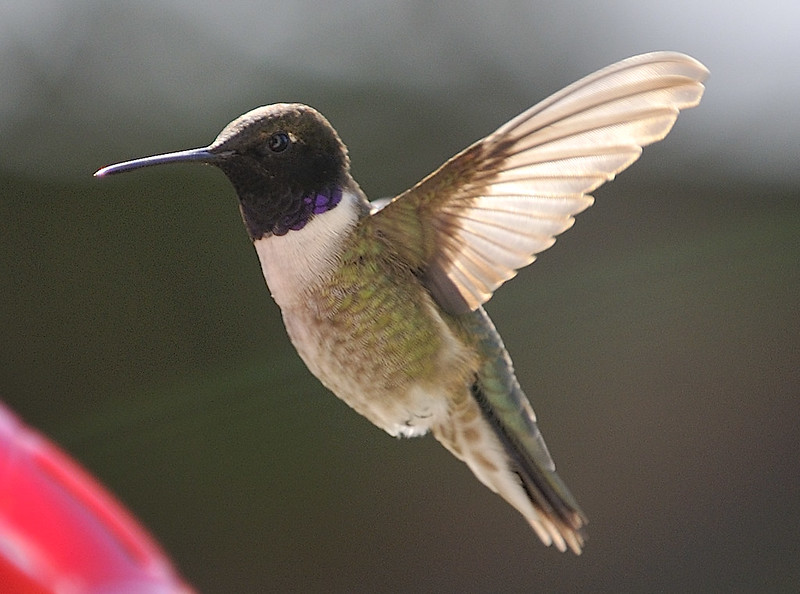
Male Black-chinned Hummingbird. Photo by Peter Baer, CC BY-NC-SA 2.0.
Listen:
On a clear June morning, I made for the pine bench on our land near Stoney Creek, just west of Missoula. Spring had arrived and the creek rippled with life. Songbirds chirped, in a cadence of their own, and mingled with the snowberry bushes, willow and hawthorn along the shaded banks. I leaned my head back. Seventy-foot ponderosa pines, fir, and larch reached skyward. Cottonwood, birch, and willow trees leaned even closer to the creek. Giant and earthbound, the conifers whispered, “Look up.”
There in the trees, a flash of something dark and light darted across the sky and landed on an exposed tree branch. I grabbed my binoculars and caught a glimpse. It was the size of my car key.
No sooner had I focused, when it dashed from the branch, swerved upward nearly 20 feet, plunged down the same distance and then rose again. This tiny powerhouse hummed like a tire crossing the rumble strips on a highway. I held my breath and listened—a steady and deep vibrato hung in the air. And then it was gone, leaving behind the quiet sky. I craned my neck and waited for this spry caller to return to the same perch. This time, I caught some details—a slender black face and chin, a shimmer of purple around its throat, metallic dark green on its back and sides, and a hint of gray-white underneath. A Black-chinned Hummingbird. My first sighting along Stoney Creek.
This was the male, of course, a tiny acrobat known to perform diving displays, sometimes plunging sixty to eighty feet during courtship or when defending his territory. His buzzing trill is produced by rapid wing beats and air movement through the feathers. While I didn’t see another male or a female nearby, I imagined they were close. Black-chinned hummers have other calls too, high-pitched chirps commonly heard from both males and females. In contrast to the darker males, females and immature males have a whitish throat and underbelly, a muted metallic green color along the flanks and white tips on their outer tail feathers.
The black-chinned is a mere 3 ½ inches long, with a slender straight beak, and weighs an eighth of an ounce, as light as a few paperclips or even a dime. One of the smallest migratory bird species, Black-chinned Hummingbirds can fly over 30 miles per hour and travel solo, up to 500 miles at a time, between their seasonal homes—south in the winter to Texas and western Mexico, and back to parts north, like Montana, in the spring and summer.
Each year, the arrival of hummingbirds renews my sense of awe. These iridescent wonders feed on swarms of tiny insects and find nectar in flowering plants and shrubs.
It seems fitting, with their profusion of color, that a flock is called a bouquet, a shimmer, and even a tune. Near the creek they feed on a vibrant palette of serviceberry, golden currant, scarlet beebalm, Oregon grape. Here they also find cover and even raise their young in a nest no bigger than the size of a golf ball, made from plant down, grasses, and spider webs. Spider silk is highly elastic which allows the nest to expand as the young grow.
In the spring and summer, the black-chinned female lays two eggs, each the size of a coffee bean. She incubates them on her own, and the eggs hatch in about two weeks. Only about one-quarter inch long at birth, these fledglings grow quickly and leave the nest after only 21 days.
In some cultures, hummingbirds are a symbol of love, joy, and peace, the bearers of good fortune. In others they are symbols of endurance and strength. From my bench near Stoney Creek, these tiny warriors, with their unique plumage, rapid flight and agility, and resilience are shimmers of courage and grace found in our Montana landscape.
Every week since 1991, Field Notes has inquired about Montana’s natural history. Field Notes are written by naturalists, students, and listeners about the puzzle-tree bark, eagle talons, woolly aphids, and giant puffballs of Western, Central and Southwestern Montana and aired weekly on Montana Public Radio.
Click here to read and listen to more Field Notes. Field Notes is available as a podcast! Subscribe on Apple Podcasts or wherever you listen to podcasts.
Interested in writing a Field Note? Contact Allison De Jong, Field Notes editor, at adejong [at] montananaturalist [dot] org or 406.327.0405.
Want to learn more about our programs as well as fun natural history facts and seasonal phenology? Sign up for our e-newsletter! You can also become a member and get discounts on our programs as well as free reciprocal admission to 300+ science centers in North America!