A Bee’s Guide to Overwintering
By Mariella Bodemeier Loayza Careaga
Broadcast 12.24 & 12.27.2025
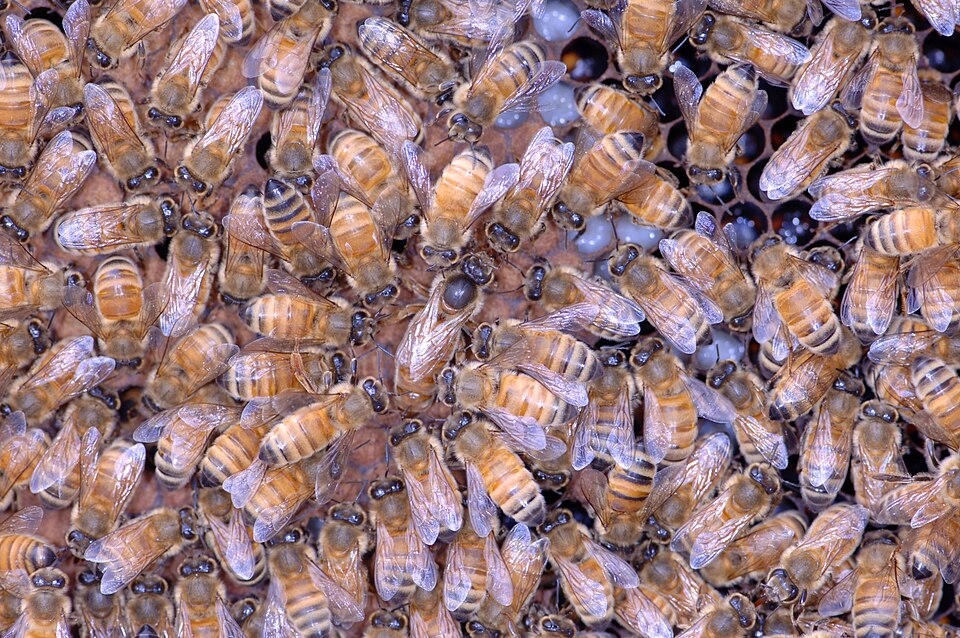
European honeybee (Apis mellifera) workers clustered round their queen. Photo by Denis Anderson, CSIRO, CC 3.0.
Listen:
Winter in Montana is not for the faint of heart—and that goes for wildlife, too. While we cover ourselves in layers of clothing and stay cozy in our homes, some animals use their fluffy feathers or fur for insulation. Others hibernate or even migrate to warmer places, leaving the frigid winds and snow behind.
It’s clear that big mammals and birds have some of the coolest and perhaps most straightforward strategies to overwinter; yet these haven’t surprised me as much as the strategies that bees may use when it’s too cold outside.
Like many insects, bees are pros in keeping themselves protected from colder temperatures. In terms of heat production, bees can be like us and generate their own heat. When they are not actively producing heat, bees behave like lizards and rely on an environmental heat source to warm their bodies.
At the individual level, a bee produces heat using the powerful flight muscles located on its thorax, the middle section of a bee’s body. When a bee needs to warm itself, it vibrates these flight muscles without moving its wings, similar to shivering.
Bees need to keep their thoraxes warm, so reducing heat loss to other body parts is important. The abdomen, the striped, soft rear segment of the bee’s body, contains many of its organs and draws most of the heat from the thorax. To prevent heat loss to the abdomen, bees use a unique feature of their circulatory system: a series of loops in their waist that connect the thorax to the abdomen. By directing their warm, blood-like fluid, called hemolymph, from the thorax through these loops before it reaches the abdomen, bees slow down the exchange of heat between the two body parts.
For honey bees, which are well-known for living in highly organized societies, there is also the need to keep the colony temperature stable. This is particularly important when there is brood—the eggs, larvae, and pupae of developing bees—in the colony, as drops in temperature impair brood development and may compromise how well the colony works and grows.
To avoid significant changes in the colony temperature, honey bees engage in clustering behavior, that is, worker bees huddle together around the queen, forming a disk of bees that works as a living furnace.
Bee experts have uncovered some amazing facts about cluster formation by studying honey bees living in hives. This work has shown, for instance, that the bee winter cluster is not uniform, and it is made up of two distinct regions: the mantle, which is an insulating layer comprised of rows of tightly packed bees, and the core, which is a less densely packed region where bees can move around and perform tasks such as feeding.
Additionally, not all worker honey bees shiver their flight muscles to produce heat in a winter cluster. Producing heat is costly, and if all worker bees did it, they would probably run out of honey before winter ends. To balance the need to produce heat with the colony resources, some bees shiver to generate heat, while others contribute to the colony thermal regulation through their resting metabolism, which produces small amounts of heat. These bees also act as passive insulators, using the downy fleece on their bodies to help trap warm air in the cluster.
From shivering to anatomical tweaks to clustering behavior, bees certainly have some of the coolest—or should I say warmest?—behavioral and physiological adaptations for surviving when it is too cold outside. Next time I see a bee, I’ll remember that, despite their tiny size, they are pros at overwintering, much like some furry mammals and feathered birds.
Every week since 1991, Field Notes has inquired about Montana’s natural history. Field Notes are written by naturalists, students, and listeners about the puzzle-tree bark, eagle talons, woolly aphids, and giant puffballs of Western, Central and Southwestern Montana and aired weekly on Montana Public Radio.
Click here to read and listen to more Field Notes. Field Notes is available as a podcast! Subscribe on Apple Podcasts or wherever you listen to podcasts.
Interested in writing a Field Note? Contact Allison De Jong, Field Notes editor, at adejong [at] montananaturalist [dot] org or 406.327.0405.
Want to learn more about our programs as well as fun natural history facts and seasonal phenology? Sign up for our e-newsletter! You can also become a member and get discounts on our programs as well as free reciprocal admission to 300+ science centers in North America!