Meeting My Neighbor
By Aimee Hurt
Broadcast 4.8 & 4.11.2026
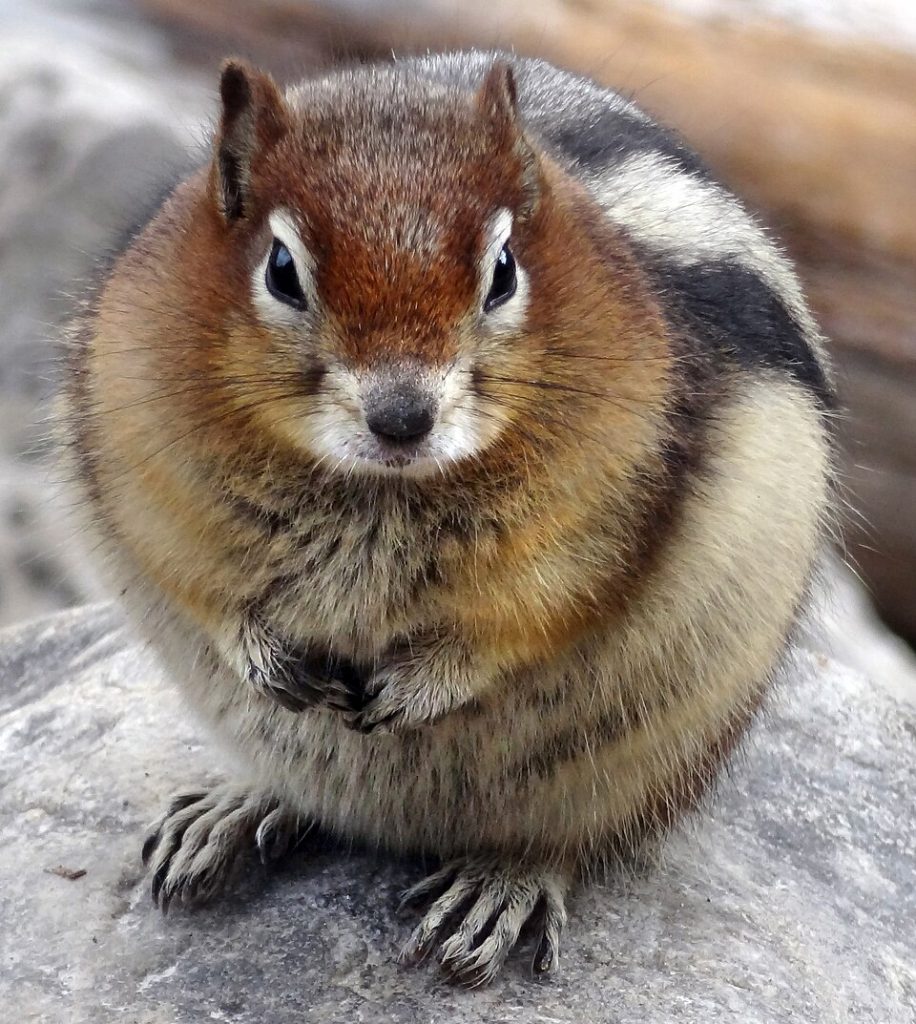
Golden-mantled ground squirrel, looking particularly chonky. Photo by WikiPedant, CC BY-SA 4.0
Listen:
Warm spring day in the Potomac Valley, I’m sitting on my patio in a ray of sun. After the relative stillness of winter I’m noticing the activity of spring. I let my eyes go lazy and don’t focus on anything in particular so that small bits of activity catch my attention. I notice a huge, fat, relatively slow “chipmunk” emerging from the stacks of wood and onto the splitting stump alongside my woodshed. I marvel at its immensity. And though its plush coat looks shiny and thick, it moves slowly, not the hurky-jerky sprints I’m used to seeing. And then it “sploots” onto the stump, a belly flop with legs akimbo, creating maximum exposure to the warm sun. This posture of seeming resignation and this creature’s relative lethargy make me briefly wonder if it’s healthy.
Then, from the opposite side of the woodshed, emerges another chipmunk. It takes a few quick steps, almost too fast for me to see, until it stops for a second to strike a pose, look around, then take off again. It scales the woodpile in this staccato way until it, too, rests for a minute in the sun, just a dozen logs away from its portly neighbor. And seeing them side by side, I feel myself begin to smile. The first animal isn’t a sickly, plump chipmunk. It’s a different creature altogether and I’m about to learn something new today.
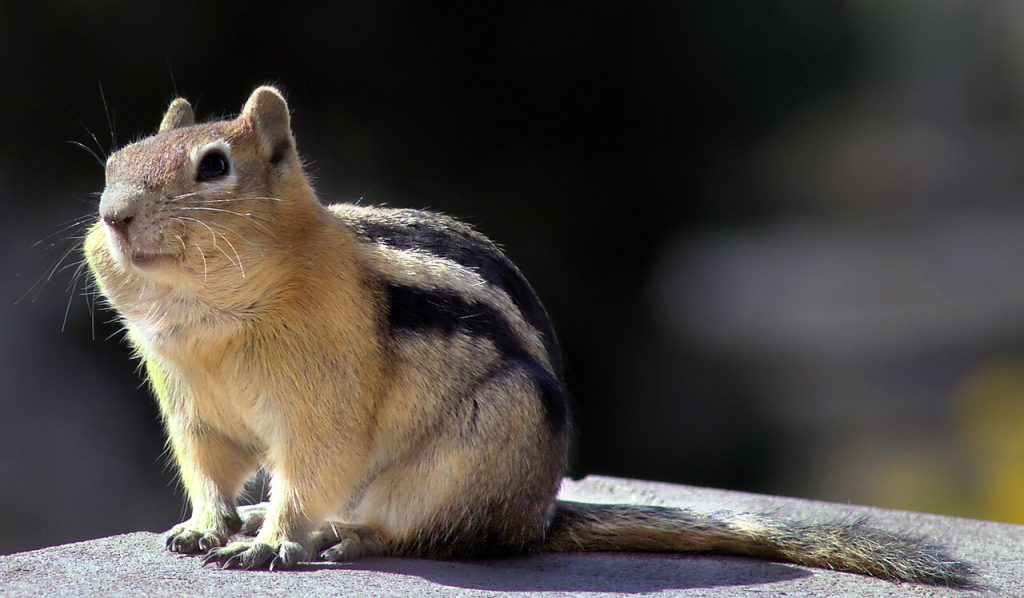
Golden-mantled ground squirrel. Photo by Zachary S.L. Foster, CC BY-SA 4.0.
Grabbing my binoculars, I look at the rotund critter: striped, yes, but only along its body; one creamy-white stripe captured like an Oreo cookie by two black stripes. Its face is tawny and devoid of stripes, with only an ivory ring of eyeliner. From the back of the ears along its neck and down over the shoulders is a buttery bronze which gives this critter its name: golden-mantled ground squirrel.
Ground squirrels are part of the Sciuridae family, which includes chipmunks as well as tree squirrels, prairie dogs, marmots, and flying squirrels. Montana is home to six species of ground squirrels. At 9 to almost 12 inches in length, the golden-mantleds are several inches longer than the yellow-pine chipmunks I first confused them with. Also, much weightier—two to five yellow-pine chipmunks would have to climb aboard a seesaw to balance a typical golden-mantled ground squirrel sitting opposite. But the dead giveaway? Ground squirrels have no facial stripes—whereas all chipmunks do.
My woodshed acts as a protective entryway to their burrow, which are typically less than a foot underground, but may extend up to 100 feet in length. Golden-mantled adults are solitary, getting together only briefly to mate. The female—distinguished by a paler, less extensive golden mantle than males—solely rears the young, called kits. Averaging five in a litter each spring, the kits grow agile running among piles of wood and playing a rough and tumble form of chase and wrestle, learning to sniff out underground fungi to eat as well as seeds and pine nuts, the latter helping to sustain their long hibernation from about September to April. But they aren’t picky eaters, and will even opportunistically eat a chipmunk that’s gotten itself trapped.
Usually, golden-mantleds are good neighbors. When there’s a predator afoot (or a-wing) they will call in alarm. These calls are heeded by other golden-mantleds, of course, but research has shown that other species will “eavesdrop” on these alarms; nearby yellow-bellied marmots, pika, and even mule deer also heed their warning! In my own wooded meadow I’ve seen chipmunks head for cover at the sound of the golden-mantled’s warning.
Golden-mantleds live up to seven years in the wild, so it may be the same female who has reared many generations in my woodshed. I now appreciate her plumpness as evidence of fine fettle, and I won’t confuse her for a chipmunk again. She and her family have become some of my favorite neighbors, whom I now know by name.
Every week since 1991, Field Notes has inquired about Montana’s natural history. Field Notes are written by naturalists, students, and listeners about the puzzle-tree bark, eagle talons, woolly aphids, and giant puffballs of Western, Central and Southwestern Montana and aired weekly on Montana Public Radio.
Click here to read and listen to more Field Notes. Field Notes is available as a podcast! Subscribe on Apple Podcasts or wherever you listen to podcasts.
Interested in writing a Field Note? Contact Allison De Jong, Field Notes editor, at adejong [at] montananaturalist [dot] org or 406.327.0405.
Want to learn more about our programs as well as fun natural history facts and seasonal phenology? Sign up for our e-newsletter! You can also become a member and get discounts on our programs as well as free reciprocal admission to 300+ science centers in North America!