Montana’s Stay-at-Home Beauty, the Mourning Cloak Butterfly
By Mary Ann Reuter
Broadcast 5.7 & 5.10.2025
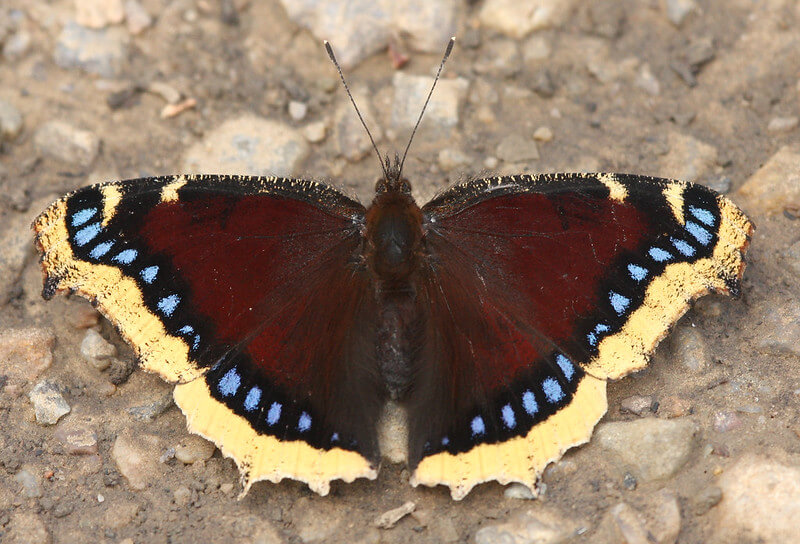
The mourning cloak, Montana’s state butterfly. Photo by J. N. Stuart (CC-BY-NC-ND-2.0).
Listen:
“There is nothing like staying at home for real comfort.” – Jane Austen
Ah, the first hint of spring, filled with sweet robin song and noisy mallard coupling, and then a playful fluttering of dark maroon, almost black wings overhead catches my eye. Then it’s gone. Was that…? Did I just imagine it? Or was that tiny tease the first butterfly after a long Montana winter?
Like many a late-coming amateur naturalist, I have been following the fate of the monarch, that charismatic darling of the butterfly world. Its numbers are dwindling due to habitat loss, climate change, pesticides, and herbicides that kill its necessary food source, milkweed. Because it’s a long-distance migrant, it must rely on international cooperation for a comeback.
But more recently, I learned about an equally beautiful but less flashy, more abundant butterfly that appears almost spontaneously as the last winter snow melts. The modest mourning cloak, with its solemn velvet robe rimmed in a soft yellow petticoat and dusty blue dots, has been here all along, cozied up under a blanket of fallen leaves or tucked into the warm crevices of tree bark.
As a non-migrating homebody, the mourning cloak avoids the dangers of international travel. One of the few butterfly species that overwinters as an adult, this ordinary beauty emerges to warm itself in the native sun rather than joining the masses huddled on foreign trees like tourists packed on a crowded beach. This lack of strenuous flight over many weeks may contribute to its longevity. The stay-at-home mourning cloak is among the longest-lived of butterflies, often aging gracefully for 10 to 12 months.
Unlike the celebrity monarch, mourning cloaks are common – and not threatened – in most of North America. Since they emerge in spring fully grown and radiant, like Venus from the sea, the adults don’t waste time in other developmental stages like eggs or cocoons. No, they get right to work, eating sap from trees, drinking from muddy puddles and…mating. No need to wait for the flowers to bloom.
As non-pollinators, mourning cloaks prefer common deciduous trees like willow, cottonwood, hawthorn, and elm to colorful blossoms. This is where the female lays her eggs so the hungry caterpillars that hatch can feast on the leaves. It gives the males a place to perch while they watch for passing females to woo. Trees also provide camouflage for these clever butterflies when they close their wings tight and play dead, as the underside of their magnificent cloak is brown and mottled-looking like bark.
The mourning cloak’s easygoing adult offspring take a relaxing break during the hottest and driest parts of the summer, entering a sleepy, siesta state of dormancy. Later these not-so-ordinary beauties will repeat their parents’ cycle of winter hibernation, warmed by increased alcohol levels in their blood (don’t try this at home). The butterfly’s unique metabolism also creates a gooey, gelatin-like substance that prevents their bodies from freezing as they slumber under the covers.
Which reminds me of the antifreeze we put in our cars to weather the cold Montana winter. In fact, many of the characteristics of the hardy, adaptable mourning cloak butterfly remind me of Montanans. Instead of fleeing south for warmer climates, we hunker down and accept the snow, emerging revitalized and ready to seize the first breezy spring day. It’s no mistake that the mourning cloak is the state butterfly of Montana.
While the regal, but fair-weather monarch is the butterfly mascot for neighboring Idaho – and six other states as diverse as Alabama, Illinois, and Vermont – only Montana claims the humble mourning cloak as its own symbol of transformation, renewal, and new beginnings. Like our practical winged beauty, we embrace the familiar comfort of a good staycation. Because, as the saying goes, “there’s no place like home.”
Every week since 1991, Field Notes has inquired about Montana’s natural history. Field Notes are written by naturalists, students, and listeners about the puzzle-tree bark, eagle talons, woolly aphids, and giant puffballs of Western, Central and Southwestern Montana and aired weekly on Montana Public Radio.
Click here to read and listen to more Field Notes. Field Notes is available as a podcast! Subscribe on Apple Podcasts or wherever you listen to podcasts.
Interested in writing a Field Note? Contact Allison De Jong, Field Notes editor, at adejong [at] montananaturalist [dot] org or 406.327.0405.
Want to learn more about our programs as well as fun natural history facts and seasonal phenology? Sign up for our e-newsletter! You can also become a member and get discounts on our programs as well as free reciprocal admission to 300+ science centers in North America!