The Last of the Ents: Listening to the Ancient Silence of the Cedars
By Morgan McNeill
Broadcast 1.29 & 2.1.2025
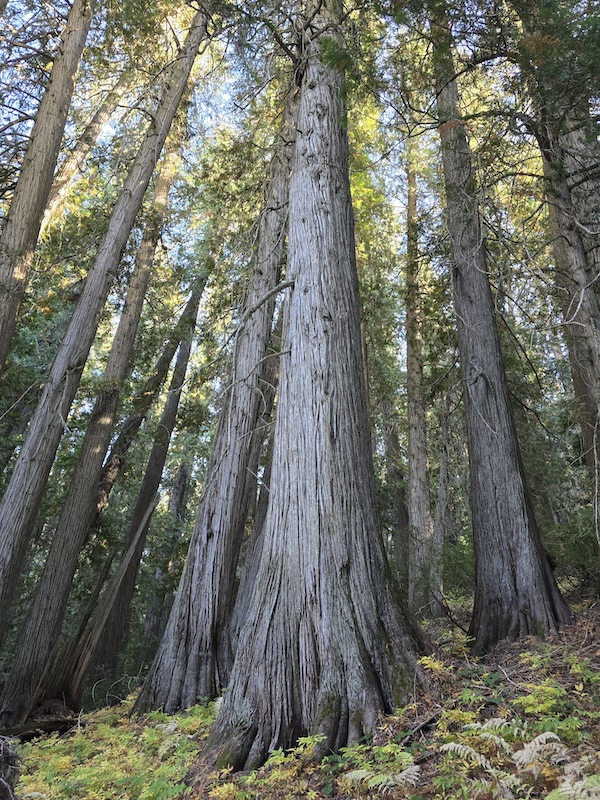
Perkins Cedar Grove at Morris Creek. Photo © Morgan McNeill.
Listen:
The late fall sunshine warms the interior of the truck as my sister and I drive up a winding Forest Service road. We carefully watch for a small sign tucked off to the side, the only indication that there’s something special here. The road has branched several times and we continue to climb. Did we miss it? No, it’s gotta be just up ahead after this switchback…or after this next one. We laugh and continue driving. We’re on an adventure. Suddenly, there it is. A wooden sign with white lettering and a small turnout that’s just big enough for us to pull off the road and park.
A worn trail covered in moss and leaves muffles our steps as we begin our journey. I breathe deeply, the smell of damp earth and decay soaking into my bones, and pause to listen to the life around me. It’s quiet here. This silence feels thick with secrets waiting to be told; we’re stepping into another world, another time. I look ahead and there they are. Towering, ancient beings from a time long past. Shepherds of the forest. Giant western redcedar. Or as I like to think of them: Ents.
I first learned about Ents when I was six, sitting next to my dad on the couch before bedtime, as he read The Lord of the Rings by J.R.R. Tolkien to my sister and me. The Ents were ancient, tree-like beings that watched over the forests of Middle-Earth.
I watch my sister as she climbs up the hillside in front of me, small beneath the giant trees. She’s visited this stand before and I ask her if it’s always this quiet here. Yes, always. You see, Ents, and redcedar, are never hasty. Time passes much more slowly for them than it does for us humans. This particular stand has been here for over 500 years and could be here for another thousand or more…
Long lines of grey bark run in continuous strips and draw our gaze up and up into the soft greens of the canopy some 230 feet above. Graceful branches sweep outwards to end in flat spans of soft, young leaves. Evergreen, only the old leaves near the trunk fall to the ground, a deep russet brown, providing a cushion beneath our feet and a spicy scent on the breeze.
I lean over and touch the stringy bark, rough and soft at the same time, and I begin to hear the lilting music of water. Through a gap in the roots of the tree, I can see the sparkle of a small stream dipping down into the earth. The lifeblood of this ancient stand: water. Redcedar require up to 28 inches of annual rainfall and thrive in the cool, wet climates of temperate forests. I follow the stream as it flows down the hillside, almost hidden by the multitude of ferns covering the understory. Their leaves have faded to a pale yellow and they begin to glow in the last rays of light as the sun sets behind us.
The weight of the silence grows as I begin to understand: these beings may be the last of their kind. The world is changing. Our climate is warming, and wildfires claim more of our wild places each year. I grope for reassurance. They’ve lived for centuries, overcoming periods of drought and change before… I look over to my sister as she gazes upward and I hear the thrumming voice of the Ents echo in my memory. “Do not be hasty.” I breathe deeply again. That is the magic of these deep places: the silence here allows us to witness the passage of time, while bringing our present into sharp focus. I catch up to my sister on the trail. We’re no longer sitting on our childhood couch listening to the words of the Ents; we’re walking amongst them.
Every week since 1991, Field Notes has inquired about Montana’s natural history. Field Notes are written by naturalists, students, and listeners about the puzzle-tree bark, eagle talons, woolly aphids, and giant puffballs of Western, Central and Southwestern Montana and aired weekly on Montana Public Radio.
Click here to read and listen to more Field Notes. Field Notes is available as a podcast! Subscribe on Apple Podcasts or wherever you listen to podcasts.
Interested in writing a Field Note? Contact Allison De Jong, Field Notes editor, at adejong [at] montananaturalist [dot] org or 406.327.0405.
Want to learn more about our programs as well as fun natural history facts and seasonal phenology? Sign up for our e-newsletter! You can also become a member and get discounts on our programs as well as free reciprocal admission to 300+ science centers in North America!