The Pileated Woodpecker: Red-Headed Wonder
By Dawn Gelderloos
Broadcast 1.21 & 1.24.2026
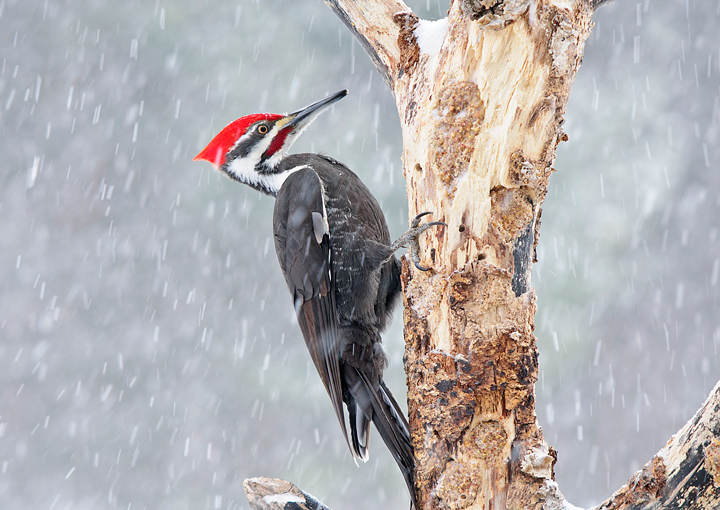
A male Pileated Woodpecker is a bright splash of color on a winter day. Photo by Khushie Singh, CC BY-SA 4.0.
Listen:
Winter leaves its mark here in the Ninemile Valley, just northwest of Missoula. Fields and pastures, now covered in patches of ice and snow, stand quiet and still. Forests of pine, fir, and larch, empty of sound and song, seem to reach to the light and wait.
I feel as if I’m waiting too. Waiting for signs of life in the trees and the sky, waiting for something to change, to lighten my heart, on these short and cold days.
On an afternoon walk, a loud and rhythmic drumbeat, a rat-a-tat-tat, breaks the stillness and echoes through the trees. It starts and stops and is followed by a high-pitched call. Perched high above on the branch of a decaying ponderosa pine, the brilliant red head of a Pileated Woodpecker bobs back and forth as he uses his long, chisel-like beak to drill into the tree. He seems like a giant compared to the Downy and Hairy Woodpeckers that frequent our feeder in late spring. About the size of a crow, with a wingspan of nearly 30 inches, this boisterous bird becomes easier to spot as he drills holes into the fleshy pine bark. Small piles of woody debris accumulate at the base of the tree, a sign of his handiwork. He is on the hunt for his next meal, which lies hidden underneath the soft and crumbling tree bark.
Pileated Woodpeckers (Dryocopus pileatus) are year-round residents in Montana. It is so nice to meet a new neighbor, especially in winter. Often found in wooded or forested areas, with large decaying trees, they feast on carpenter ants, by far a favorite meal. Their long, sticky tongues lap up thousands each day. They also dine on beetles, and other insects and larvae that live in the woody material from standing and dead trees. Depending on the season, these birds will also feast on fruits, nuts, and berries.
North America’s largest woodpecker, the Pileated is known for its red crest and the bold white stripes on its head and neck. It can also be identified by its distinctive call and resonant “drumming” as it echoes through the forest. These rhythmic birds drum up to 20 times per second, which seems mind boggling. And yet, these mighty red heads don’t have to worry about boggling their own minds, or suffering concussions, like we do. Their skulls contain their own version of shock absorbers to protect them when they are striking a tree.
If you look closely at the trees where they’ve been, you’ll often see areas where the bark has been stripped away, as well as large rectangular holes often used for nesting. Each year the Pileated will create a new nesting cavity. They never use a nesting spot twice and the old nesting holes are often used by other birds and animals. And these red-crested wonders mate for life, defending their shared territory and working together to raise their young.
On this day, I watch the male. In addition to his brilliant red crown, he also has a distinctive red mustache-stripe on his cheek. Both males and females sport a showy red crest. In contrast, the female has a gray-black forecrown and no red mustache stripe. In flight, they both show off white underwings as they search for suitable trees to stop for a meal or start a home.
At this time of year, their persistent drumming feels like nature’s heartbeat, in an otherwise silent forest. It reminds me to stay present, to listen and watch. And on days when it appears there is nothing here in the woods, to simply breathe. Now in the cold, as the daylight fades, I catch a hint of red in a muted landscape. And then, distant drumming. I let it wash over me and suddenly feel grateful for what is beautiful and boisterous as winter settles in. I realize there is no need to wait after all.
Every week since 1991, Field Notes has inquired about Montana’s natural history. Field Notes are written by naturalists, students, and listeners about the puzzle-tree bark, eagle talons, woolly aphids, and giant puffballs of Western, Central and Southwestern Montana and aired weekly on Montana Public Radio.
Click here to read and listen to more Field Notes. Field Notes is available as a podcast! Subscribe on Apple Podcasts or wherever you listen to podcasts.
Interested in writing a Field Note? Contact Allison De Jong, Field Notes editor, at adejong [at] montananaturalist [dot] org or 406.327.0405.
Want to learn more about our programs as well as fun natural history facts and seasonal phenology? Sign up for our e-newsletter! You can also become a member and get discounts on our programs as well as free reciprocal admission to 300+ science centers in North America!