The Long Lives of “Short-Lived” Insects
By Brian Bush
Broadcast 1.28 & 1.31.2026
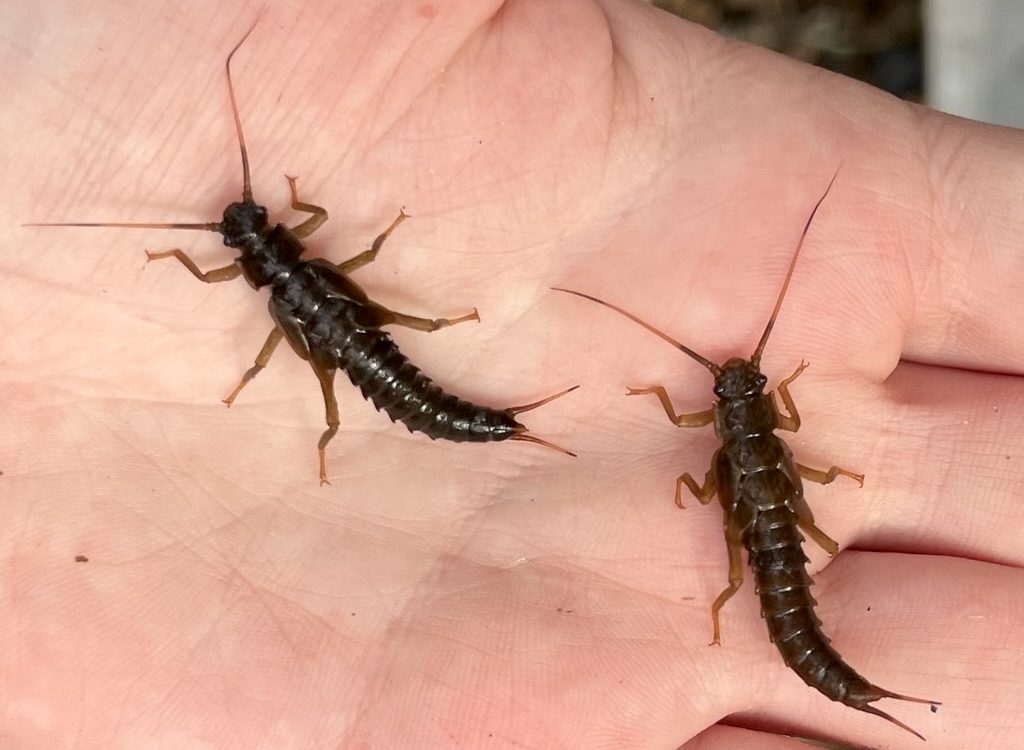
A couple of salmonfly larvae – longer-lived than you might think. Photo by Brian Bush.
Listen:
Slogging through a cold mountain stream is one of the best ways to experience Montana’s incredible biodiversity. From the sharp chatter of a Belted Kingfisher skimming the water’s surface to the sudden splash of an acrobatic trout, it’s easy to see how fresh water draws in creatures of every kind. But when winter settles in, most of us stop thinking about getting anywhere near a river—unless it’s frozen solid. Summer is when we grab our sandals, climb onto a raft, or cast a fly rod to enjoy the beauty of our mountain waterways. Yet even after the Canada Geese head south and the big streamside cottonwoods drop their leaves, life doesn’t disappear. In fact, there’s still an entire world teeming just beneath the surface.
In search of life on a dreary overcast December day, I grab my wading boots, pull on a pair of long dishwashing gloves, and head to a shallow riffle along Rattlesnake Creek. I’m out here to go hunting, not for elk or deer, but for something much more modest: bugs. The frigid, near-freezing water of the Rattlesnake might seem like the last place you’d expect to find biological activity, but flip a few cobbles in the fast-moving current and you might be surprised to see a jet-black, six-legged creature the size of a paperclip crawl across your hand.
These tiny creatures are known as aquatic insects (or “aquatic macroinvertebrates” by scientists) and are incredibly diverse, often with very unique life histories. Many of them, including the mayflies, stoneflies, and caddisflies familiar to anglers, spend most of their lives as larvae crawling along the stream bottom, only emerging during seasonal “hatches” to fly, mate, and lay eggs. But while these summer hatching events make them more visible when it’s warm, the old adage “out of sight, out of mind” fits well: people often give little thought to what the lives of these insects look like during the rest of the year.
A good example of this misconception comes from the scientific name for the mayfly order: Ephemeroptera, meaning “short-lived wings.” While the name refers to the fact that mayflies live only a few days as flying adults, typically just long enough to mate, lay eggs, and die, it can unintentionally reinforce the idea that these insects are fleeting or unimportant. In reality, many aquatic insects spend months developing beneath the water’s surface before emerging, and some, especially stoneflies, remain multiple years in their underwater larval stage.
This ecological concept of how long an insect takes to reach maturity, or, more specifically, how many broods a species produces in a year, is known as voltinism. These differences in voltinism are part of what makes finding aquatic insects in winter feel especially meaningful. Seeing a (relatively) large stonefly crawling through the water and knowing it was in this same stream at this same time last year gives me a deeper appreciation for these species. Society often thinks less of organisms with short life spans, perhaps because they seem so unlike us long-lived Homo sapiens. While that view is flawed on its own, it’s also completely overturned once you look underwater, where these insects invest months or even years growing before their brief adult lives.
So, listener, the next time you take a winter walk along the Clark Fork, I hope you pause for a moment to think about the aquatic insects patiently moving through the cold water beneath the surface. We may be holed up for the winter, but they’ve still got plenty of work to do.
Interested in learning more? Check out:
Macroinvertebrates.org
Stroud Water Research Center
Montana Salmonfly Research Group
The Salmonfly Project
Every week since 1991, Field Notes has inquired about Montana’s natural history. Field Notes are written by naturalists, students, and listeners about the puzzle-tree bark, eagle talons, woolly aphids, and giant puffballs of Western, Central and Southwestern Montana and aired weekly on Montana Public Radio.
Click here to read and listen to more Field Notes. Field Notes is available as a podcast! Subscribe on Apple Podcasts or wherever you listen to podcasts.
Interested in writing a Field Note? Contact Allison De Jong, Field Notes editor, at adejong [at] montananaturalist [dot] org or 406.327.0405.
Want to learn more about our programs as well as fun natural history facts and seasonal phenology? Sign up for our e-newsletter! You can also become a member and get discounts on our programs as well as free reciprocal admission to 300+ science centers in North America!