The Little Bacteria That Changed the World
By Mikaela Hoellrich
Broadcast 8.20 & 8.23.2025
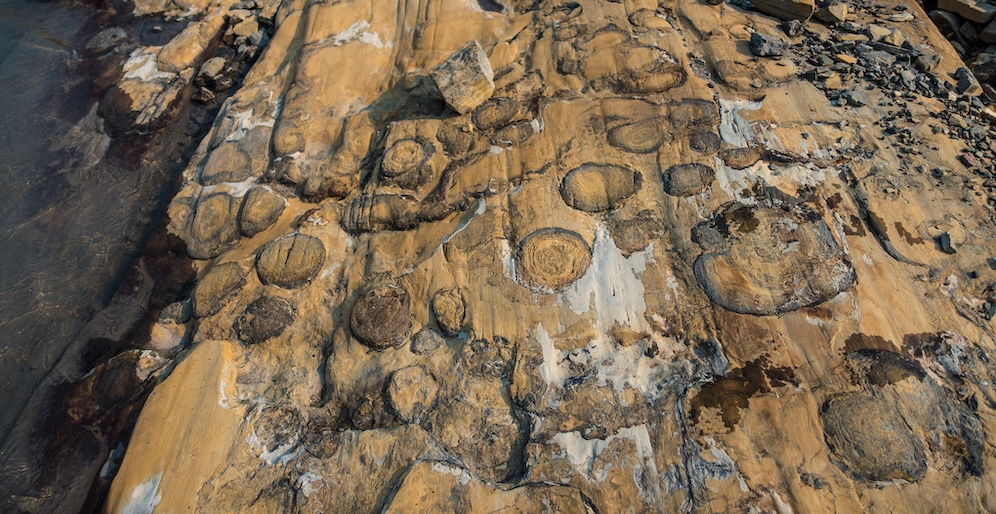
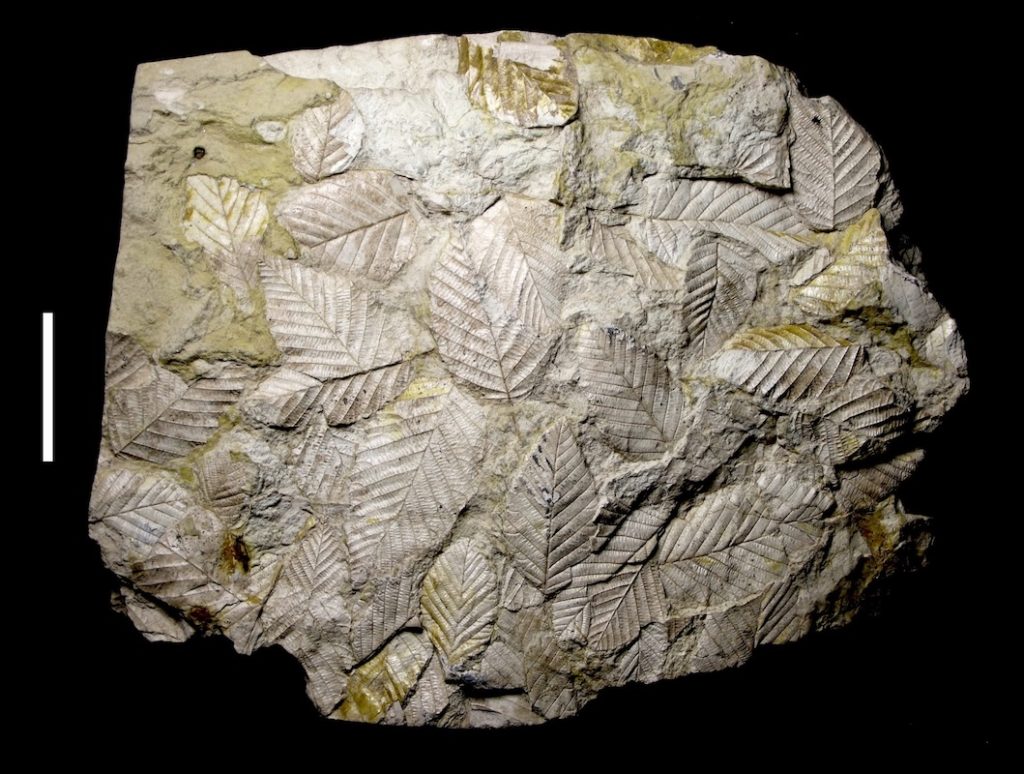
Stromatolites, or fossilized cyanobacterial mounds, near Grinnell Glacier in Glacier National Park. NPS photo, public domain.
Listen:
Imagine a rock outcrop. From the top you see dozens of strange rings embedded in the stone, some nearly two meters wide. It’s like someone’s stuck giant gobstoppers in the rock and cut the sheet in half revealing the concentric rings. From the side you can see a million intricate, wavering lines, like the fine lamination of a pastry. If you’ve been hiking in Glacier National Park maybe you’ve seen these odd rock formations.
These are stromatolites. Fossilized evidence of cyanobacterial biofilms from approximately 1.5 billion years ago, from when the park was submerged under a warm, shallow sea. During this time, sediment fell to the seafloor and became trapped as these bacteria grew up toward the sun, preserving this pattern of delicate stone layers.
While these massive structures are largely an artifact of the past, cyanobacteria are still around today. They’re also known as blue-green algae. You may have heard of them in the context of harmful algal blooms or maybe touched on them briefly in a biology class. They don’t tend to get a lot of attention for some of the most important organisms to have ever existed on earth.
What do cyanobacteria look like? They’re microscopic, only visible to the naked eye when they form colonies. They come in many shapes as some of the only multicellular bacteria. They can look like spheres, ovals, spirals, filaments like spaghetti, filaments like a string of pearls, and branching like if that string of pearls was a road splitting off into a dozen dead ends. All these shapes are encased in a protective layer of slime and appear in a variety of colors: They can be red, yellow, purple, brown, and a million shades of green depending on the types of photosynthetic pigments they use.
Because cyanobacteria are photosynthetic – they take in carbon dioxide and release oxygen. Like plants but not like plants because cyanobacteria came first. The organism that became the first plant consumed a cyanobacterium and kept it. It became the chloroplast, the photosynthetic organelle of plants.
Cyanobacteria have been performing photosynthesis for a long time. They are the very oldest organisms we have evidence for, having been around for at least 2.5 billion years. They came into being when there was very little oxygen around. Over hundreds of millions of years, the volume of oxygen produced by these early cyanobacteria was great enough to change the composition of the atmosphere from around zero to two percent oxygen. While that may not sound like a huge change, this period is known as the Great Oxidation Event. It killed off most life on Earth and fundamentally changed the future of our planet. This change in atmospheric composition allowed for the rise of complex oxygen-breathing organisms like us, and for the formation of the ozone layer that protects us from harmful UV rays.
Today, cyanobacteria are all around us. They’re in pond scum, in the slime coating rocks along waterways, in green stains on the wet concrete and wet tree bark. They form associations with fungi to make lichens, they eke out an existence in the hot springs of Yellowstone National Park and atop the snow high in the mountains. Huge swaths of open desert are held in place by a thin layer of hardened cyanobacterial slime.
And cyanobacteria have been used in biofuels, fertilizers, in wastewater treatment, and food production. Cyanobacterial compounds have been identified for anti-viral, anti-bacterial, anti-fungal, and anti-cancer properties, and they’ve been used in the production of vitamins, pharmaceuticals, and cosmetics.
But beyond their functional usefulness to us, beyond their historical part in making the world a place where we could live, on a personal level, I think they’re fantastic. Old and ancient and beautiful.
So, the next time you stumble upon some stromatolites or see something green and slimy, I hope you’ll remember how much these little bacteria changed the world.
Every week since 1991, Field Notes has inquired about Montana’s natural history. Field Notes are written by naturalists, students, and listeners about the puzzle-tree bark, eagle talons, woolly aphids, and giant puffballs of Western, Central and Southwestern Montana and aired weekly on Montana Public Radio.
Click here to read and listen to more Field Notes. Field Notes is available as a podcast! Subscribe on Apple Podcasts or wherever you listen to podcasts.
Interested in writing a Field Note? Contact Allison De Jong, Field Notes editor, at adejong [at] montananaturalist [dot] org or 406.327.0405.
Want to learn more about our programs as well as fun natural history facts and seasonal phenology? Sign up for our e-newsletter! You can also become a member and get discounts on our programs as well as free reciprocal admission to 300+ science centers in North America!