Going On a Larch March
By Michael Shroyer
Broadcast 10.29 & 11.1.2025

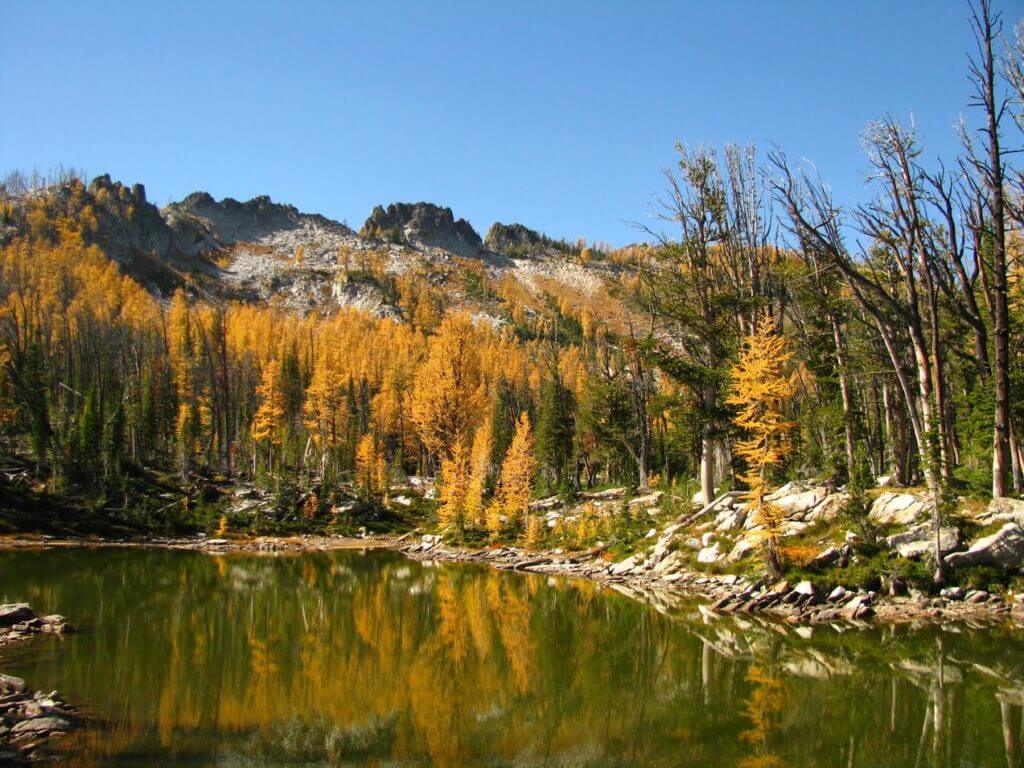
Alpine larches in their autumnal glory at Tamarack Lake in the Anaconda-Pintler Wilderness. Photo by Michael Shroyer.
Listen:
Imagine hopping in your car on a cool, crisp, fall morning. You drive two hours to a trailhead before a planned seven-mile round-trip hike with 2,000 feet of elevation gain. Within a half mile of the parking lot, you find vehicles overflowing onto the main highway. What is happening?! There must be over 125 cars.
Now imagine a similar fall morning, but the drive is 10 minutes, and there are only 8 cars in the parking lot for your casual stroll through the forest.
I have experienced both of these situations—the first, in western Washington; the second, here in Montana—with the common denominator being the march to see a specific species of tree that has turned golden yellow. The leaves on this particular tree are in fact needles, similar to all coniferous trees throughout the Pacific Northwest. But what makes this conifer unique is that it’s deciduous, and the needles are about to fall off! The tree that I seek out every fall is one of only two types of deciduous conifers native to North America—the larch.
There are two species of larch trees found in Montana: the western larch and subalpine larch, and to distinguish between the two it’s all about elevation, elevation, elevation! The fire-resistant western larch is found between 2,000 and 7,000 feet in mixed-conifer stands, where it competes with other species that prefer full sunlight such as the Douglas-fir and ponderosa pine. The subalpine larch, on the other hand, is found between 7,000 and 9,000 feet, and as a result has a highly fragmented distribution. This species can often form pure stands 500 to 1,000 feet above the elevational limits of other timberline conifers such as whitebark pine, Engelmann spruce, subalpine fir, and mountain hemlock. Unlike the western larch, the subalpine variety is thin-barked and easily damaged by fire, though its habitat of remote rocky locations fortunately tends to be less fire-prone.
In rare circumstances these species have been known to hybridize, and this behavior has been documented right here in Montana, in small areas within the Bitterroot and Cabinet Mountains.
Like all deciduous trees in the fall, larches change color and lose their leaves. Far more than an annual ritual, there is a lot going on beneath the branches, and this adaptive trait may also offer some unique benefits to their surrounding environment. Each fall, as the daylight hours get shorter and nutrients more limited, larches are able to pull nitrogen from their needles back into the inner tissues of the tree. The orange and yellow pigments that are visible after this process are known as carotenoids, the most common of which is beta-carotene—the same pigment responsible for making carrots orange! These pigments are always present in the needles but only become visible as photosynthesis shuts down and the chlorophyll degrades.
Throughout the winter and into spring, a forest dominated by western larch intercepts much less snow than a typical evergreen forest due to its bare branches. This offers a clear hydrological benefit, whereas in an evergreen canopy, snow is trapped by the needles and more water is lost to evaporation. The bare branches of the western larch in the spring also allow sunlight to penetrate the ground sooner, causing an earlier snowmelt, which results in warmer soils and a more effective spring photosynthesis to regenerate new needles. Their deciduous advantage is perhaps even more apparent in the subalpine species, as losing their leaves allows them to stay relatively protected from the harshness of winter and grow taller. At these elevations, their evergreen neighbors, the subalpine fir and Engelmann spruce, can only sustain short stubby growth.
As I reflect on the relative effort it took to encounter changing larch trees in two different places, I now have a deeper understanding of where these unique trees thrive. Living at sea level in western Washington involved a long drive, a strenuous hike, and sharing the trail with hundreds of other larch marchers. Now that I live in western Montana, I’m able to travel both near and far to see them and walk in solitude along the golden carpet of their dropped needles.
Every week since 1991, Field Notes has inquired about Montana’s natural history. Field Notes are written by naturalists, students, and listeners about the puzzle-tree bark, eagle talons, woolly aphids, and giant puffballs of Western, Central and Southwestern Montana and aired weekly on Montana Public Radio.
Click here to read and listen to more Field Notes. Field Notes is available as a podcast! Subscribe on Apple Podcasts or wherever you listen to podcasts.
Interested in writing a Field Note? Contact Allison De Jong, Field Notes editor, at adejong [at] montananaturalist [dot] org or 406.327.0405.
Want to learn more about our programs as well as fun natural history facts and seasonal phenology? Sign up for our e-newsletter! You can also become a member and get discounts on our programs as well as free reciprocal admission to 300+ science centers in North America!