Cornelius and My Dad
By Annie Mealey
Broadcast 3.18 & 3.21.2026
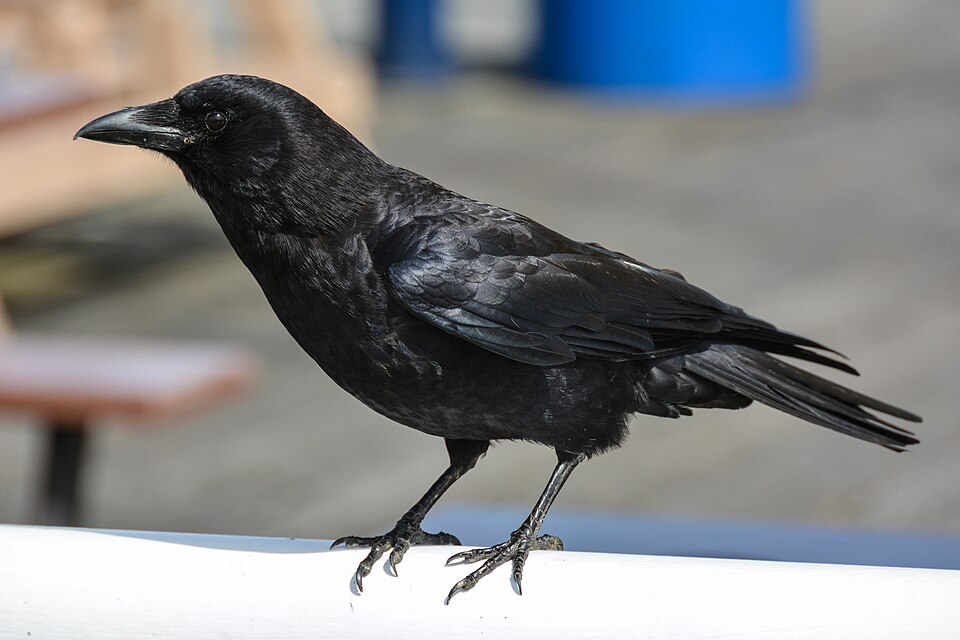
American Crow, photo by Gordon Leggett / Wikimedia Commons / CC BY-SA 4.0.
Listen:
When did you find your “nature spark”? As a very young child I remember watching tadpoles become frogs. After that, I was hooked on the natural world. For my 99-year-old father, on the other hand, his spark came last summer.
He is in assisted living and rarely goes outside. He never really understood my love of the outdoors. Until now.
When I was visiting one day I told my dad about a crow who had been hanging out at my house. He’d been getting into one of my bird feeders so I put it inside. The crow sat outside the window in a nearby tree and seemed to glare at me so I filled some small bowls with various foods and offered them to him. He came close to the window and took the treats.
Dad perked up and was listening to my story intently.
I told him how I named the crow Cornelius and with joy discovered I had become part of his routine. He began visiting me around 4 pm daily, though when I was out of town for a week he did not visit, which intrigued Dad.
I started taking Dad outside in his wheelchair more often and he began to breathe more deeply, noticing the birds, squirrels, plants, and insects. We wanted to learn more about crows so I did a little research.
I imagine that Cornelius was born in the nearby woods, since there seems to be a family group nearby. You know the “crow’s nest,” the little bucket at the top of a ship? A real crow’s nest looks very much like that, built at the very tops of trees and often in urban areas. They like to have a good view of their surroundings. Crows will sometimes nest in cemeteries because they’re home to large trees. Nesting in cemeteries doesn’t help with their undeserved reputation of being evil and associated with death. It also doesn’t help that a flock of crows is known as a “murder”!
The basic social unit is the family, which can have 12-15 members. The offspring often help with the babies and stay in the family group for several years. That’s unusual in the bird world! They often roost together in large communal groups at night, most likely for protection and to communicate about food sources. You’ve seen this when you pass a group of crows and they begin to yell “car-car” to each other.
Dad noticed a crow in a tree the next time I visited him. “You know,” he said, “I think the crow is watching us as much as we are watching it.” I realized he was right. If I forgot to put out food Cornelius would come around to the back porch to look for me. I’d watch as he would turn the bowl upside down and bring it back for me to fill. Caching food is also important for crows. They have great memories and seem to do future planning! I watched as Cornelius filled his cheeks with food, then used his beak to store the food in trees.
Dad loved every new story I told him about Cornelius—and one day he suggested we write a children’s book together about our experience.“It might help a child find their nature spark before they are 99 years old!” he said. We laughed. We decided to write a book, and suddenly his life had more purpose. There was a spring in his voice when he’d call and ask about Cornelius.
We may never write a children’s book but that doesn’t really matter. We have both learned a lot about crows and about each other through this experience and that’s what really counts. And we learned that it’s never too late to find your nature spark!
Every week since 1991, Field Notes has inquired about Montana’s natural history. Field Notes are written by naturalists, students, and listeners about the puzzle-tree bark, eagle talons, woolly aphids, and giant puffballs of Western, Central and Southwestern Montana and aired weekly on Montana Public Radio.
Click here to read and listen to more Field Notes. Field Notes is available as a podcast! Subscribe on Apple Podcasts or wherever you listen to podcasts.
Interested in writing a Field Note? Contact Allison De Jong, Field Notes editor, at adejong [at] montananaturalist [dot] org or 406.327.0405.
Want to learn more about our programs as well as fun natural history facts and seasonal phenology? Sign up for our e-newsletter! You can also become a member and get discounts on our programs as well as free reciprocal admission to 300+ science centers in North America!