American Dippers: Lighting a Spark
By Jen Elison
Broadcast 7.2 & 7.5.2025
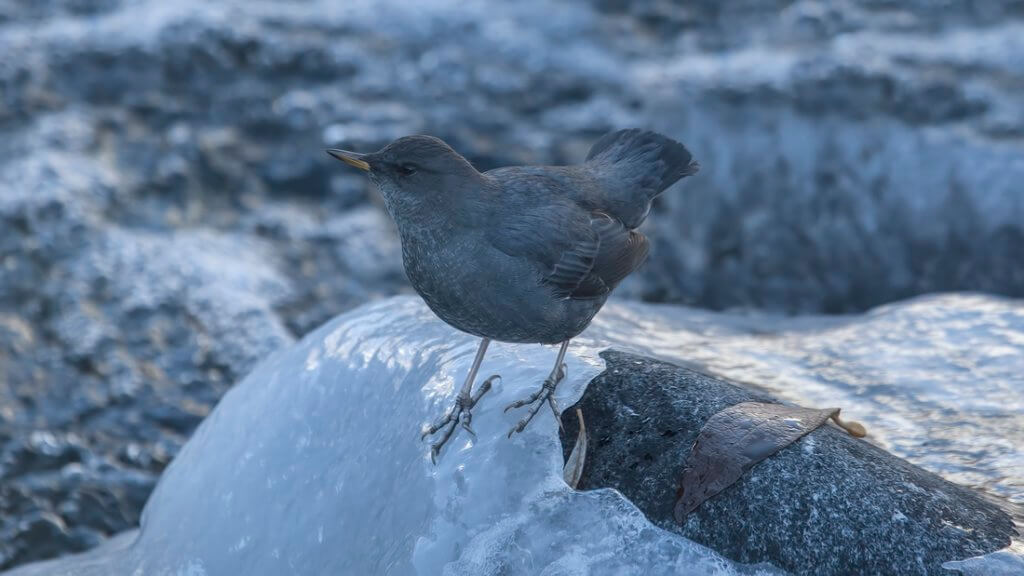
American Dipper, also known as a water ouzel. Photo by Alan D. Wilson, naturespicsonline.com.
Listen:
I first heard about the notion of spark birds while listening to NPR’s This American Life. Instantly captivated by the idea of a single bird catapulting an ordinary citizen into an enthusiast, I began asking friends about their own experiences with bird conversions. One shared that banding osprey during a volunteer stint sparked her interest in all things avian. Another told me that attending a lecture on how the feathers of an owl are designed for soundless flight ignited her increased passion for birds.
My spark bird remained visually elusive to me until just recently. In fact, I had only heard its call once last August, in the Seeley Swan Valley. The Clearwater River is eerily absent of the lively cacophony of summer bird sounds by late summer. One might occasionally hear the songs and calls of flickers, chickadees, and nuthatches intermingled with squirrel chatter but otherwise it is quiet and still. So, when I was awakened by an unfamiliar bird call early one morning, I grabbed my phone and, while standing on the deck in my nightgown, tapped the Merlin Bird ID app and activated the Sound ID function. In just a few seconds the spectrogram revealed the source to be an American Dipper. This was a bird I had never heard of and, since I like to know my avian neighbors, I immediately began looking up information about this unknown-to-me bird. And then, I became obsessed.
Everything I read about this small, dark gray and brown passerine captivated my imagination. With the scientific name Cinclus mexicanus and the nickname “water ouzel,” it has no avian doppelganger in North America. The American Dipper is the only aquatic songbird on our continent and only one of five species of dippers in the world. And that’s just the beginning of this unique bird’s attributes.
The American Dipper gets its name from the dipping or bobbing behavior it exhibits while perched on a shoreline, rock, or ledge. I found myself perseverating on this motion while attending my weekly Barre Pilates class. With a rollicking tune by the artist “Pink” in the background, and my feet in first position turnout, each time the instructor directed the class to “pulse” or bob up and down I imagined the movements of the American Dipper, and somehow, those glute-strengthening exercises became more tolerable. No one really knows why the birds dip but there is speculation that the motion helps them to spot prey in the water or perhaps helps to protect them from predators by concealing their image. As their habitat of fast-moving streams is noisy, others wonder if the bobbing is a way for the birds to visually communicate.
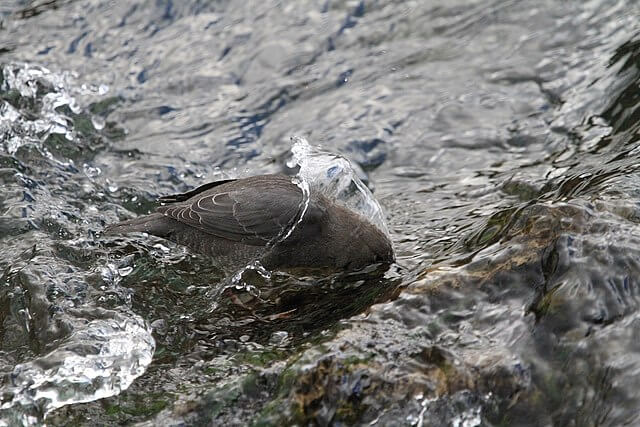
American Dipper looking for food beneath swift-flowing water in Yellowstone National Park. Photo by Knecht03, CC BY-SA 3.0.
These small birds forage for food underwater and are expert divers and swimmers. A movable flap covers their nostrils while they are submerged and their blood has a large capacity for carrying oxygen. Their strong toes allow them to grip the bottom of a stream bed and turn over stones as they hunt for aquatic insects and fish eggs. Despite river currents, they can swim upstream by folding and using their wings to stroke like an avian version of an Olympic competitor.
Knowing that the winter months in Montana can be frigid, I fretted about the non-migrating Dipper. I’ve since learned that I need not have worried about the Dipper’s ability to endure cold air and water, for they are well adapted to their habitat. Their thick layers of down and feathers act as insulation and are enhanced by waterproofing oil secreted by their preen glands. Their internal thermoregulation system is well designed for warmth and allows for endurance of below-freezing temperatures.
After a year of carefully watching the banks of rivers and creeks, I finally spotted my spark bird. I was slowly paddling a kayak along the shoreline of Lake Inez when I saw a lowly water ouzel bobbing along the bank. It was a moment of sheer delight for me to observe this small but mighty bird in action. My “aha” moment first hearing the call of the American Dipper has indeed inspired my ongoing curiosity about birds. I’ll continue scanning the shorelines and skylines for the water ouzel and other examples of feathered glory.
Every week since 1991, Field Notes has inquired about Montana’s natural history. Field Notes are written by naturalists, students, and listeners about the puzzle-tree bark, eagle talons, woolly aphids, and giant puffballs of Western, Central and Southwestern Montana and aired weekly on Montana Public Radio.
Click here to read and listen to more Field Notes. Field Notes is available as a podcast! Subscribe on Apple Podcasts or wherever you listen to podcasts.
Interested in writing a Field Note? Contact Allison De Jong, Field Notes editor, at adejong [at] montananaturalist [dot] org or 406.327.0405.
Want to learn more about our programs as well as fun natural history facts and seasonal phenology? Sign up for our e-newsletter! You can also become a member and get discounts on our programs as well as free reciprocal admission to 300+ science centers in North America!