The Cynicism of Marriage and A Story of Inosculation
By Stacy Boone
Broadcast 5.21 & 5.24.2025

Inosculation of two trees in Millersylvania State Park, Washington. Photo by John Sears, CC-BY-4.0.
Listen:
Whenever I see two trees embracing one another, I remember the first time I observed this phenomenon. Interestingly it was with my friend Mitch, a confirmed bachelor two decades my senior and devoted curmudgeon who fully believed in his qualification to have an opinion about the institution of marriage.
We are hiking through a tangle of roots and oversized boulders in the swale of a steep ravine. I feel like I’m walking into a secret when we arrive at the edge of a small bog waiting in shady darkness. This dripping wetland feeds a crooked scribble of a brook to the northwest. Settled at the edge is a trio of trees wrapped in a sacrificial lover’s hold—a cedar, a birch, an ash.
This merging of trees is called “inosculation.” The term derives from the Latin root osculari, to kiss. How sweet this sounds when rolling off one’s tongue—inˌäskyəˈlāSHən.
Inosculation isn’t grafting, the technique humans use to join two pieces of living plant tissue to form one being. Instead, it is when trees—their trunks, roots, or branches—rub and fuse to form a singleness.
This trio of trees is old. The ash is one of the biggest trees I have ever seen. To wrap arms around her girth would require Mitch, me, and one more person. Then, we would need another one, or two, to clasp arms around the attached kissing trees. How did they come to be?
Imagine a foraging squirrel hurrying from tree to tree in the autumn, packing her cheek pouch with seeds. She scurries to her burrow and caches her gathering for later—only she never needs the cache. Undisturbed, a smooth tiny cedar cone, a winged birch nutlet, and the curved winged seed of an ash key wait a year, or maybe a decade. One day, water drips to the buried seeds and in a rush, three sprouts rise towards the light.
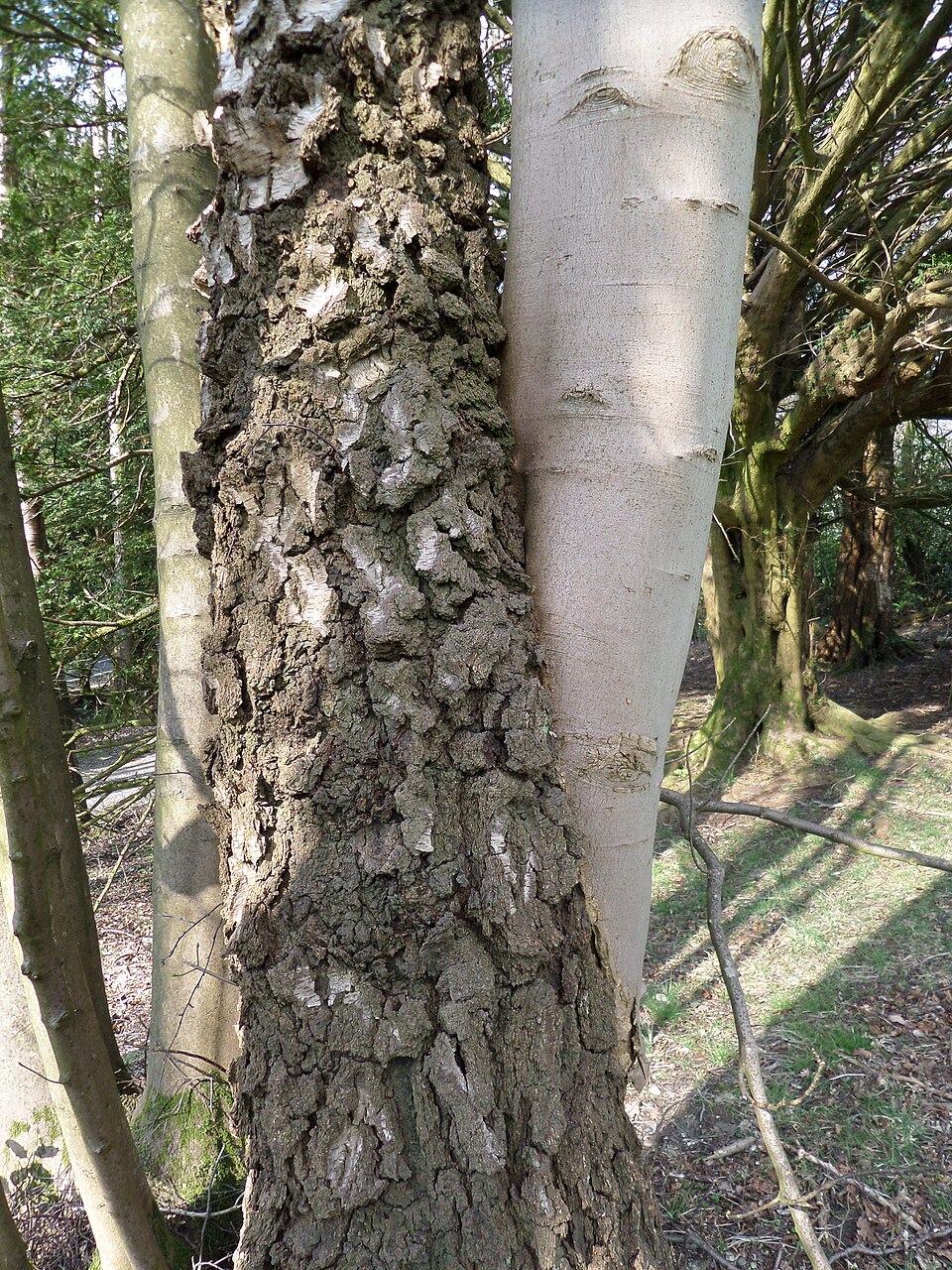
Birch and ash “kissing trees.” Photo by Roger Griffith, CC-BY-4.0.
I like to believe it began with that squirrel centuries ago, but anything could have planted those seeds—the droppings of a bird or maybe scat from a rabbit or mouse. However the seeds arrived, the trees grew close together, eventually rubbing each other’s bark as their trunks’ circumferences widened. It is possible that a windy day or winter’s snowpack pushed the thin trunks together. Maybe a deer gnashing his antlers during shed created a wound that blemished the protective bark and exposed the cambium.
Vocabulary lesson. Tucked between the xylem (think towards the center of a tree) and the phloem (think the outer edge beneath the bark) is the cambium. Cambium is the tissue for tree growth. When bark is scratched a glue-like substance forms over the wound like a scab. Growing close together, trees can conjoin, to create a steadfast, unbreakable marriage—nature’s beautiful alliance.
Kissing trees have long been portrayed in art. In 1992, Thom Gunn wrote a poem with the lines, “They have embraced so long/Their barks have met and wedded in one flow.” In Greek mythology, an old married couple, Philemon and Baucis, are rewarded for their hospitality by being turned into intertwining trees at the end of their lives. Rembrandt painted his version of the story in 1658. Illustrator Arthur Rackham created a hauntingly beautiful piece in 1922 of two trees with arm-branches wrapped around each other and faces full of emotion.
I touch each tree and peer upwards out of the shadowed darkness their girth shelters. “Mitch, these are married trees,” I begin. He shakes his head.
“These are magnificent trees. Marriage is a dispiriting legal encumbrance.”
“Ha,” I snort. “These trees, together forever.”
Later, as I walk on my own property, I bear witness to many inosculations—their presence is now difficult to unsee.
Every week since 1991, Field Notes has inquired about Montana’s natural history. Field Notes are written by naturalists, students, and listeners about the puzzle-tree bark, eagle talons, woolly aphids, and giant puffballs of Western, Central and Southwestern Montana and aired weekly on Montana Public Radio.
Click here to read and listen to more Field Notes. Field Notes is available as a podcast! Subscribe on Apple Podcasts or wherever you listen to podcasts.
Interested in writing a Field Note? Contact Allison De Jong, Field Notes editor, at adejong [at] montananaturalist [dot] org or 406.327.0405.
Want to learn more about our programs as well as fun natural history facts and seasonal phenology? Sign up for our e-newsletter! You can also become a member and get discounts on our programs as well as free reciprocal admission to 300+ science centers in North America!