A Season with a Robin Family
By Deb & Gil Gale
Broadcast 2.11 & 2.14.2026
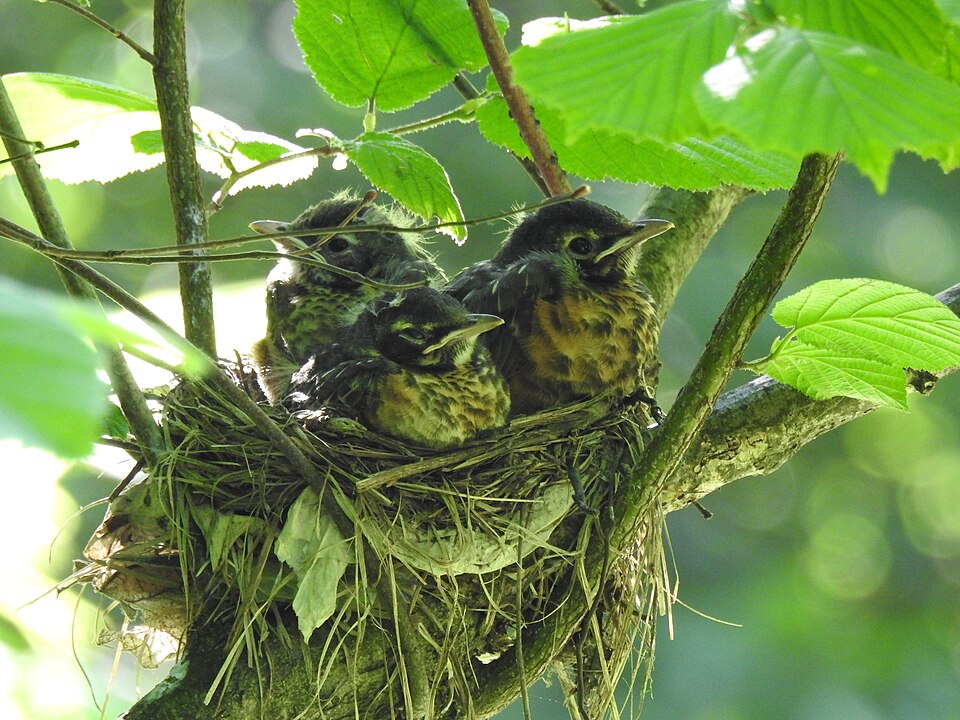
Young robins about to fledge. Photo by Tony Fanning, CC BY-SA 4.0.
Listen:
A robin’s nest sits in the paper birch tree near our porch, on a platform of branches midway up the trunk. Though empty now, in the depths of winter, the feathered family had entertained us for weeks in the spring and summer. On the other side of the kitchen window, as the birch leaves swelled and fluttered, we watched the mom and dad start their parenting journey over our morning coffee. During the next few weeks, we witnessed a condensed version of the same journey we had taken with our own children that stretched out over twenty years.
At first, we weren’t sure who was Mom and who was Dad laboring on the nest. Their sizes were similar. A little Googling told us that Mom had a lighter colored breast. She also was the architect and the lone construction worker. Dad helped bring materials. And he sang a lot to stake their claim on this tree. Mom started spending most of her time in the nest. Dad brought her food. Mom took regular nest breaks. Within two weeks, a couple of comical bald pink heads bobbed up during one of her breaks. Then a third little head.
Our non-native fescue lawn supports a couple of hundred thousand non-native earthworms and bunches of native insects. Hunting and gathering was pretty easy for the folks. At any time of day, we’d see one of them show up with a bundle of fat worms dangling in their beak. Mom or Dad’s arrival immediately triggered the chicks’ gaping response. Three big mouths stretched wide open. Bright yellow beaks with red centers made the targets hard to miss. The worms dropped in. The beaks closed and opened again for more. The insistent little heads were ravenous. Mom and Dad didn’t stop all day long. We couldn’t count every trip but our observations matched the literature that said they could make a hundred and more DoorDash trips a day to the nest. They’d have to agree that ninety percent of parenting is thinking about when you can lie down again.
During the next two weeks, the nestlings sped through their stages of growth at an astounding pace. They skipped from babies to toddlers to teenagers in a matter of days. We could almost see their feathers sprouting. When the wind whipped the branches, they hunkered down, crammed impossibly tight together. They reached the teenager phase and began flapping their wings in the nest, jostling and slapping each other in the face. One morning, in a matter of minutes, we saw them hop out onto adjacent branches. They stretched their wings, flapped vigorously for a bit and then sailed off like pros. The whole family skimmed around the yard for days but the nest stood empty.
Indigenous peoples looked to the robin as a bringer of peace and safety, of hope and family. It’s always been a notable event when they arrive with the warming months. But before last spring, our enthusiasm would fade to a ho-hum after the first robin sightings. We used to take these widespread and abundant birds for granted. Less common birds got most of our attention. But watching this family closely and listening to the melodic tunes they sang built a new feeling of shared history with them. The same kind of history that unites family and friends.
We haven’t seen any of the robin family around since August. But they’ll be back. We’ll welcome them as old friends when they return.
Every week since 1991, Field Notes has inquired about Montana’s natural history. Field Notes are written by naturalists, students, and listeners about the puzzle-tree bark, eagle talons, woolly aphids, and giant puffballs of Western, Central and Southwestern Montana and aired weekly on Montana Public Radio.
Click here to read and listen to more Field Notes. Field Notes is available as a podcast! Subscribe on Apple Podcasts or wherever you listen to podcasts.
Interested in writing a Field Note? Contact Allison De Jong, Field Notes editor, at adejong [at] montananaturalist [dot] org or 406.327.0405.
Want to learn more about our programs as well as fun natural history facts and seasonal phenology? Sign up for our e-newsletter! You can also become a member and get discounts on our programs as well as free reciprocal admission to 300+ science centers in North America!