Mystery of the Wampus
By Priya Subberwal
Broadcast 10.28 & 10.31.2026
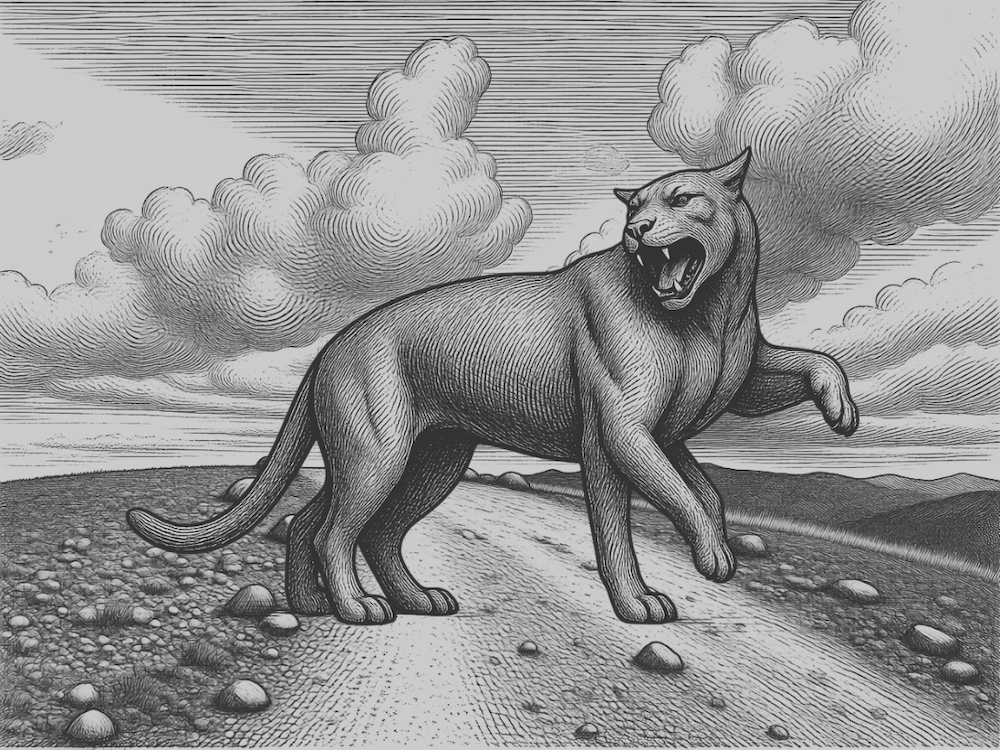
Perhaps the wampus is out there, in Missoula’s North Hills. Perhaps we’ll see it again.
Image created from photo of Conway High School’s wampus cat statue (CC BY-SA 4.0) superimposed on a photo of Waterworks Hill, Missoula.
Listen:
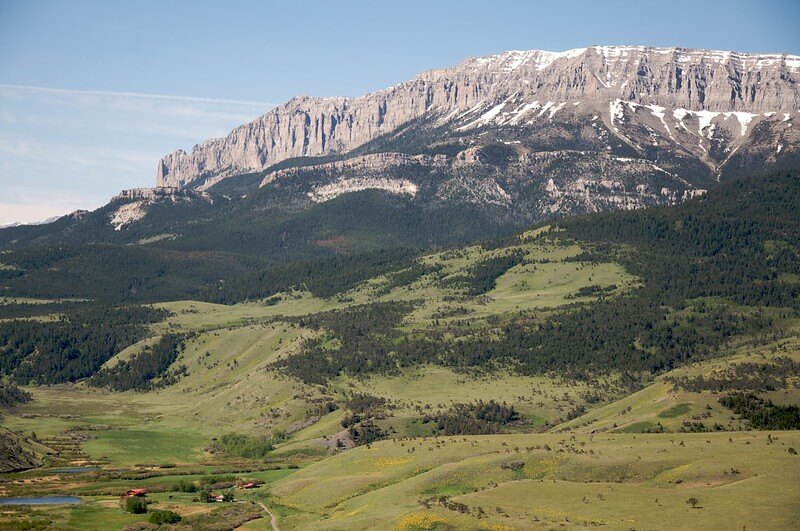
There’s not much mystery left in these hills. They’ve been cataloged and surveyed, excavated and archived. The roaring highway lights them nightly with a pale white glow, held to the hillside like a flashlight underneath the chin. It’s hard to imagine anything magical happening here, wedged between the weaving trails and the rumble of the train. But, when it gets late, when the highway quiets to a murmur and this sleepy town rests, the North Hills seem to grow in the darkness. They swell and heave, churning as they chew on the night and spit it back out at dawn.
It’s times like these when you can almost believe it, the stories of a strange creature who lives in these mountains. In the shimmering moonlit grasses, you could be convinced those shadows are alive, have sharp teeth and many legs.
The headline from the Daily Missoulian in 1914 reads “FEROCIOUS WAMPUS ALMOST VISITS MISSOULA,” and describes an encounter between railroad workers and a large, mysterious creature descending from the North Hills. According to the article, H.T. Lindsey, a railroad dispatcher, “had just arrived for his shift when he saw Mr. Wampus making tremendous leaps down the hill.” Another dispatcher “ watched and listened without saying a word. As the animal dropped from sight, he asked: “What the hell is a wampus, anyway?” There have been several stories over the years of a strange creature being sighted, however, reporting is scarce. The mountains like to keep their secrets.
The wampus cat is a cryptid creature of American folklore that has origins in Cherokee cosmology and Appalachian legend, though its descriptions vary. Some accounts of the creature claim it has six legs, while others say four. In almost every account, it is described as spiritual, with occult-like powers. In 1936, The Knoxville News-Sentinel described the cat as having “a body of 15 or 20 feet long, and eyes like small moons…”
I can almost imagine it, that railyard late at night. Sleepy eyes unfocused on the hills, blinked, rubbed, widened awake. The prickling feeling across the skin that comes from the realization that you are less alone than you thought. The eyes that blink back, glowing.
It’s not hard to explain away the wampus. According to the witnesses in 1914, it couldn’t have been a bear, “since bears are soundly asleep in their holes this time of year.” Bears don’t sleep consistently through the winter, however, so it’s entirely likely that a bear simply woke up and wandered down the hills. Some evenings, when my black dog lopes across the fields towards me, I could swear he’s a bear, or something else entirely. I could swear he’s got more legs than four.
But, these days, when everything feels knowable, I don’t want to know everything. I asked an AI engine if the wampus cat is real, and it said no. But I like the idea that there are things our databases don’t know, and can’t find out. The things that live in the darkness, known only through the hairs on the back of the neck, the crawl of skin, the electricity in the air. None of us could say what those men saw that night. There are times when the blurry black shape in the distance is indistinguishable. When the stories and archives are sparse, and the data is limited, when the mind rushes to fill in the unknown with some type of certainty. And there is so much we do not know. This year, a new species of cat was recorded in Bolivia, the first new feline discovery in over 100 years. And, while it might be foolish to look at a bear-shaped thing in bear country and assume it’s a cat, it would also be foolish to imagine we know with certainty who all lives in these woods. It’s the same type of foolishness, the false confidence of a young species like humans, that enables us to slash forests, dam rivers, spur extinctions.
There’s something to be said for the mind that stays open. The wild imagination of a child in the woods in the dark, who knows enough to know not to go out there alone, to not rush to explain away the things that go thump in the night. There’s something in the gut that’s worth listening to. There’s something in the swell of the mountain, the stories layered in her chest, that makes you want to turn your head and pay attention. Pay attention. We are not alone.
Every week since 1991, Field Notes has inquired about Montana’s natural history. Field Notes are written by naturalists, students, and listeners about the puzzle-tree bark, eagle talons, woolly aphids, and giant puffballs of Western, Central and Southwestern Montana and aired weekly on Montana Public Radio.
Click here to read and listen to more Field Notes. Field Notes is available as a podcast! Subscribe on Apple Podcasts or wherever you listen to podcasts.
Interested in writing a Field Note? Contact Allison De Jong, Field Notes editor, at adejong [at] montananaturalist [dot] org or 406.327.0405.
Want to learn more about our programs as well as fun natural history facts and seasonal phenology? Sign up for our e-newsletter! You can also become a member and get discounts on our programs as well as free reciprocal admission to 300+ science centers in North America!