Seed-Stashers & Bird Pines
By Cedar Mathers-Winn
If you’ve never looked between the scales of a pine cone, you might be surprised by what you find there. Or any Montana conifer, for that matter. Like a maple, the seeds have wings. And although they might look a little different, they work the same way: the seed spins as it falls, so the wing generates lift, so the seed has a few extra seconds to catch a breeze and float somewhere a little distance away from its parent tree. It might not move far, but over time, this is how conifers have come to spread across and dominate most of the ecosystems that the Rocky Mountains have to offer.
That’s how it works for most pines, anyway. But, of over a hundred different pine species worldwide, there are about twenty that break the mold. The seeds of these pines are wingless, and what’s more, they are extremely large and heavy. These hefty seeds are packed full of calories, fat, protein, and nutrients that all contribute to getting a young pine started off with everything it needs, even in harsh environments. And indeed, these trees tend to do well establishing themselves and surviving in places where others can’t, from Mexico’s arid Mesa Central to the subalpine slopes of the Himalayas. But, being particularly weighty and lacking any means of buoyancy, these seeds aren’t going far on their own. Luckily, they don’t have to.
As it turns out, these hefty seeds do have wings—they’re just on another organism’s body. These seeds are dispersed by birds.
Though not common, these so-called “bird-pines” are widespread. In the Desert Southwest and all throughout the Mexican highlands, the many species of pinyon pine are dispersed by jays; Pinyon Jays in the north, Mexican Jays further south. But elsewhere in the world—from the Mediterranean to Siberia, from the Swiss Alps to the Himalayas—the seeds of these bird-pines are dispersed by another, related group of birds: the aptly named nutcrackers.
In Montana, we are blessed with not one but two bird-pines: the limber pine (Pinus flexilis) and the whitebark pine (Pinus albicaulis). Both are dispersed primarily by Clark’s Nutcracker.

Clark’s Nutcracker’s have long, strong bills that serve as both chisel and tweezer, perfect for breaking apart pine cones and efficiently removing the seeds. Photo by Walter Siegmund, CC BY-SA 3.0.
Nutcrackers and jays belong to the family Corvidae, a notoriously crafty and mischievous group that also includes the ravens, crows, and magpies. There’s a lot to love about corvids: many are bold, highly social, extremely adaptive, and possess remarkably complex systems of communication. Corvids are also noteworthy for their proficiency at storing food and retrieving it later. This may not sound impressive at first, but consider this: Pinyon Jays cache tens of thousands of pine seeds each year, and recover about 95 percent of them. Ever lost your car keys? Exactly.
The impressive capacity for these and other specialized corvids to remember absolutely mind-boggling numbers of caches requires some serious brainpower. Evolution has bestowed these expert cachers with an enviable hippocampus, the region of the brain responsible for spatial memory. Interestingly, while most corvids cache food to some extent, those that don’t invest as much in this strategy also have smaller hippocampi—good evidence for the function of this particular chunk of brain in this particular group of birds.
In fact, there is quite a bit of variation in how much different corvid species cache, how good they are at remembering where they put things, and the size of their hippocampi. Most corvids aren’t the masterful cachers that Pinyon Jays are, and some, like the Jackdaw of Eurasia, don’t seem to cache at all. For the most part, corvids are “only okay” as cachers—the majority of the world’s ravens, crows, and jays cache food, but not that much, and they don’t rely on it the way the highly specialized cachers do. And among those that do cache often, that hippocampus can perform quite differently, depending on how exactly the species does its caching.
Take the Western Scrub-Jay, for example. These highly social birds frequently cache acorns and other snacks for later, but, often hanging out in groups, they are seldom alone to do so. This simple fact gives scrub-jays plenty of opportunities to reap the benefits of a cache without doing any of the work. These birds pilfer each other’s caches constantly. It’s a whole thing. They spy on each other to see where their buddies are stashing the goods. If they know another bird saw where they put said goods, they go right back and move it to somewhere else. And they actively try to avoid being spied on. Western Scrub-Jays will choose to cache their prizes behind some kind of barrier or even in a shaded area to avoid being seen when they know they are being watched. They even try to muffle the sounds of their digging. If a scrub-jay is aware of a spying neighbor, he or she will choose softer or damper substrate to bury their treat. Maybe the wildest aspect of this cache-stealing arms race is that scrub-jays will only protect their caches if they have pilfered from another bird themselves. The poor, naïve, non-pilferers apparently don’t even recognize that they need to go back and move the food when someone else was watching. Until they figure out the game anyway.
Where the hippocampus comes in here is in remembering not just where things are cached, but what has happened to those caches. It pays to remember what caches have been eaten already, whether by the bird who cached them or by a pilferer. One might waste a lot of time visiting thousands of caches through a season if one did not remember which were already empty. Western Scrub-Jays show a remarkable ability to remember whether caches still have food in them. This “episodic memory” is another fascinating feature granted by the wonderful hippocampus.
Among the most extraordinary of caching corvids is Clark’s Nutcracker. This bird will create tens of thousands of caches each year, each containing on average three to five seeds. This can amount to nearly 100,000 seeds per bird, per year. And they do this over a massive home range of around 60 square miles. Of this unimaginable number of seeds, over their impossibly large ranges, they recover about 60 percent. Maybe not as impressive as the Pinyon Jay’s 95 percent, but still pretty dang impressive. And as we’ll see, it’s ultimately a good thing for them that they leave those 40 percent behind. More on that later. For now, let’s marvel a bit longer at the Nutcracker.
Clark’s Nutcracker is a stately-looking bird: gray body, black wings with white along the back edge, and a white tail with the two middle feathers black. Their voice is usually what gives them away; a harsh, cranky-sounding call, somewhere between a creaky door and a malfunctioning printer. They’re easiest to spot doing what they’re best known for: hacking apart pinecones with their long chisel-like bills; delicately plucking out the seeds, the chisel now tweezers; and then carefully testing each one to see if it’s a keeper. (Some seeds don’t develop, some get
eaten by insects, etc.)
While Clark’s Nutcrackers may only store a few seeds in each cache, that doesn’t mean they’re only carrying around a couple seeds at a time. These birds are known to fly up to 20 miles to a good stash spot, so they need to make these trips efficient. To help them out, the nutcrackers have evolved a specialized structure called a sublingual pouch. This adaptation is unique to the world’s four nutcracker species, Clark’s in North America, and the Northern, Southern, and Kashmir Nutcrackers of Europe and Asia. The sublingual pouch is basically a stretchy sac extending from a hole under the tongue and contained within the neck. And they can hold a lot of seeds; Clark’s can carry as many as 150 at a time. Nutcrackers will stuff that pouch so full that you can see the bulge in their necks.
Once the sac is stuffed, the nutcracker will fly to a caching site and get to work. Sites run the gamut from forests to meadows to recent burns to barren subalpine slopes. The caches themselves can also be just about anywhere: in a mound of moss, wrapped in lichen on a tree branch, placed under a stone, or buried in the soil. Nutcrackers will carefully hide just a few seeds from that throat bag in each little spot, carefully covering them with soil, a small rock, a patch of moss, etc. A lot of the forest management and scientific literature will tell you that Clark’s Nutcrackers prefer to cache seeds in bare, open areas, but the evidence for this is lacking. The observational studies that these claims are based on are likely to be biased by the fact that it’s just easier to see them make caches in open areas. But, as it turns out, these particular cache sites end up being especially important, somewhat for the bird but more so for the seed.
Recall, the trees producing these wingless seeds are often the ones found in some of the most extreme environments—dry, cold, windy, rocky, and unwelcoming. Regardless of whether nutcrackers specifically seek out these kinds of environments, they have a lot of seeds to put into caches, a lot of caches to find space for, and only so many different kinds of habitat for all of them. We don’t have a great understanding of their preferences, but either way, those harsh, open, largely unvegetated and easily observed sites get a lot of use.
And these are the sites where those seeds—about 40 percent of which are getting left behind each season—are most likely to germinate into trees. Essentially, the forgotten seeds have been planted, and many of them right in the habitat where they do best. In forgetting, on average, almost half of the seeds they cache, these helpful birds have supplied their own future generations with the food they will depend on. Think of them as accidental gardeners. At a landscape level, and with literally thousands of seeds.
Take a minute to soak that in. Trees have big, nutritious seeds that help them survive in difficult environments. Nutcrackers like the seeds, and hide some of them in the tree’s favorite habitat—which could be miles away from where the tree grew. Those trees have no other way of getting to their preferred habitat than by being carried by nutcrackers.
This is why the seeds lost their wings.
In fact, when nutcrackers take seeds that do have wings, like those from a ponderosa pine, they scrape the wings off as their first order of business. And for the tree, losing the seed wing ditches a minor inconvenience to the bird, but also reduces that little bit of resource investment to make the wing in the first place. It may not seem like a lot, but across all the seeds on a tree, and all its years of making seeds, the cost adds up.
There’s some strategy involved in being a plant. Some of it comes down to lifestyle, or “life history” in biology-speak. Plants like dandelions, lodgepole pines, and cheatgrass live fast and die young. They germinate, grow, pump out as many seeds as possible, and die after a relatively short time. Dandelions usually live two to ten years, lodgepoles up to about 150, and cheatgrass is an annual, dying after a single season and relying on its seeds to keep the population alive (which they’re pretty good at doing). Other plants use the opposite strategy: they live slow, and they die old. The arrowleaf balsamroot, a relative of the dandelion in the botanical family Asteraceae, doesn’t even flower for three to five years, and can live up to 80. Researchers estimate bluebunch wheatgrass can live from 50 to 100 years. And limber pines can live to be over 1,000. There’s a tree in the Absaroka Mountains between Montana and Wyoming that was 1,921 years old in 2005. Limber pines won’t even start producing seeds until they are at least 20 years old, often 50, and don’t reach full maturity until at least 100. This is a patient species of tree.
Spreading the seeds around is another issue that requires a bit of strategy. Dandelion seeds are tiny and fluffy and can get where they need to get on the wind, and dandelions can make a lot of them because each individual seed is so cheap to produce. For the bird-pines, with their enormous flightless seeds, they’ve really hedged their bets on the birds. It makes sense, then, that they’d go the extra mile to get the seeds to those birds.
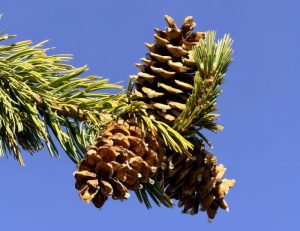
Limber pines present their cones in groups at the ends of their branches, making them easily visible from the air for high-flying Clark’s Nutcrackers. Photo by Cedar Mathers-Winn.
First, of course, there’s the giant, tasty, nutritious seeds. (And they are tasty, just like a “pine nut”—which is, incidentally, the seed of a different species of bird-pine, usually the Korean stone pine, Pinus koraiensis.) But the birds need to see that there are cones on a tree before they will land on it. With their long-distance commutes, Clark’s Nutcrackers are often flying pretty high up in the sky, so the cones need to be obvious. A common strategy among bird-pines, and one that our whitebark and limber pines use, is to only grow cones on the outer branches at the top of the tree. Another thing that sets these pines apart in our area is the shape of their crown. Rather than forming a narrow profile around a central trunk, something that helps many of our other conifers avoid broken limbs under heavy winter snows, limber and whitebark have multiple trunks, arching upwards, providing many more places to show off their goods.
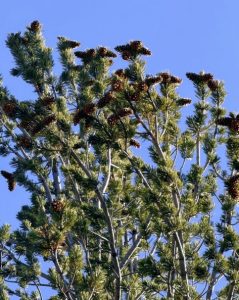
Limber pines, with high, visible cones. Photo by Cedar Mathers-Winn.
Once the nutcracker is in the tree, things get a little more complicated. From the tree’s perspective, the cone serves two purposes: to get seeds to the nutcracker, but also to keep the seeds away from other animals that won’t provide the tree any benefit. In our area, red squirrels are the key antagonist in this story. They also love the rich, plentiful, fatty, nutritious limber and whitebark pine seeds. And they are also big-time cachers. The issue is that red squirrels have a very different caching style than the nutcrackers. Some nutcracker caches will never be trees, but for the many that are buried in the ground in a suitable location, the cache
itself will just be an inch or two deep, just like planting a seed. And the habit of creating lots of little caches with only a few seeds in each is great for the pines too, since each seed has a chance to germinate without it getting too crowded.
This strategy is called “scatter hoarding.” Lots of little hoards scattered around. Red squirrels, on the other hand, are adherents of the “larder hoarding” school of thought. They build one or a few enormous caches and just chuck everything in there. These are usually crammed into a cavity excavated underground, or in a hollow log, dead tree, or other useful feature. And they don’t even remove the seeds first, they just shove the whole cone in there. Basically, everything that the Clark’s Nutcracker does right, the squirrel does wrong. With only a few caches, they’re also way less likely to forget and leave anything behind. So, long story short, trees don’t like them.
So here’s the issue: How does a tree entice a nutcracker, but repel a squirrel? Unfortunately, there’s no easy answer. It’s a tradeoff.
Fortunately, the trees can be somewhat flexible. Limber and whitebark pines share a few defenses against squirrels, and these vary between populations depending on how big of an issue squirrels are. Where there are more squirrels, cones will be heavier, with thicker scales, and the scales themselves will be covered in pitch. Each of these defenses hinders the nutcrackers too, but less so. Where the birds have a long, smooth pinecone-jabbing beak, squirrels have fuzzy little faces and sharp teeth—they have to work harder at getting past the defenses. All the same, it’s not in the pine’s best interest to hinder their seed dispersers, so where there are squirrels, the trees are caught in a balancing act, forced to make the best of a situation that’s less than ideal.
The relationship between the bird-pines and the pine-birds is deep, complicated, and fascinating. But it’s not unique. There are many, many plants that specifically rely on birds to disperse their seeds. In the east, Blue Jays are major cachers of acorns, facilitating the spread of oak trees. In our area, Townsend’s Solitaires and juniper, especially Rocky Mountain juniper, have a similar relationship. In this case, the persistent juniper “berries” (actually cones that have evolved to be edible) are the solitaire’s winter food, and the solitaires actually defend specific trees from their neighbors. They digest the fleshy cone, then poop the seeds out elsewhere. In the tropics, hornbills and toucans perform this service on much larger fruits, such as those of nutmeg and mahogany, and are among the only flying creatures large enough to do so. Cassowaries in New Guinea and Australia are the only animals capable of dispersing the seeds of the extremely large and poisonous fruits of the cassowary plum (Cerbera floribunda). Phainopepla in the deserts of the southwestern US and northern Mexico are the key dispersers of desert mistletoe, and essentially glue the tree-parasitic seeds onto host branches with their butts (that’s another story—look it up). At a broad scale, any plant that has invested in making a fruit is doing so to attract some bird or mammal that will help disperse its seeds.
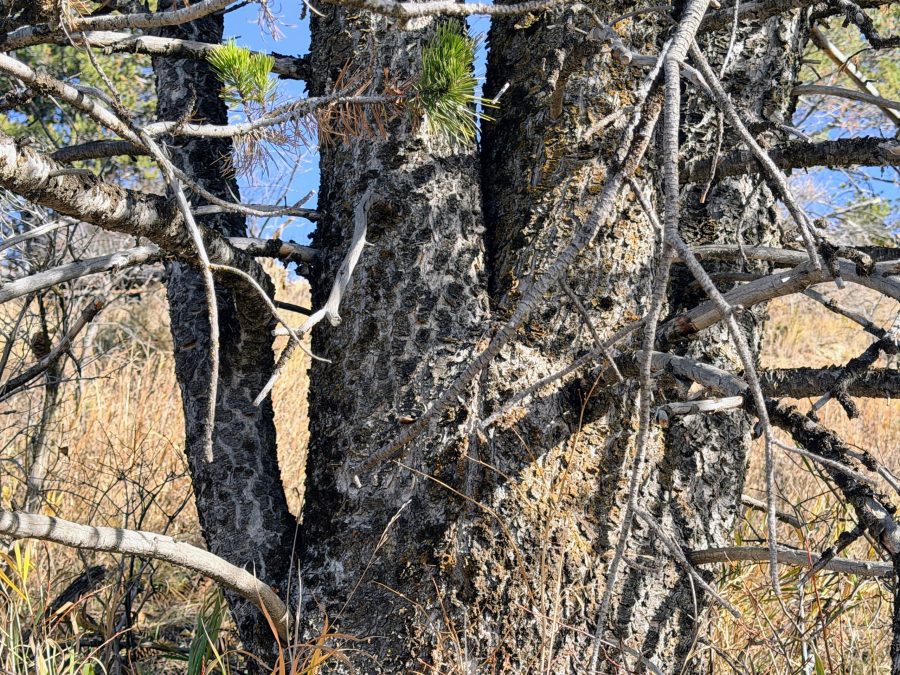
Groups of two to five trunks are a good sign of trees that sprouted from an abandoned nutcracker cache. To be sure they are actually separate trees, look for a graft scar running from the spot where two trunks meet and the ground; this is where two trees have fused. Photo by Cedar Mathers-Winn.
Of course, a limber pine doesn’t require a nutcracker for its seeds to germinate. A cone might roll down a hill and drop a few seeds; that could work too. Not very efficient, and certainly doesn’t get these trees uphill in the first place, but it works. There’s something characteristic, though, of a lot of pines “planted” by Clark’s Nutcrackers. If the typical cache has three to five seeds, then you might expect three to five trees if the cache isn’t recovered. And a lot of times, that’s exactly what you get! Three to five trunks all growing out of the same little spot on the ground, an old nutcracker’s cache hole.
Where I live in Bozeman, there’s a little park right in town on the top of a hill. (If you’re ever there, it’s called Burke Park.) On one dry stretch of slope on that hill, there are tons and tons of limber pines. It’s the only place in town that I’ve seen them. There are a few younger trees here and there, slim, solitary trunks reaching steadily up toward the sun and just starting to produce cones. But mostly it’s older trees, and the older trees all come in groups of two, three, four trunks, all fused at the base. On each of these clumps, there are folds in the bark where these separate trunks join, graft scars running all the way to the ground, the only sign that these trees started as separate seeds. Planted by a nutcracker, probably over a hundred years ago, before there was even a town here. And every year, as summer starts sinking back into fall, the nutcrackers return, extracting the seeds, reaping the crops planted by their ancestors.
Cedar Mathers-Winn is a naturalist, educator, and writer living in Bozeman, Montana. He received his Master’s degree from the University of Montana studying Black-capped Chickadees—another caching species, to which he provided winter-long all-you-can-eat sunflower seed buffets in exchange for a little data and a lifelong connection to one of the world’s coolest birds.
This article was originally published in the Fall/Winter 2026 issue of Montana Naturalist magazine, and may not be reproduced in part or in whole without the written consent of the Montana Natural History Center. ©2026 The Montana Natural History Center.
Click here to read more articles from Montana Naturalist magazine.
Want to learn more about our programs? Sign up for our e-newsletter! You can also become a member and get discounts on our programs as well as free reciprocal admission to 300+ science centers in North America!