Fungal Guttation: Like Water off a Mushroom’s Back
By Drew Lefebvre
Broadcast 9.16 & 9.19.2026
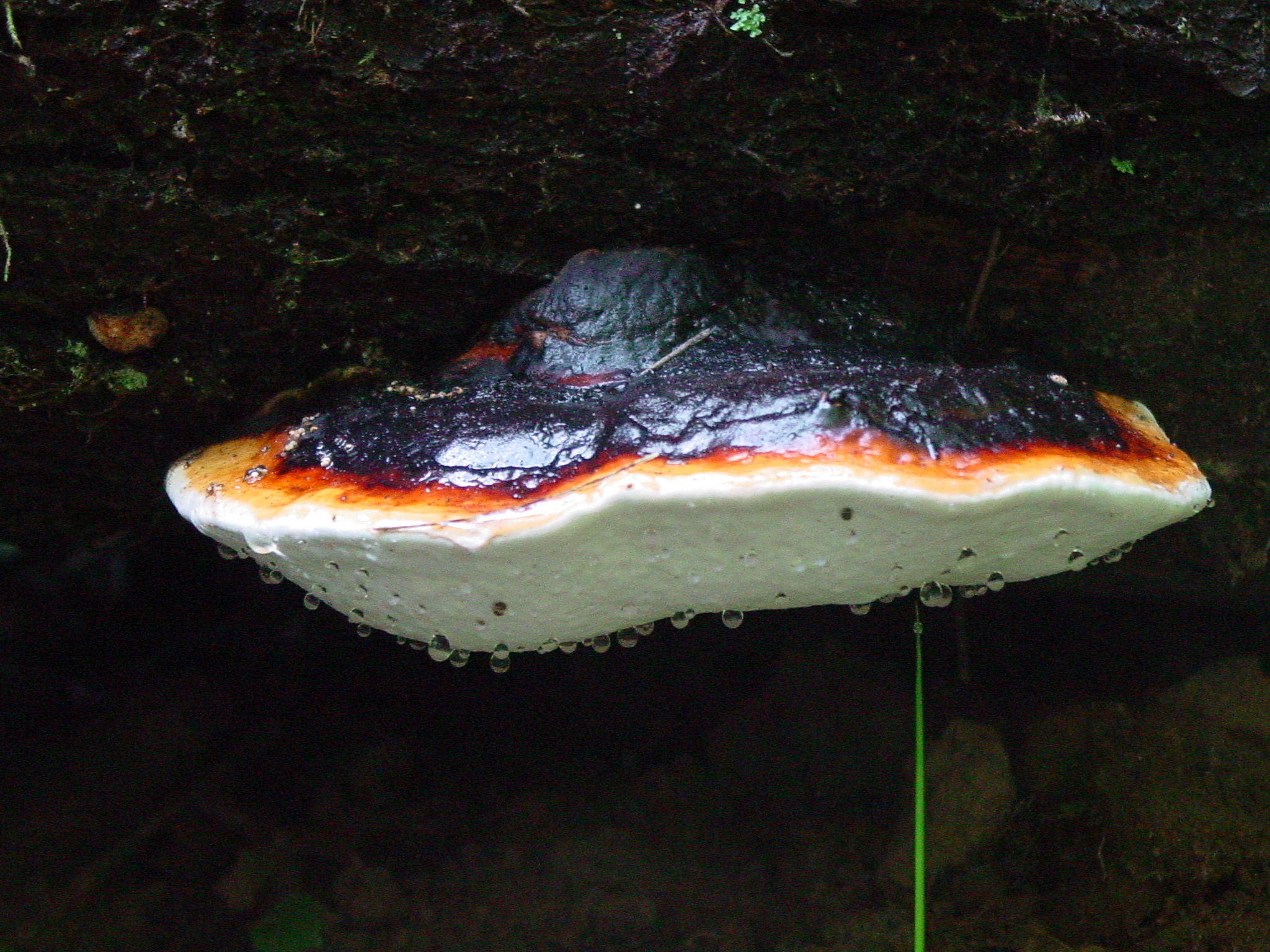
Red-belted polypore shelf fungus (Fomitopsis pinicola), with guttation droplets. Photo by Sharksbaja, CC by-SA 3.0.
Listen:
I started thinking about guttation on a hike at the end of summer. It was a humid day; it had rained almost nonstop the previous week and there was even more in the forecast. Low clouds—or was it high fog?—clung to the hillsides, accumulating in draws and coulees. I’d chosen this day for my hike because the chance of rain was low but, as I slogged through the mist, trodding on saturated soil and brushing against slick green leaves, I wondered if it made any difference. Perhaps I’d get just as water-logged walking through the clouds as I would in a rainstorm.
I should clarify here: I wasn’t actually thinking about guttation, because I wasn’t yet acquainted with the word, but I was beginning to notice it all around me. We say spring is the season of renewal, and I know that’s true, but still—there’s nothing like the first real rains after the drought of summer. I swear everything looked greener, even the dry stalks of long-dead plants. Conifer needles twinkled in the diffuse light, coated in miniscule drops of condensation. Most eye-catching of all were the mushrooms, sprouting from nearly every conceivable surface. So many shapes, sizes, colors, growth habits, all having finally received enough moisture to send a fruiting body through the substrate.
I began to notice a large number of polypores growing on conifer trunks around me. Polypores, also known as shelf fungi or bracket fungi, are a familiar sight in many forests. Their fruiting bodies, known as conks, are hard and woody and shaped—you guessed it—like a rounded shelf or bracket. Almost all polypores grow on the trunks or branches of trees, consuming the wood. In fact, polypores are some of the most efficient decomposers of lignin and cellulose, the main components of wood, and play a vital role in nutrient cycling. On this particular day, I encountered one species, the red-belted polypore, on tree after tree. And almost every one I saw was covered, all along its characteristic white outer edge, in hundreds of glistening droplets.
This, I learned later, is guttation. Correlated with periods of rapid growth, guttation happens when a mushroom grows so quickly, and its metabolism is so high, that it produces more water than its cells can hold. This water is exuded from its growing edge which, in the case of the red-belted polypore, is a white outer ring surrounding the shiny red coloration closer to its center. Because of the recent rains, these polypores had grown quickly, and the high humidity had prevented evaporation. As a result, the exuded droplets collected on the conk’s surface, growing larger and larger, like miniature stalactites.
I couldn’t resist touching some of these shiny water formations. They were slightly viscous—clearly there was more here than just water. In fact, depending on the species of mushroom, guttation droplets can contain a wide range of fungal metabolites: compounds like mycotoxins, antivirals, antifungals, antimicrobials, herbicides, insecticides, cancer inhibitors, and more. Many of the fungal compounds that we humans have noticed, isolated, and harnessed for our own purposes (penicillin, for example) can be found in guttation droplets.
Not all mushroom species undergo the process of guttation: in some it’s virtually unknown, while in others—many polypores, for example—it’s common enough to aid in identification. And it’s worth mentioning that mushrooms aren’t the only ones who do this. Guttation can also be seen in plants, when excess liquid water is removed through the leaves. And while we’re at it, let’s not forget that, like mushrooms, we humans also produce water and carbon dioxide as metabolic byproducts whenever we exhale. So as I hiked along on that foggy day, breathing out metabolic byproducts of my own, perhaps I had more in common with my fungal neighbors than I might have thought!
Every week since 1991, Field Notes has inquired about Montana’s natural history. Field Notes are written by naturalists, students, and listeners about the puzzle-tree bark, eagle talons, woolly aphids, and giant puffballs of Western, Central and Southwestern Montana and aired weekly on Montana Public Radio.
Click here to read and listen to more Field Notes. Field Notes is available as a podcast! Subscribe on Apple Podcasts or wherever you listen to podcasts.
Interested in writing a Field Note? Contact Allison De Jong, Field Notes editor, at adejong [at] montananaturalist [dot] org or 406.327.0405.
Want to learn more about our programs as well as fun natural history facts and seasonal phenology? Sign up for our e-newsletter! You can also become a member and get discounts on our programs as well as free reciprocal admission to 300+ science centers in North America!