For the Wiley Coyote, Resistance Is Fertile
By Darby Minow Smith
Broadcast 6.3 & 6.6.2026

Coyote in long grass. Photo by Henry Weinberg, CC by 2.0.
Listen:
Across the U.S., a long-despised enemy slinks farther and farther. We’ve tried all sorts of weapons against this foe—poisons and helicopters, bullets and snares. We’ve held killing competitions and dedicated wildlife officers to figuring out how to best exterminate it. Our disdain and frustration is reflected in words, calling it trickster, vermin, desperado. It’s not even worthy of fleas, said Mark Twain. And yet, for all our efforts, the prairie wolf, the coyote, trots into new territory, and swells in numbers.
As a cattle rancher in southwestern Montana, I shouldn’t admit to respect that borders on fondness for the coyote. I often see the animal when we move cows across the rolling land below the Elkhorn Mountains. A lone coyote sits and watches as the herd streams by. Horses, cows, dogs, calves, people—we, the mostly domesticated—turn back our heads to take in its wholly feral stare.
We haven’t allowed wholesale shooting of the coyote on our ranch for decades. If an individual starts harassing calves, that’s one thing, but my dad turns away neighbors and friends who want to do us a favor by shooting the animal for sport. My dad likes them too, he admits, sees them as a way that the ecosystem keeps everything cleaned up and balanced, including the pesky gopher population.
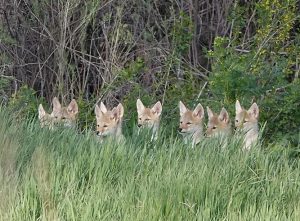
A litter of eight coyote pups. Photo by Jim Kennedy, CC by 2.0.
It turns out all that killing is counterproductive, anyway. In places with high rates of coyote hunting, the population rebounds and often surges. By killing coyotes, there is less competition for food, and so the surviving females have larger litters. Coyotes are creatures who can either be solitary or live in packs, and so, under intense hunting pressure, they split off. In order to avoid territory overlap, those coyotes expand into new areas. And so, in our efforts to kill the coyote, we’ve not only boosted their numbers, we’ve pushed them farther, their range expanding from Alaska to Panama, from prairie to strip mall parking lot.
We’re usually better at killing off things, the wolf being a prime example. The coyote watched their cousins’ near-extermination, and rushed in to fill the ecological hole with yipping snarling kin. It wasn’t just the predators that disappeared. Due to overhunting and habitat pressure from the first white settlers, my people among them, this valley was nearly emptied of wildlife by the early 1900s. In black and white photographs, men unload replacement elk from a train car from Yellowstone. Now, in the spring, a boom shakes the hay yards, in an attempt to chase off the hungry results of that successful reintroduction. Now, elk, coyotes, people grumble over the wolf pack padding through the Elkhorns. There’s a push/pull with most wild animals—eradications, ecological vacuums, regrets, attempts to make it right, and resulting blowback. Coyotes just turned up their noses at the typical Western animal story.
The historian Dan Flores followed the coyote from its appearance as a god in the oldest American stories to its relentless expansion today. He pointed out that to simply call the coyote a trickster is to miss much of the mystique about them. In the old stories, the coyote is both hero and fool, trickster and wise. Flores called their lonesome, defiant call, “the original American anthem.”
Most of us live in the respectable world, of efficiencies and spreadsheets. Where we are good at killing off things, often too good. We think we know the story, even if it’s a brutal one, of bullets and cyanide. We are the exceptional species, who decides what lives, dies, is traded on the global market.
That, of course, isn’t the only world. Another world slinks along the fencelines. It doesn’t care about our tidy beliefs in cause and effect, our proudly held dominion over nature. At twilight, from my house in the sage, I hear the underdogs singing out to each other. Sometimes, I swear, it almost sounds like laughter.
Every week since 1991, Field Notes has inquired about Montana’s natural history. Field Notes are written by naturalists, students, and listeners about the puzzle-tree bark, eagle talons, woolly aphids, and giant puffballs of Western, Central and Southwestern Montana and aired weekly on Montana Public Radio.
Click here to read and listen to more Field Notes. Field Notes is available as a podcast! Subscribe on Apple Podcasts or wherever you listen to podcasts.
Interested in writing a Field Note? Contact Allison De Jong, Field Notes editor, at adejong [at] montananaturalist [dot] org or 406.327.0405.
Want to learn more about our programs as well as fun natural history facts and seasonal phenology? Sign up for our e-newsletter! You can also become a member and get discounts on our programs as well as free reciprocal admission to 300+ science centers in North America!