
- This event has passed.
Spring Luncheon 2025: Learning for a Lifetime
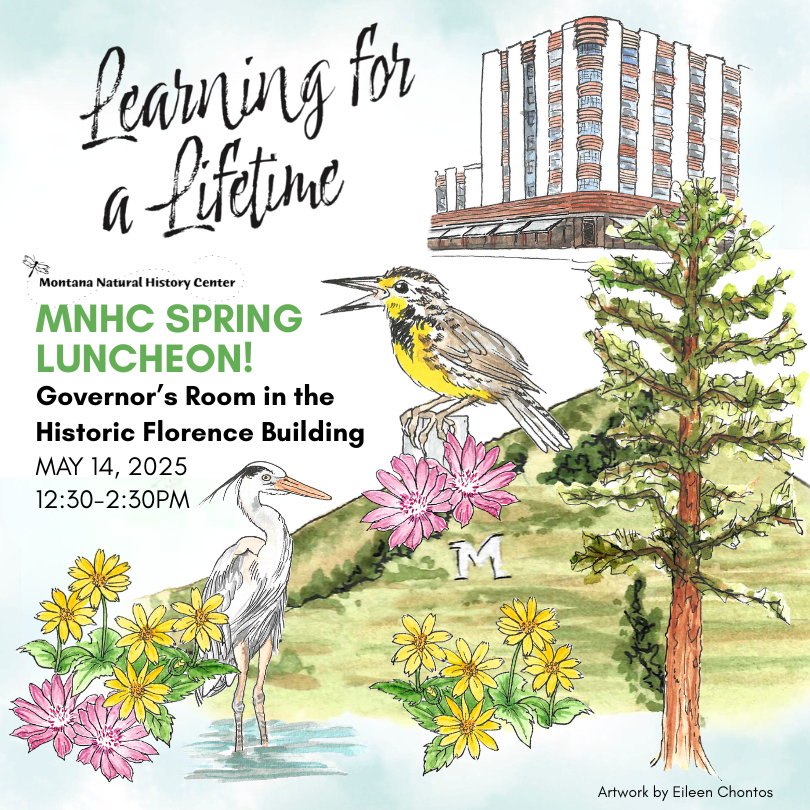
Date: Wednesday, May 14th
Time: 12:30-2:30 p.m.
Location: Governor’s Room in the Historic Florence Building, Catering by River and Range.
GET YOUR TICKETS TODAY!
Learning for a Lifetime!
 Join us for the 13th Annual Montana Natural History Center Spring Luncheon to support our Summer Camp scholarship funds! Gather with friends for a good purpose and enjoy a lovely, fresh lunch in a beautiful setting. This year, we will also take advantage of our luncheon location in Missoula’s historic downtown and join field experts on short walking tours (optional) to learn more about our region’s geology, hydrology, wildlife biology, and unique history. Attendees can choose from six different “field trips” at the time of ticket purchase.
All proceeds go directly to our camp scholarship funds. When you purchase tickets for this event, you are donating to make a real and tangible difference in a child’s life.
The Montana Natural History Center is committed to ensuring that every child has the opportunity to hear meadowlarks warbling, breathe in the vanilla fragrance of sun-warmed ponderosa pine bark, and fall in love with Montana’s wild places. Our compassionate, fun, and experienced Seasonal Naturalists help guide summer campers through Missoula’s natural spaces and encourage lifelong learning and curiosity through the lens of an artist, writer, scientist, and naturalist.
All ticket holders will also be entered into a raffle for a chance to win one of five copies of Mariah Gladstone’s cookbook Mountains to Oceans: Kids’ Recipes from Native Land.

Sponsorship Opportunities
Are you a business interested in being a sponsor for MNHC’s Spring Luncheon? Please contact our Development Director, Kellen Beck, at kbeck@montananaturalist.org, or click here for more information.

Field Trips Aren’t Just for Kids and Campers!
There is no substitute for hands-on experiences that encourage us to learn more about ourselves, our community, and our environment. And just like our campers, MNHC Spring Luncheon guests have the opportunity to learn, discover, and to take a Field Trip as we explore downtown Missoula like you’ve never seen it before! These short excursions will have you walking away with new curiosities and knowledge about our historic hub’s culture and landscape.
Field Trips are optional and are offered as an added way for MNHC to show our gratitude for your attendance at our Spring Luncheon and support of our scholarship program. There’s a little something for everyone and every interest (please choose only ONE option). Sign-ups are first-come first-serve, so don’t wait to reserve your preferred option.
Field Trips will follow lunch. Each tour is 30-40 minutes long and requires roughly 10 minutes of walking outside (come rain or shine), with the exception of the Wild Wanders option. This field trip remains at the Florence Building.
MNHC is guided by our values that promote learning, growing, and encouraging people to discover new experiences and different environments in our natural world! We hope you will enjoy your Field Trip and never stop learning; never stop exploring our remarkable Montana.
About the Field Trips
1. Birding Under the Beartracks
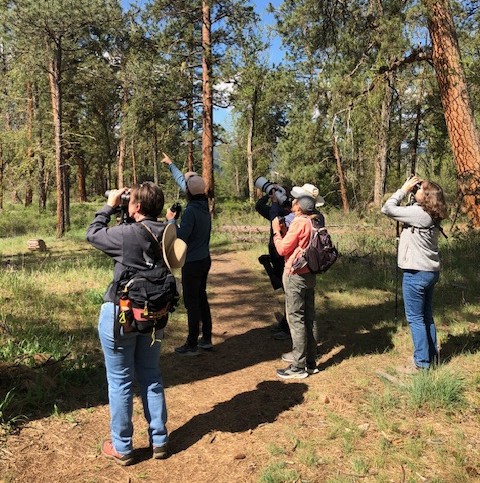
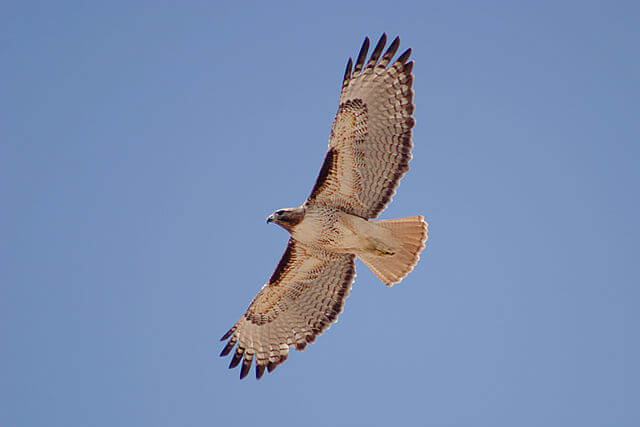
MNHC Teaching Naturalist Ryan Mahar takes you under the Beartracks Bridge on a guided birding tour. Spring offers unique opportunities to see and hear some of Montana’s most charismatic avifauna, right in the heart of town. The bridge is a great vantage point to spot cliff swallows, yellow warblers, osprey, great blue herons, bald eagles, and common goldeneyes, just to name a few. No experience is required, and all are encouraged to come! Ryan will also offer a few tips on birding by ear for beginning birders.
2. A Geologic Sense of Place
Take a walk with us through Missoula’s ancient past, as we discuss and look at the geologic and biological history written all over its landscape. It is easy to forget that Missoula currently resides at the bottom of what was once an enormous ancient lakebed of one of the most influential geologic features of North America: Glacial Lake Missoula. This lake was so massive that when it finally drained it scarred the majority of three western states, rewriting the ecology and topography of our region. Understanding and remembering these calamities of our not-so-distant past are the crucial key to understanding the context for the beloved natural landscape we enjoy around us today. Led by MNHC Teaching Naturalist Kevin Niehaus.
3. Whoopsie Boop! Arnica Showcase with Wild Wanders
Join Sydney Morical and Cathryn Raan of Wild Wanders to learn about the nitty gritty on Montana’s favorite pain reliever, arnica. We’ll learn how to identify arnica, first aid applications, chronic use cases, and how we craft the most potent medicine. This “field trip” takes place at Governor’s Room in the Florence Building and is a good option for guests with limited mobility or who would prefer to stay inside.
4. What Built This City: Geology
Bruce Baty, geologist and educator, will lead you on this fascinating downtown tour to visit select iconic buildings, learning about both their geologic and cultural history. Bruce will identify the various rocks used in their construction and the stories they tell about Montana’s geology. Gain a fun, fresh perspective on Missoula’s downtown buildings!
 5. Carnal Enterprises with Unseen Missoula
While most in Missoula are familiar with the name Mary Gleim or the brief history of Front Street’s “red light district,” many of the district’s stories remain untold, including Gleim’s and her businesses. From 1889-1917, West Front and Main Streets became home to a vibrant “restricted” community of working women, Chinese laborers, African American soldiers, and immigrants who built the environment we as Missoulians have come to love today. This field trip discusses the district through the historical lenses of sex, race, class, and occupation in order to create a broader social understanding against the backdrop of the remaining built environment. Led by Sophia Etier of Unseen Missoula.
6. Clark Fork’s Lost Islands and Hidden Histories
The Clark Fork River is the lifeblood of the landscape and conduit to cultural connection in our region. Comparing what we see today to historical maps and photos, we will rewind the river’s path and discover hidden treasures along the way. Learn about lost islands and a regenerating aquifer, beavers and bull trout and much more. Led by MNHC Naturalist and Community Programs Coordinator Christine Morris.