
Forearm crutches make it easier for Amy to explore outdoors, allowing her to walk farther, with much less pain and much less recovery time. “When I first started using the forearm crutches, I really needed to see someone like me in the outdoors,” Amy says. Now she uses her platforms to encourage people of all abilities to find ways to explore outdoors. Photos by David Luke.
Amy Denton-Luke loves exploring outdoors. But as someone who has struggled with illness her entire life, and who has been disabled since 2015—suffering from a neurological disorder that causes chronic fatigue, pain, and mobility issues—she faces many barriers to outdoor adventuring. To raise awareness, provide accessibility information, and encourage people of all abilities to find ways to get outdoors, she began her blog, Disabled in the Wild (disabledinthewild.com), in 2022, along with an Instagram account and YouTube channel of the same name.
Amy and I met over Zoom to talk more about her experience and the meaningful outreach she does around disability and accessibility in the outdoors. Here is our full conversation (a condensed version was published in the Fall/Winter 2024 issue of Montana Naturalist).
Allison De Jong: I would love to hear a little about your background and your motivation for creating your Disabled in the Wild YouTube channel and blog and Instagram page.
Amy Denton-Luke: Sure! Where to start? I moved to Montana when I was 18. I went to college in Bozeman for anthropology. I came to Missoula in 2015 for grad school, I was originally going for archaeology. About halfway through I had to drop out due to my current illness. I have a neurological disorder, it kind of mimics MS, so I have a lot of issues with mobility, obviously, issues with my legs especially, fatiguing weakness and chronic pain, so the forearm crutches really help me go farther and with a lot less pain, and a lot less recovery time – it takes me a really long time to recover after I do anything, so using the forearm crutches definitely helps with that, too.
I started Disabled in the Wild – it was kind of a result of the pandemic. There was a lot of unfortunate messaging during the pandemic. People with disabilities, people who are immunocompromised – that our lives are not as valuable or as worthy as other people’s lives. I remember those first few months of the pandemic, and people were saying, “Oh, don’t worry, it’s only the elderly or the sick who die,” and I was like, “That’s me! You’re talking about me!” Even certain states and hospitals were making decisions on who would get a ventilator and who wouldn’t, based on a number of factors, including disabilities and preexisting conditions, so if you had any of those preexisting conditions, you were not someone worth saving compared to someone who didn’t have those conditions. And as someone who was immunocompromised, and at a higher risk – it’s really hard to deal with. Especially when everyone was saying those things to comfort themselves during the pandemic, not realizing that so many people around them have those issues.
So it really came out of that confusion – “I don’t understand why people are saying my life is not worthy and my life is not worth living. I do, I think it is, I can still do all of these wonderful things.” And just confronting how much people view disability as solely a tragedy and a fate worse than death. That’s how we see it in our culture. The pandemic really inspired me to use my voice and say, “That’s not true. Yes, disabilities are hard. I have my challenges. I’d like not to have chronic pain. But it’s still worth living. I still have a beautiful life. I can still get out and do the things I love. It looks a little bit different, but that doesn’t mean it’s not still valuable.”
So that’s sort of where I came from and when I started. Of course, I love the outdoors, so I just wanted to talk about that.
Allison: I agree that the messaging at the beginning and even at this point in the pandemic has been really unfortunate. I’m sorry. I’m sorry for what you had to go through, and what we’re all dealing with. That messaging hurts everybody.
Amy: It does. Think about the people who, after years of receiving that messaging, then become disabled or become chronically ill, who got long Covid, who’ve got this culture and worldview that oh, this is a tragedy and a fate worse than death and my life is not worth living. That makes it so much harder to adjust to life with disabilities. We all become disabled if we live long enough, and that transition into disabled life would be so much easier if our worldview and culture around disability was more accepting.
Allison: It looks like you started this in early 2022? So where did you start? What was the first thing you did?
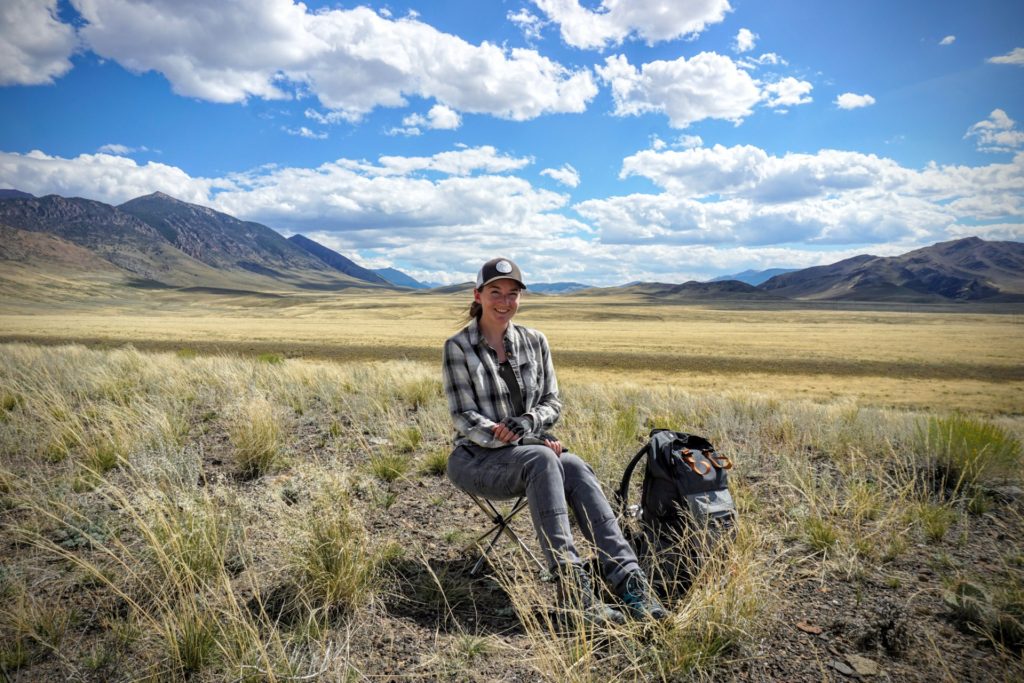
Amy incorporates taking breaks into her exploring, making sure to take care of herself—a good reminder for all of us.
Amy: I started on Instagram. I first created that account. I just started posting pictures of me in the outdoors because I knew I didn’t want to just grab the attention of other disabled people. I wanted to get the attention of non-disabled people as well. And seeing somebody who is physically disabled, very apparently disabled, in the outdoors, can, I think, catch people’s attention. So I started posting pictures of me in the outdoors, and just sharing a little bit of my story and my experiences, and how I was adjusting to life with disability. At that point I was seven years into being disabled, but still kind of adjusting a little bit. Just kind of coming to terms with it. So I started on Instagram, just sharing stories, and quickly realized I wanted to turn it into a blog. I’m a writer, I like being very in depth and very nuanced in what I discuss, so the short captions on Instagram were not for me. I wanted to dive much deeper. So I started the blog. I don’t remember when I started the YouTube channel. I think it was that summer, 2022. I really wanted to do adventure videos. When I first started using the forearm crutches, I really needed to see someone like me in the outdoors. I needed to know that was something that was still possible for me, with forearm crutches.
Back in 2015 or 2016, I could only find one or two YouTube videos of someone disabled outdoors. But those one or two videos meant a lot to me. So I knew how powerful that was as somebody with a disability. This was a message that I really needed when I was younger, so I thought other folks might need to hear it, too. I wanted to show other disabled that it’s possible, and here’s how I do it. And it’s not just, “Oh, I’m out here overcoming my disabilities by being disabled outdoors.” I’m very much working with my disabilities and living with them, and exploring while taking breaks, while taking care of myself, and this is how I do it now. I started with adventure videos, but then also started turning some of my blog posts into video versions, because not everybody likes to read. When you’re just relaxing at home, sometimes it’s just better to watch a video instead. So I started converting my blog posts into videos.
Allison: And that’s an accessibility issue, too, right?
Amy: Exactly.
Allison: I was fascinated to see how there doesn’t seem to be a standard for what “accessible” means. And that’s part of the problem, right? And I just wonder – is that one goal here? What does it mean to have “standard accessible design”? Is there a definition for that, or is anyone working towards it?
Amy: That’s a really good question. I don’t know if there’s anyone specifically working towards that. There might be? I know people are certainly starting to talk about it more. And I would definitely like to see a more standard design, and have the ADA expanded and applied to new outdoor spaces being built. Just like when we build new buildings, they have to have certain things in place. I would love to have new outdoor spaces have wide paths, and with certain pathway materials, and lots of benches, and all of those things. I think more people are talking about it, and that’s always the first step, is awareness.
There are some groups. There’s the Montana Access Project, and I know that they have some suggestions and a handbook. They have an Instagram with some links you might look into, where they have some suggestions. But I don’t think there’s a central group or idea or central standard yet.
Allison: Yet!
Amy: Yet.
Allison: The idea of raising awareness, like you said, is really the first step. Putting your videos out into the world and saying, “This is me, not looking like all the gung-ho people who hike 100 miles…” There are other ways of being in the outdoors, you don’t have to be this ultra adventurer. And creating that awareness, that starts to create a safer space for people who are disabled.
Amy: Syren, at Disabled Hikers, they had a post back in 2018 that said, “‘Disabled Hiker’ is not an Oxymoron.” And I think people still think that it is. If you’re disabled, you can’t possibly do anything outdoors, that doesn’t fit their narrow definition of what disability is. Showing people that disabled people ARE interested in the outdoors, and that disabled means more than just one thing, and we all have various accessibility needs is key. It’s important for both disabled and non-disabled people to see there’s more ways to enjoy the outdoors than just those intense mountain hikes, and experiencing the outdoors in these other ways is still valid and beautiful.
I think that another thing people are afraid of, when I talk about accessibility in the outdoors, people are afraid I want to pave everything with concrete and just ruin nature. And that’s not the case at all! Pavement and concrete are good for some disabled folks but not for others. It’s really bad for me and my legs. But there are other path materials that people can use successfully, even with a wheelchair, that blends in with nature better. But it’s more than a paved path or a smooth trail, it’s all of these other things that are not difficult to put in place. These are not big changes that we need to make. It’s very small, subtle things – but very important things that make a difference in some people being able to explore a certain area or not.
Allison: Can you give some more examples of that, of those small changes?
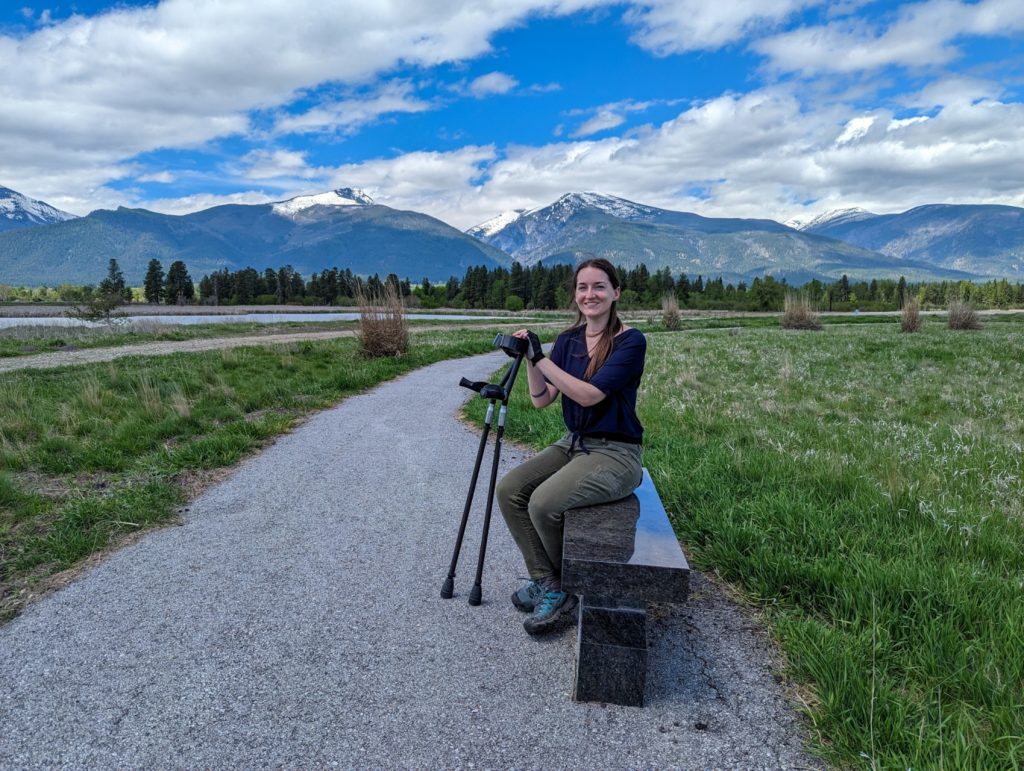
Accommodations like benches and wide, smooth, level paths help make natural spaces accessible for people of all abilities.
Amy: More benches. Benches with back support especially. Path materials just need to be firm and somewhat smooth and level, not necessarily asphalt or concrete. I don’t need paved trails, I really like finely crushed gravel, and then making those paths wider as well. Especially for boardwalks, it’s really hard to be in a wheelchair and go down a boardwalk and having people coming the other direction. Having restrooms available, not just at the parking lot but a little bit further into the site if that’s possible. Van-accessible parking spaces. I see a lot of outdoor spaces that have accessible parking, but then they don’t have a protected van-accessible area. Signage is another big thing – making sure certain parts of the trail are clearly marked, especially before forks in the road and footpaths so people don’t get lost and confused. And for people with low vision as well, to be able to navigate the trails on their own. And then making sure there’s no stairs, or if there are stairs, that there’s also a ramp. Hills, where possible, should be graded to no more than a certain percentage. Making sure the trails are maintained. Spring flooding comes in and washes out the accessibility! A big thing for me is making sure those details are available online. If I drive an hour away to this outdoor space I just heard about, I have no idea if I’m going to be able to walk the path. If the trail’s washed out, or if there’s no benches and I don’t have anywhere to rest, I don’t know if I can go there and enjoy it. And that’s a big issue for a lot of people, just the lack of information. I can’t tell if I can go and enjoy it if I don’t have that information. So that’s super important, too.
Allison: I like how you said in your article [in The Changing Times], that maybe it’s not the wilderness areas that are going to be accessible, we can’t pave those, but the places like state parks, places that are supposed to be for the general public—it should be the bare minimum to make those truly accessible.
Amy: There’s a balance, I think. I’m not expecting them to level mountain trails for me as a disabled person, and I think most disabled people understand that there is a balance. We’re not asking for much, we’re just asking for equity and inclusivity in spaces that are intended for use by the general public.
Allison: I was also wondering if there are places, or organizations, perhaps, you feel this issue of disability justice and accessibility is being done well. Examples that we can look to for motivation and inspiration.
Amy: The example I always give is Syren at Disabled Hikers. I just think they’ve done such a wonderful job of raising awareness and educating people and calling attention to the issues. And creating spaces where disabled people can come together for a group hike and explore an area all together. They’re also working on various guides for hiking trails and outdoor spaces in Washington and northern California, and so they were really an inspiration for me when I was getting started. For me, they’re the gold standard of disability justice in the outdoors.
Also, Birdability – and then I have a friend working on a guide for accessible birding locations in the U.S. I’m trying to remember her online name. There’s Birdability, and then there’s Freya, I think she goes by OT Birder on Instagram. I believe her organization is called Access Birding. But she’s also in this space of doing accessible guides for disabled people in wildlife refuges, and she’s actually leading some research through Virginia Tech on inclusivity and accessibility for disabled people in wildlife viewing areas.
Do you want specific outdoor spaces?
Allison: Yes, that, too, actually. Where they’re doing this thoughtfully.
Amy: The first one that comes to mind is Milltown State Park out by Bonner. They’ve got a wide, paved trail with benches every couple hundred feet, van-accessible parking, restrooms available. And then there’s down here in the Bitterroot, Hieronymus Park, River Park, and Skalkaho Bend Park, has a little ADA accessible trail. They’ve all been great about having wide, smooth trails with benches. Trying to think of what else… Lee Metcalf has a couple of great accessible trails as well. Many other local parks do a couple of accessibility features very well but then fall short in other ways, like Traveler’s Rest State Park or Maclay Flats. It just depends on your particular disabilities. What works for one disabled person might not be great for another person.
Allison: Milltown, at least, is a pretty new park, and it’s good to know that this newer place has been done thoughtfully, and in this way.
Amy: They did a great job. I was very impressed with that place. That’s what got me thinking about having a standard, because they did such a great job, and obviously considered everybody who would be coming to that space. I’d like to see that more.
Allison: It’s interesting to think that maybe, moving forward, we can be more thoughtful and deliberate about how we create new spaces. And there’s also the issue of retrofitting current spaces.
Amy: For sure…and getting the budget to do that. That’s always the problem!
Allison: Another question: What can we do? As a larger society? What can I do? What do you want me to do with this article? What do you want to say to our reading public here?
Amy: That’s a great question. I think one thing that everybody can do, one easy thing, right off the bat, is when you go to outdoor spaces, write a review for them on Google, and talk about the accessibility features. What kind of trail does it have? Is there van-accessible parking? Are there benches? And take lots of pictures, too, because you won’t remember all the right details, but someone might be able to get the information they need from your pictures. So just sharing the information that you were able to get from your adventures can help a disabled person decide if it’s accessible for them and if they can go and enjoy that space. That’s an easy one.
And just learning and educating yourself about what disability actually means. I like to recommend books like Demystifying Disability by Emily Ladau and Disability Visibility, a collection of stories put together by Alice Wong. Both are such great introductions into life with disability and people with disabilities. In addition to writing reviews and educating yourself, I think it’s important to challenge your assumptions and biases about disabilities and the people who have them. Plus, helping to raise awareness, whether that means interviewing a disabled person for your magazine, or sharing disability awareness stories and work by disabled activists on your social media, or having conversations with friends and family members. Donating to organizations like Disabled Hikers and supporting the work they do is a big deal as well. Support initiatives and bills that help protect disabled people and their rights, of course. Disabled people are a marginalized group in law and in culture, so anything you can do to raise awareness, shift perceptions, and center disabled voices and experiences is a really great thing to do.
Allison: We live in such a weird time, with so much vitriol, but there are also these important things that are being lifted up and being made visible, and that’s a really positive thing that’s happening.
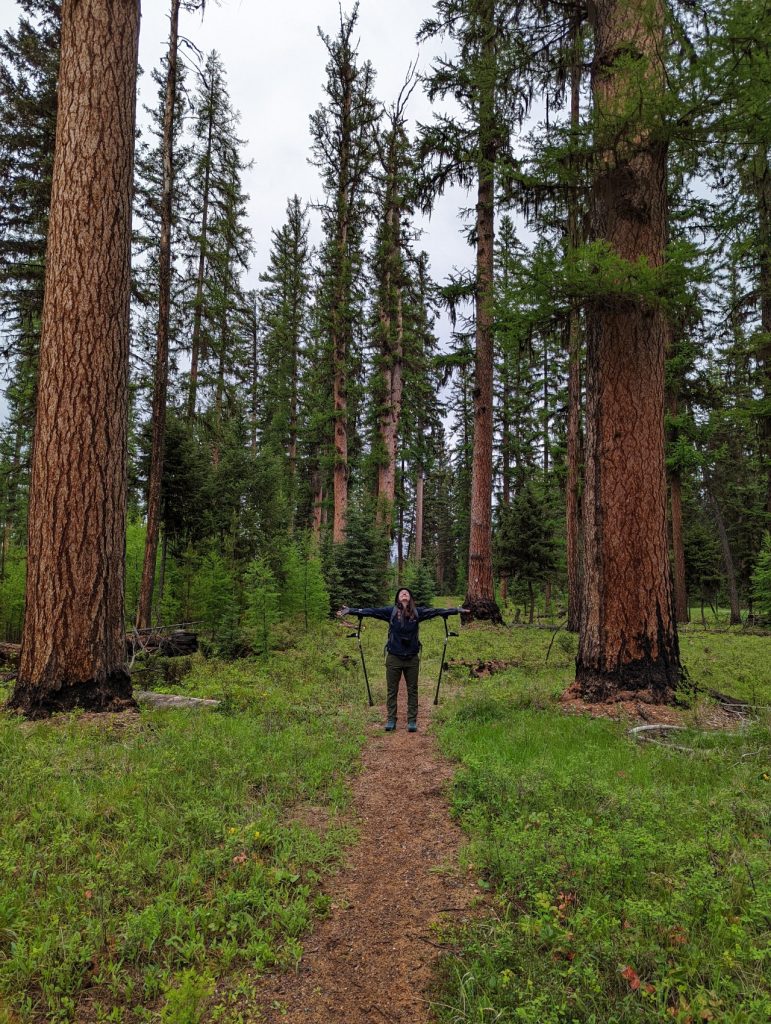 Amy: I feel like I started this social media account at the right time because people seem to be very interested in being more inclusive and talking about these things, and learning more about disabilities. I think the big message that I always want to get across to people in general when I’m doing my work with Disabled in the Wild is – for disabled people, encouraging them to find ways of exploring the outdoors within their ability, but also for non-disabled people, I don’t necessarily want to be that inspiration, because that can be problematic in some ways when taken to a certain extreme, i.e. inspiration porn, but I do want to reassure and encourage non-disabled people that becoming disabled is not the end of the world, it’s not a fate worse than death, it’s not a tragedy. I want to encourage people that you will find ways to keep living and doing the things you love. It might look a little bit different, but you can still find joy, still explore the outdoors. I think people need to hear that.
Allison: As you said before, if we all live long enough, we’re all going to find ourselves in a space where we’re not as able as we used to be. And like you said, it’s not the end of the world…it’s just a different world.
Amy: It’s a tough adjustment, but we’re very adaptable creatures, and we find a way.
A condensed form of this interview was originally published in the Fall/Winter 2024 issue of Montana Naturalist magazine, and may not be reproduced in part or in whole without the written consent of the Montana Natural History Center. ©2024 The Montana Natural History Center.
Click here to read more articles from Montana Naturalist magazine.
Want to learn more about our programs? Sign up for our e-newsletter! You can also become a member and get discounts on our programs as well as free reciprocal admission to 300+ science centers in North America!