Community Focus
Amy Martin and Threshold:
From Montana to the World…and Back
by Caroline Kurtz
Many folks around Missoula and throughout Western Montana will remember musician Amy Martin. She arrived in town in 1999, drawn to the area’s natural beauty and to the vitality and creativity of the human community. She plunged headlong into being a singer/songwriter, performer, leader of children’s choirs, and the impetus behind numerous community music projects for all ages. She told stories about life and the world—particularly the natural world—through lyrics, and sought to connect people through the actions of singing and making music together, regardless of experience or ability. And she was beloved for all of it.
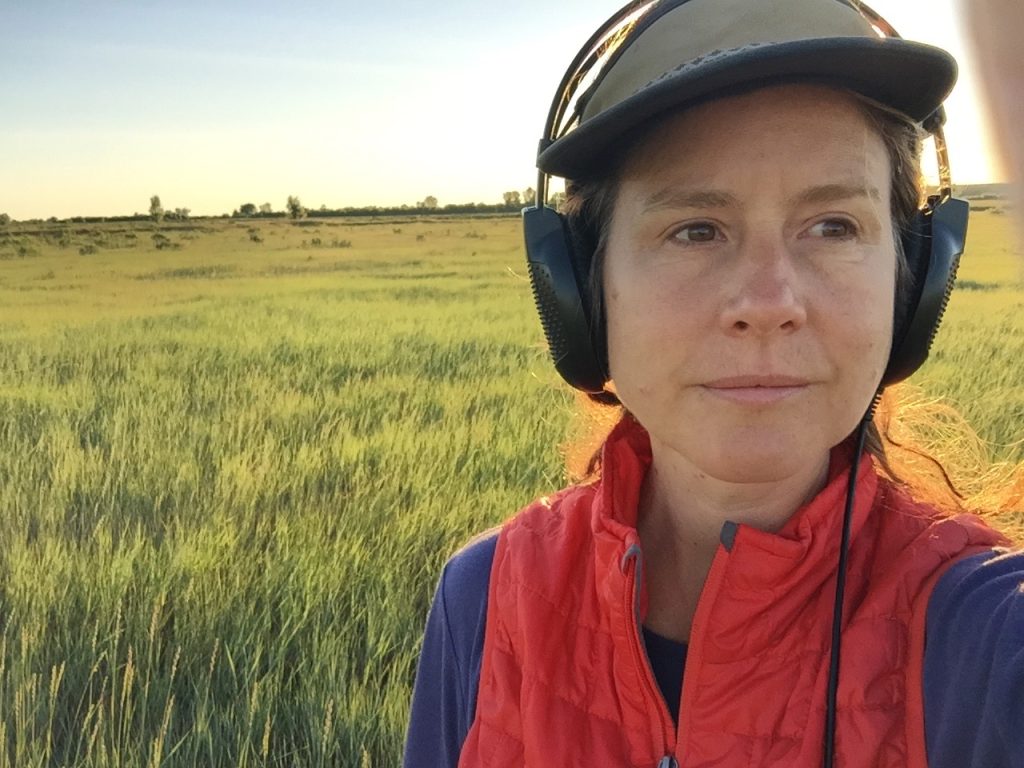
So much of Amy’s interest and work is rooted in a naturalist sensibility – what we observe, what questions we ask, how we feel or care about the world. Photo by Amy Martin.
Nowadays, her voice and stories are eagerly anticipated—and heard globally—via her Peabody Award-winning podcast brainchild Threshold. Her focus today is nothing less than the exploration of humanity’s complicated and inextricable relationships with the non-human world. Through interviews and explanation, observations and rich soundscapes, she illuminates the myriad threads of these relationships and leads us to consider why we should care.
“Music is where it all started,” she says. “Sound has always had a huge impact on me,” including the natural sounds that can be found outside in one’s own place. Through helping people make music she found she was particularly drawn to the affinity young people had for the natural world. “I wanted to help kids connect with their inherent love of being outside. I loved that work…. I started to think, Oh, you know what the world needs? The world needs a podcast that features kids’ voices [and focuses on] their connections with nature.”
Amy worked on that idea for a time, but eventually, she says, “I realized this wasn’t quite the show [I was thinking of], this was a season of a different show…a show that is really trying to think deeply about environmental issues.” So she set her recording with kids aside and turned her attention toward building this other show. “I remember thinking pretty quickly [that it] should be called ‘Threshold,’ because I loved the idea of both standing on the cusp of something…and the ambivalence and uncertainty of that, and the idea of hitting a threshold, like a climate threshold,” she says. “I just got really interested in making this other show and that’s what I’ve been doing ever since.”
Being a person of near-boundless curiosity, and living and spending lots of time on public lands around the state, she continues to increase her understanding and appreciation for Montana ecology and ecosystems, as well its human history and the impact settler expansion had and has on the Native people who lived and still live here. Interconnections between natural history, human history, science, politics, and culture, regardless of the specific topic, are threaded throughout every season and episode of Threshold.
Amy now splits her time pretty evenly between homes in Missoula and Umeå, Sweden, which she shares with her partner Ulf, who she met during a reporting trip several years ago. Though Sweden and the U.S. are quite different in some ways, Umea and Missoula are “amazingly similar.” They are both smallish cities located in rural areas, both are defined by rivers crossed by many bridges, and both are university towns. “I never intended to move to a different country, but I find I now have these deep connections in two different places, two different versions of the local-global.” The dual perspective helps her look at environmental issues from a broader context. “I’m constantly reminded that there is always more than one way to do things, to manage your forests, to get elected, to heat your home.”
A bison herd in the Fort Peck Indian Reservation. Photo by Amy Martin.
Now in its fifth season, Threshold podcast is the current flowering of Amy’s desire to write, create, and engage people with ideas and questions at all scales—from the hyper local to the global. Each season takes fully a year to 18 months to develop and involves much reading, thinking, writing, interviewing, more research, more interviewing, more writing, and recording. “Oh Give Me A Home,” the title of the first season, was entirely conceived, recorded, and produced in Montana, and explores the perennial debate about bison and whether they can ever be free-roaming again.
“I wanted to begin with something I was close to, and had been gaining understanding of,” she says. She brings listeners with her on a tension-filled bison hunt outside of Yellowstone National Park, to listen to pithy and poignant observations of a rancher in the Paradise Valley as she goes about her daily chores, to hear the anger and pride of Indigenous people whose connections to the buffalo are deepest. Through the personalities and voices of local people on the front lines she unveils beauty, tragedy, complexity, and hopefulness in the ongoing story of America’s national mammal.
Subsequent Threshold seasons have taken Amy much farther afield: to all eight countries that touch the Arctic Circle to talk about issues that affect the human and non-human inhabitants of those places; to the National Arctic Wildlife Refuge andspecific threats facing life there, for which she won a Peabody Award for Environmental Reporting; and to the topic of climate change directly, starting with an immersive visit to COPP 26 in Glasgow, Scotland, and continuing with explorations of the origins of the Industrial Revolution in England; the rise and fall of Gary, Indiana; making green steel in Sweden; the dual face of rising sea levels in Lagos, Nigeria, among many other stories. In every story, she’s careful to consider who are the people or beings that are not being asked questions or invited to the conversation. “It’s not just humans, what about the non-human elements? What is their part of the story?”
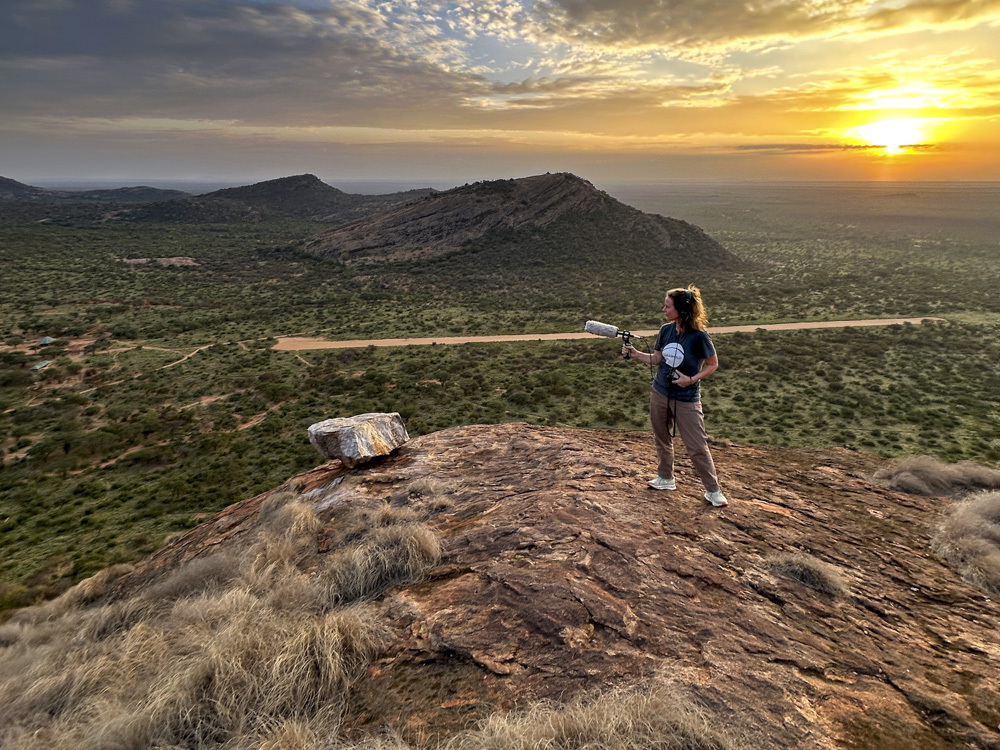
Amy records a soundscape during a reporting trip to Kenya for Season 5 of Threshold. Photo by Jed Allen.
In Season 5—“Hark —she takes a step back and considers a much more pervasive and fundamental phenomenon: that of listening and the evolutionary importance of sound. She doesn’t like to say too much about upcoming episodes or possible future seasons. But listeners can be assured that later “Hark” episodes will feature some more Montana voices and research.
There’s never any shortage of fodder for new seasons of Threshold, she says, “but something has to hook me at a deep enough level to spend up to a year and a half researching, reading, thinking, talking to people about it, looking for those big connections.
“I want to tell stories—not ones no one has ever told because those don’t exist—but ones that maybe reveal some deeper or new layers….[ones] that don’t fall easily into the evening news. I want to talk about things that play out on longer timescales.”
Ultimately, Amy says, Threshold always has to be moving in and out, back and forth in scale, from local to global. “I don’t want to only be thinking and working at the largest level, that’s too abstract. The challenge of telling stories and reporting from that connective tissue between what’s happening in our backyards and what’s happening elsewhere on the planet is just really interesting.”
“Hark,” Season 5, began airing last November. After a short hiatus, it begins again in March. You can listen to all seasons of Threshold and more on the website at thresholdpodcast.org, or find it wherever you stream podcasts. Through a long-standing partnership with Montana Public Radio, “Hark” also began airing there on January 26th—listen in on Sundays at 4:00 p.m.!
Caroline Kurtz proudly and happily serves on the boards of both Threshold and the Montana Natural History Center.
This article was originally published in the Spring/Summer 2025 issue of Montana Naturalist magazine, and may not be reproduced in part or in whole without the written consent of the Montana Natural History Center. ©2025 The Montana Natural History Center.
Click here to read more articles from Montana Naturalist magazine.
Want to learn more about our programs? Sign up for our e-newsletter! You can also become a member and get discounts on our programs as well as free reciprocal admission to 300+ science centers in North America!